Tuesday, March 10, 2009

When on Google Earth, No. 10


Q: What is When on Google Earth? A: It’s a game for archaeologists, or anybody else willing to have a go!

Q: How do you play it? A: Simple, you try to identify the site in the picture.

Q: Who wins? A: The first person to correctly identify the site, including its major period of occupation, wins the game.

Q: What does the winner get? A: The winner gets bragging rights and the chance to host the next When on Google Earth on his/her own blog!


ΠΟΤΕΝΓΟΥΓΕΛΟΓAΙΟΝΙΚΗΣ

#
Host:Victor:Site:Period:
1.Shawn GrahamChuck JonesTakht-i Jamshid / Persepolis terrace
Achaemenid period
2.Chuck JonesPDDChurch of Saint Simeon at Qalat Siman, Syria5th-6th c. AD
2.1.Chuck JonesPaul ZimmermanQal’at al-Bahrain
16th c. AD
3.Paul ZimmermanHeather BakerBaraqish (Yathill), YemenMinaean
4.Heather BakerJason UrMohenjo Daro
ca. 2600-1900 BC
5.Jason UrDan DiffendaleMonte Albán, Oaxaca, Mexico
1st-5th centuries CE
6.Dan DiffendaleClaire of Geevor MineSegontium, Caernarfon, Wales77ish to about 390 AD
7.Claire of Geevor MineIvan CangemiCarn Euny
ca. 500 BCE-100 CE
8.Ivan CangemiSouthie ShamMonks Mound (Cahokia), Illinois USA
fl. 1050-1200
9.Southie ShamDan DiffendaleGergovia
fl. 1st c. BCE
10.Dan Diffendale


Friday, March 06, 2009

When on Google Earth, no. 8


Q: What is When on Google Earth?
A: It’s a game for archaeologists, or anybody else willing to have a go!

Q: How do you play it?
A: Simple, you try to identify the site in the picture.

Q: Who wins?
A: The first person to correctly identify the site, including its major period of occupation, wins the game.

Q: What does the winner get?
A: The winner gets bragging rights and the chance to host the next When on Google Earth on his/her own blog!

Like so much in archaeology, this game comes to us from our methodological cousins in geology. Shawn Graham adopted their game, and modified it for our use at whenonge #1. Chuck Jones had the first correct answer, and then hosted whenonge #2. The mysterious and elusive PDD got #2 right but never claimed his prize, so Chuck struck back with whenonge #2.1. Paul Zimmerman got the correct answer to #2.1 and hosted whenonge # 3. Heather Baker got the correct answer to #3 and hosted whenonge # 4, and Jason Ur won and hosted whenonge # 5. Dan Diffendale won that, and hosted whenonge #6 . Claire at the Geevor Mine won #6 and hosted #7, which was won by Ivan Cangemi. Since Ivan is without a blog of his own, I offered to host it here at Tria Corda. Be the first to correctly identify the site above and its major period of occupation in the comments below and you can host your own!

Thursday, February 26, 2009

When on Google Earth, No. 6


Q: What is When on Google Earth?
A: It’s a game for archaeologists.

Q: How do you play it?
A: Simple, you try to identify the site in the picture.

Q: Who wins?
A: The first person to correctly identify the site, including its major period of occupation, wins the game.

Q: What does the winner get?
A: The winner gets bragging rights and the chance to host the next When on Google Earth on his/her own blog!

Like so much in archaeology, this game comes to us from our methodological cousins in geology. Shawn Graham adopted their game, and modified it for our use at whenonge #1. Chuck Jones had the first correct answer, and then hosted whenonge #2. The mysterious and elusive PDD got #2 right but dropped the ball and never claimed his prize, so Chuck struck back with whenonge #2.1. Paul Zimmerman got the correct answer to #2.1 and hosted whenonge # 3. Heather Baker got the correct answer to #3 and hosted whenonge # 4, and Jason Ur won that round. His challenge of whenonge # 5 was over at AWBG, and I won that, so here we are... be the first to correctly identify the site above and its major period of occupation in the comments below and you can host your own!

In bocca al lupo!

Sunday, January 18, 2009

From the Italian Press

A bunch of Italian news over the past few days; since we're still catching up, I'll just direct you to David Meadows' list at Rogue Classicism, "From the Italian Press."

Thursday, January 15, 2009

One Steak with Catchup

Finally made it home from that little AIA/APA shindig in Philadelphia... here's a wrap-up of what happened while we were conferring.


The Soprintendenza di Bari is digging at S. Severo near Foggia in the Apulian Tavoliere, in an area previously targeted by tombaroli. Among the finds was a 4th century BCE tomb containing a lower jawbone, a bit of an upper jawbone, and two bronze spearpoints -- the 'Daunian warrior' of the headlines. (ANSA, TeleRadioErre)


Three "Crime Beat" Stories thanks to SAFE:
  • The Palermo Carabinieri have arrested a man for attempting to sell on Ebay more than 500 artifacts looted from sites of numerous periods in Sicily. (Business Week)
  • The Italian crackdown on looting is having an effect: the value of stolen or looted objects recovered in 2008 was more than double the value of such objects recovered in 2007. But the number of illegal digs in Italy increased by 15 percent, to a total of 238. (ArtInfo) ...of course, it's hard to say whether in fact the actual number of clandestine excavations increased, or whether the Carabinieri are just getting better at finding them.
  • And, finally, the repatriations go both ways: Italy will return 3800 artifacts, mostly coins, stolen from Bulgaria and recovered in Verona (Sofia Echo). Nathan T. Elkins adds much more to the story at Numismatics and Archaeology...


I see that Past Horizons is now selling trowels from Battiferro, so you don't have to order direct from Italy anymore...


Finally, Jovanotti was King of Italy in 2008 -- at least as regards record sales. You know you love Jovanotti.

Wednesday, January 07, 2009

AJA 113.1

The latest issue of the American Journal of Archaeology (113.1, 2009) is out, and it's chock full of good stuff. Three articles pertain to Italian pottery of the 5th through 1st centuries BCE. First and foremost for the purview of Tria Corda is T.H. Carpenter's "Prolegomenon to the Study of Apulian Red-Figure Pottery" (39-56; Abstract), in my opinion a must-read.

Carpenter's analysis offers a fresh alternative to the (art historical) orthodoxy represented by the work of the late A.D. Trendall, and places the vases back into their "native" context—at least as far as possible for an object class that has suffered so much from looting: "To use the term 'Hellenized' for [the Italic] people, who had been trading with the Greeks for several hundred years, is meaningless unless the specific meaning is that they were Hellenized in the same sense that mainland Greeks were orientalized in the seventh century" (p.36). Recent scholarly activity has gone far in overturning colonial ideologies both ancient and modern, e.g. in the work of Edward Herring (for a good introduction to current trends, see his "Daunians, Peucetians and Messapians? Societies and Settlements in South-East Italy," in Bradley, Isayev & Riva, (eds.), Ancient Italy: Regions without Boundaries, Exeter 2007, 268-294); that such a well-known class of artifact had escaped such treatment up to now may be a function of the eminence of Trendall in the field. Carpenter also dissociates Taranto from its traditional role as producer of or major influence on Apulian vases, especially with regard to theatrical scenes, and refutes the notion that some scenes on Apulian vases represent images from "Orphic" religion.

Elsewhere, J. Theodore Peña and Myles McCallum discuss evidence for both the pre-Roman and Roman phases of the city in "The Production and Distribution of Pottery at Pompeii: A Review of the Evidence; Part 1, Production" (57-79; Abstract). Notable is the evidence for a Black Gloss Ware pottery production facility dating before the 2nd half of the 2nd century BCE, in the Vicolo Storto Nuovo.

Roman Roth—whose dissertation, published as Styling Romanisation: Pottery and Society in Central Italy (Cambridge 2007), treated Black Gloss Ware in Volterra and Capena—discusses the social implications of the replication of specific ceramic urn shapes in stone during the 2nd century BCE in "From Clay to Stone: Monumentality and Traditionalism in Volterran Urns" (39-56; Abstract).

H
élène Verreyke and Frank Vermeulen report on some results of the Potenza Valley Survey Project in "Tracing Late Roman Rural Occupation in Adriatic Central Italy" (103-120; Abstract), in a region (Picenum) better known for its Iron Age inhabitants.

Nothing explicitly to do with either pottery or Italy, but Stephen V. Tracy and Constantin Papaodysseus' note on "The Study of Hands on Greek Inscriptions: The Need for a Digital Approach" (99-102; Abstract) is very exciting--it means that we can soon replace epigraphists with computers... but seriously, this technique has a lot of potential. I wonder if it could be used to compare the work of known forgers with doubtful inscriptions?

Etruria in Philadelphia, Post AIA/APA

If you're still in town the day after the Annual Meeting wraps up, or if you're just lucky enough to live in Philadelphia, be sure to check out the following lectures on Monday the 12th of January:


Alba Frascarelli: Lost History Rediscovered? The Campo della Fiera Excavations and Livy's Fanum Voltumnae

The twelve peoples of ancient Etruria were said to meet at the shrine of their most important god, the Fanum Voltumnae outside the city of Volsinii, now recognized as modern Orvieto. Only recently have excavations by the University of Macerata begun to identify this all-important site of so much history. Dr. Frascarelli, one of the excavators, will present the latest findings.


Claudio Bizzarri: American Archaeological Projects in Etruria: The Excavations at Poggio Civitelle and Monterubiaglio.

The co-director of joint US-Italian excavations in Tuscany presents the results of this year's campaigns conducted by Florida State University, the University of Oklahoma and St. Anselm College.


Monday, January 12th

Classroom 2

University of Pennsylvania Museum

6pm

Tuesday, January 06, 2009

Museo Archeologico Nazionale di Canosa

Happy new year. Bidding has opened (and closed?—I don't pretend to know anything about how this works) for the construction of a new National Archaeological Museum (not to be confused with the existing Museo Civico) in Canosa di Puglia. The planned complex will incorporate the remains of the Baptistery of S. Giovanni with its attached basilicas of Sta. Maria and S. Salvatore (as seen in the plan). The entire project runs to the tune of 16 million euro.

[From CanosaWeb, and again]

Wednesday, December 31, 2008

Update on Daunian stele in Emilia-Romagna

Last year, it was reported that excavation for a shopping center on the outskirts of Cattolica in Emilia-Romagna had turned up a 6th century BCE Daunian stele [Soprintendenza BA dell'E-R, Archeoblog]. Lithographic and pollen analyses now prove its origin in the area of Manfredonia in the Tavoliere of Puglia, as expected for such monuments. The Soprintendenza reports that it was not found in situ, but is probably to be connected with illegal landfills in the area, dumped in the 1960s or 70s; the stone appears to bear the mark of an excavator arm [Manfredonia.net].

Monday, December 29, 2008

7th Century BCE Necropolis at Spoleto, Umbria


Rescue excavations in Spoleto (PG), Umbria, have turned up tombs dating from the 7th and early 6th centuries BCE. The ten inhumation pit graves were discovered in advance of the construction of 18 housing units in the Piazza d'Armi [Google Maps].

Wednesday, December 24, 2008

Some notes on the votive deposit at Campoverde

There seems to be some confusion. There's been a lot of coverage (Ministero per i Beni e le Attività Culturali, IGN/Adnkronos, GMA News/AP, Winston-Salem Journal/AP, Discovery Channel, etc.; blogs: ArchaeoBlog, ArchaeoBlog (again), Archaeology in Europe, Looting Matters, Rogue Classicism, Tria Corda, Tria Corda (again), etc.) of the votive deposit apparently dug up by a farmer in Campoverde near Aprilia in Lazio. The site, at a certain 'Laghetto del Monsignore', dates to the 7th-6th centuries BCE, and was unknown to the scientific world ("sconosciuto al mondo scientifico": thus MiBAC; some sources add a gratuitous "assolutamente"). And yet...

A votive deposit was discovered at the spring of Laghetto del Monsignore, on the Via Mediana in Campoverde, in 1968 (Fulminante 2003: 226, note 409, with references). And, in 1977-1978...
"...the Archaeological Soprintendenza per il Lazio rescued a fair quantity of miniature and normal sized ancient artefacts from a small lake with a spring at its heart, today called the 'Laghetto del Monsignore'. These artefacts, mostly ceramic vessels but also a few bronze sheet figurines, fibulae, glass and amber pearls, constitutes probably only a very small portion of a much larger quantity of ancient votive objects dedicated at the spring. The spring at Campoverde must be considered an open votive deposit, the gifts were directly thrown into the water and they remained there for a long time as can be concluded from the streaks of scale (limonite) on the little pots. The spring may be called a 'deposito volontari' or favissa. At the moment of the rescue-excavation the area already had been illegally plundered, but still a few hundred small votive vessels could be stored. Today, only the here published miniatures are available for further study because robbers struck again in the storerooms of the Soprintendenza per il Lazio at Tivoli." (Kleibrink 1997: 441)
This must be the same spring-fed lake with the same name and the same types and dates of finds -- and apparently the same problems with looting. None of the sources I've seen on the latest, 2008, operation mention the earlier discovery or its circumstances, at least directly. The Discovery article's lede hints at it
—"Italian police have found the long-sought 'treasure of Satricum' in a farmer's bookshelf"—but goes no further. I don't know what, if anything, came of the earlier robbery, or whether the objects retrieved in the farmer's cabinet are to be understood as the material robbed in 1978 and thus "long-sought".


References:

Crescenzi, L. 1978. "Campoverde." Archeologia Laziale 1:51-55 [non vidi]

Fulminante, F. 2003. Le sepolture principesche nel Latium Vetus.

Guidi, A., 1980 "Luoghi di Culto dell'Et
à del Bronzo Finale e della Prima Età del Ferro nel Lazio Meridionale." Archeologia Laziale 3:148-155. [non vidi]

Kleibrink, M. 1997. "
The miniature votive pottery dedicated at the 'Laghetto del Monsignore', Campoverde." Palaeohistoria 1997-1998, vol. 39-40, pp. 441-512 (abstract).

Friday, December 19, 2008

Italian Updates, December 19, 2008

From MiBAC, more on the illegal excavations in the sanctuary at Campoverde near Aprilia in Lazio, with photos and a video slide-show (~2 min., no sound) of the looted landscape, plus a video segment from a local news station. At the same press conference, the Carabinieri displayed the recovered marble heads that had been stolen from an apartment in Rome while its residents were drugged, as well as a mosaic from the catacombs of St. Domitilla that somebody had tried to sell on an online auction site. Of note: between January 1 and September 30, there were 53 illegal excavations discovered in Italy, or almost six a month -- and that's not counting the ones that haven't yet been, or won't be, discovered.

At Cattolica in Emilia-Romagna, there's an exhibit of artifacts (right) from a 3rd century BCE deposit discovered in 2004 at the mouth of the Tavollo during the construction of a new dock. The exhibit, "VETUS LITUS. Archeologia della foce. Una discarica di materiali ceramici del III secolo a.C. alla darsena di Cattolica lungo il Tavollo," will run from 19 December 2008 to 3 May 2009 at three locations in Cattolica: the Museo della Regina, the Galleria Comunale S. Croce, and the Sala Lavatoio.

John Muccigrosso blogs a newly cleaned and identified silver quinarius of Marc Antony from the Drew excavations in Umbria this past summer.

In Ruvo di Puglia yesterday, there was a conference on the topic of the famous Tomb of the Dancers discovered in that city in 1833 (and accordingly now to be found in the National Museum in Naples), with a presentation by Dr. Giuseppina Gadaleta, who wrote a book on the subject in 2002.

Finally, it seems there's some connection between live presepi (Nativity scenes) and ancient tombs this year. In Canosa, the D'Ambra Hypogeum will be open to the public during the presepe vivente; in Sutri, the actors will actually be inside the Etruscan tombs (seen below) near the amphitheater...

CC: Originally uploaded to flickr
by sunshinecity


Thursday, December 18, 2008

Italian Updates

Some 4th century BCE coins from Hyria and Nola have found a home in the Nola Museum, seven years after being donated by an American. Among the 15 silver coins are five didrachms, two each from Hyria and Nola, and one from Neapolis.
[from IlNolano.it]


(More of) a Late Antique mosaic has been discovered in the crypt of the cathedral of Reggio Emilia. The polychrome mosaic extends over 13 square meter and dates between the 4th and 5th centuries CE.
[from Archaeogate]


A farmer in Lazio has been arrested for trying to sell off antiquities [see photo above] he dug up from a 7th-6th century BCE sanctuary near Aprilia, south of Rome.

[JournalNow, AdnKronos]


The discovery of the Greek necropolis at Himera has hit the Anglophone news.
[National Geographic]

Wednesday, December 17, 2008

Italian Antiquities Bust in Geneva

The Cultural Heritage Protection unit of the Carabinieri has confiscated 974 objects in two warehouses in Geneva. The pieces date between the 7th century BCE and the 4th century CE and come from Apulia, Lazio, Sardinia, and Magna Graecia. They include five loutrophoroi, a squatting Venus in Parian marble, 30 volute kraters and two bronze hydriae. The total value of the objects was estimated at € 25 million. The smuggling ring, based in Liechtenstein, had been operating since the mid 1990s, and was managed by a Swiss citizen and a Japanese national resident in England, both of whom have been arrested for receiving and exporting antiquities.

[From MelitoOnLine.it]

Friday, December 12, 2008

Apulia-Spain Antiquities Smuggling Route Exposed

The Cultural Heritage Protection branch of the Carabinieri, in conjunction with its Spanish counterpart, has exposed an antiquities trafficking route leading from clandestine excavations in Puglia, in the provinces of Bari and Foggia, via Valencia, Spain, to enter the market in a collaborating gallery in Barcelona.

Among the pieces seized in Barcelona and Valencia are a 1.00 m high marble torso and 131 ceramics, including red-figure bell kraters, hydriae, lekythoi, volute kraters, askoi, skyphoi, kylikes, and terracotta statuettes, the lot valued at €1,000,000. (The list also includes something called an 'asphageon,' which neither I nor anyone else currently in the vicinity can make sense of -- ideas?)

[Info and image from MIBAC]

Thursday, December 04, 2008

Another Etruscan DNA Study...

David Meadows at rogueclassicism points us to yet another article studying the DNA of those ever-enigmatic (sigh) "Etruscans" and attempting to show links to Anatolia:

F. Brisighelli et al., The Etruscan timeline: a recent Anatolian connection
European Journal of Human Genetics advance online publication 3 December 2008; doi: 10.1038/ejhg.2008.224

I will make just a couple of comments on the short report. They sampled the mitochondrial DNA of 258 modern Tuscans (from Arezzo, Chiusi, Collevecchio, Elba, Magliano Sabina, Monte Fiascone, Pitigliano, Tarquinia, Tuscania, and Vulci), of which 63 were "compatible with typical Near Eastern haplogroups," "show[ed] ambiguous haplogroup affiliation," or could provide "some phylogeographic information at the control region level." Only in the title and the historical introduction, referencing Herodotus, do the authors draw any specifically Anatolian connection; the science simply indicates the presence of haplogroups with generally Near Eastern counterparts. I guess Anatolia is an inference from the Father of Lies?

Brisighelli et al. point out a relatively high frequency of "the typical Near Eastern U7 haplogroup" in the samples from Elba. Within these samples they identify a new sub-branch of the U7a2 haplogroup, which haplogroup is known from only two other individuals, a Pakistani and an Andalusian. The amount of variation in this new sub-branch, U7a2a, is then used to calculate the arrival of a single founder on the island in the range 1.1plusminus0.1 to 2.3plusminus0.4 kya B.P., that is, 450 BCE plusminus400 years to 850 CE plusminus 100 years. This elicited David's comment, "... not sure about the dating there; even on the 'outside' end, it seems a bit short, no?" The authors suggest that this is "compatible with the Etrurian culture (9th-1st century BC)." Intensive working of the Elban mines began in the 6th century BCE; I don't know much about the earlier history of the island. But with a time span as wide as that, it seems just as probable that the haplogroup founder on Elba was a Byzantine or a Saracen... and that's all I'm going to say about that.

The Italic APA, 2009

The 2009 Philadelphia APA Program (pdf) is now available. As expected, it looks like slim pickins for the Italicist...

Friday

11:15 A.M. – 1:15 P.M. SECTION 10 Grand Ballroom K
Greek Religion
Rick Hamilton, Presider

3. Mary R. Bachvarova, Willamette University
The Transmission of Liver Divination from the Near East to Greece and Italy (15 mins.)


Saturday

11:15 A.M. – 1:15 P.M. SECTION 14 Independence II
Greek and Latin Linguistics
Sponsored by the Society for the Study of Greek and Latin Languages
Jeremy Rau and Benjamin Fortson IV, Organizers
1. Rebecca Sears, University of Michigan
Old Latin Stress in the Scipio Epitaphs: An Alternate Accentual Scansion (30 mins.)


1:30 P.M. – 4:00 P.M. SECTION 38 Independence I
The Etruscan Objects Speak: New Linguistic and Socio-Historical Approaches to
Etruscan Epigraphy
Joint APA/AIA Session
Hilary Becker and Rex Wallace, Organizers

1. Rex Wallace, University of Massachusetts Amherst
Alphabet, Orthography, and Paleography at Poggio Civitate (Murlo) (15 mins.)
2. Enrico Benelli, Consiglio Nazionale delle Ricerche
Inscriptions on Tiles from Chiusi: Archaeological and Epigraphical Notes (15 mins.)
3. Margaret Watmough & Judith Swaddling, The British Museum
Surveying the Etruscan Inscriptions on Objects in the British Museum’s Collections (15 mins.)
4. Hilary Becker, The College of William and Mary
Public, Private, and Clan Property in Etruria (15 mins.)
5. Gary Farney, Rutgers, the State University of New Jersey
Lucumo to Lucius: Etruscans with Both Etruscan and Latin Names on Bilingual Inscriptions from
Etruria (15 mins.)
Larissa Bonfante, New York University
Respondent


7:00 P.M. – 9:00 P.M. Reception Sponsored by the Etruscan Foundation


Sunday

1:45 P.M. – 4:15 P.M. SECTION 59 Independence II
Coins and Identity
Sponsored by the Friends of Numismatics
Jane DeRose Evans, Organizer

1. Rabun Taylor, The University of Texas at Austin
Their Neighbor’s Keeper: A Neapolitan Coin for Capua (15 mins.)

Sunday, November 30, 2008

Venetic, Roman and Medieval Finds in Vicenza

Restoration work in the Corte dei Bissari by the Basilica Palladiana in Vicenza (Roman Vicentia) has led to the discovery of two Roman structures and a section of road, belonging to a previously unknown cardo. The Roman remains were found beneath "some residual Medieval layers" -- about which, unfortunately, no more is written.

The interior wall of a 3rd-4th century CE Roman house, preserved for a length of 9.70 m, divides two rooms, one paved in cocciopesto, the other originally mosaicked, of which only a few tesserae remain. To the south of this building is a second, whose details remain sketchy. Both buildings front a section of a north-south road (cardo), of which are preserved three curb blocks for a sidewalk ca. 1.00 m wide.

In addition to the remains of the Roman city, archaeologists found beaten clay floors belonging to the pre-Roman Venetic settlement.

[La Repubblica, Comune di Vicenza, Storia Romana]

Saturday, November 29, 2008

Discoveries at Modena both Licit and Il-

Excavations at Modena in Emilia-Romagna have brought to light a Roman ceramic kiln area and waster heaps dating to the first centuries CE. The discovery occurred in the course of construction of a basement for a new building on the Viale Reiter (see on Google Maps), outside the ancient city walls.

A Roman level was found at a depth of 5.50 m below a thick alluvial deposit. Large pits were found filled with kiln wasters, tile kiln elements, and general Roman trash including marble, plaster, stucco, mosaic tesserae, ceramics, coins and metal objects. A large pit, probably a clay quarry, produced misfired cooking ware, bricks, and amphorae, as well as kiln spacers and architectural elements. The pit containted ceramics of different productions, including Dressel type 2-4 amphorae, floor tiles, varnished jugs and bottles, thin-walled ware, North Italian terra sigillata cups, as well as over 100 Firmalampen (Factory Lamps) with the producers' stamps Fortis, Stabili, Communis, Phoetaspi, and Eucarpi.

Also found were a terracotta statuette of Hercules and the Erymanthian Boar, and 14 lead sling bullets, attributable to the Bellum Mutinensis of 43 BCE (I can't make out any inscriptions from the photograph).

[Soprintendenza per i Beni Archeologici dell'Emilia-Romagna, with many good photos; ItalyMag]


On the other side of the law, two collectors from Castelfranco Emilia (Modena) have been arrested and accused of illegal possession of antiquities, including a very fine javelin point and spear head, a 6th century BCE votive terracotta from Magna Graecia, Gothic and Lombard buckles, and Republican Roman coins.

[Il Nuovo Giornale di Modena, via David Gill at Looting Matters]

Thursday, November 20, 2008

7th century Etruscan village discovered near Parma

An Etruscan settlement dating to the 7th century BCE has been discovered near an industrial park on the outskirts of Parma. The finds include houses built on a network of channels for collecting rainwater, a kiln for bucchero production, and numerous home furnishings. Among the most recent finds is a fine red-varnished jug dating to the 5th century BCE. The settlement was inhabited for 150 years before the Etruscan foundation of Parma. The settlers came from Chiusi or Perugia, according to the archaeologists in charge.

(You can see the area, between Via Forlanini and Strada Uguzzolo, on Google Maps. I'm not sure if those are bulldozer marks, cropmarks, or what...)

[From Parmaok.it]

Wednesday, November 12, 2008

18 Byzantine Tombs near Campomarino, Molise

Excavations by the Archaeological Soprintendenza for Molise and the Università degli Studi del Molise have brought to light 18 Byzantine tombs in the neighborhood of Marinelle Vecchie, just outside Campomarino on the coast of Molise. Such a discovery is so far unique in the area. Lombard presence is known in the region, but there is little other evidence for Byzantine activity in the 6th century.

Among the finds were amphorae and marbles with connections to Palestine, North Africa, Egypt and the opposite shore of the Adriatic, along with a Christian inscription dated to the 6th century CE. It is only the third such inscription known from Molise, according to Gianfranco De Benedittis of the Università degli Studi del Molise in Campobasso. The two previous date to the 4th and 5th centuries.

Work will continue with the hopes of locating a settlement connected with the necropolis. The excavation began a year ago, after a six-year study of the area with ground-penetrating radar, and was sponsored by the Regional Assessor for Culture Sandro Arco and the town of Campomarino.

(Via Il Tempo, Primapaginamolise.it, Termoli Online, Yahoo! News and Il Sannio Quotidiano)

Monday, November 10, 2008

Gabii Project pages

The much-anticipated Gabii Project has had a blog since July, Lapis Gabinus, which I think I've so far failed to mention. The project webpage was announced in October. They're looking for staff for the field season June 15 through July 31, 2009.

The Annotated Italic AIA, no. 2

(Part 2 of 2)

Saturday, January 10 at the 2009 AIA Annual Meeting presents a quandary of unfortunate cross-schedulings, viz. 4A: Current work in Pre-Roman and Roman Italy and 4D: Roman Cult and Ritual (with at least two Italicky papers), both from 8:30 to 11 AM, and 6A: The Ideology and Innovation of Monumental Architecture in Etruria and Early Rome, 6C: The Etruscan Objects Speak: New Linguistic and Socio-Historical Approaches to Etruscan Epigraphy, and 6G: Ancient Volsinii (Orvieto): Discoveries and Rediscoveries (workshop), all three from 1:30 to 4:30 PM. Architecture or epigraphy or Vieto? It seems one must choose.


Session: 4A: Current work in Pre-Roman and Roman Italy
Saturday, January 10, 8:30 AM - 11:00 AM

1. The Settlement of Ripacandida (Potenza, Italy) between Early Iron Age and Seventh Century B.C.
Gianfranco Carollo, Università degli Studi della Basilicata
2. A New Plan of an Ancient Italian City: Gabii Revealed
Jeffrey A. Becker, Boston University, Marcello Mogetta, The University of Michigan, and Nicola Terrenato, The University of Michigan
3. Excavations at Castel Viscardo, Italy: Field Reports 2006-2008
Silvia Simonetti (Field Director), Claudio Bizzarri (co-Director), David B. George (co-Director, Saint Anselm College)
4. Recent Excavations at Poggio Civitate (Murlo) – 2004-2008
Jason Bauer, Poggio Civitate Archaeological Project and Anthony Tuck, The University of Massachusetts at Amherst
5. First Season of Excavation at the Vicus ad Martis Tudertium
John Muccigrosso, Drew University
6. Decor, Destruction, and Renewal at Ostia in the Third–Fourth Centuries C.E.: Excavation of the Palazzo Imperiale, 2008
Joanne Spurza, Hunter College of The City University of New York
7. The Evidence for Linen as an Important Samnite Craft and Trade Good
China P. Shelton, Boston University


Session: 4D: Roman Cult and Ritual
Saturday, January 10, 8:30 AM - 11:00 AM

1. Italo-Hellenistic Sanctuaries of Pentrian Samnium: Questions of Accessibility
Rachel E. Van Dusen, University at Buffalo
...
3. (De-)Constructing Etruscan Cult Practice: New Perspectives on Etruscan Sacrificial Representations
Mareile Haase, University of Toronto


Session: 6A: The Ideology and Innovation of Monumental Architecture in Etruria and Early Rome
Saturday, January 10, 1:30 PM - 4:30 PM
Organizer: Dr. Michael L. Thomas, The University of Texas at Austin

1. Defining Monumentality in Archaic Etruria: The Case of the Etruscan palazzi
Gretchen E. Meyers, Franklin and Marshall College
2. Straw to Stone, Huts to Houses: Transitions in Building Practices and Society in Protohistoric Latium
Elizabeth Colantoni, University of Rochester
3. The Performance of Death: Rituals of Display and the Emergence of Community Identity in Early Etruria
Anthony Tuck, University of Massachusetts Amherst
4. Monumentalization of the Etruscan Round Moulding
Nancy A. Winter, Wolfson College, Oxford (UK)
5. The Colossal Temple of Jupiter Optimus Maximus and Roman Architectural History
John N. N. Hopkins, The University of Texas at Austin / American Academy in Rome
6. On the Introduction of Stone Entablatures in Republican Temples in Rome
Penelope J. E. Davies, The University of Texas at Austin


Session: 6C: The Etruscan Objects Speak: New Linguistic and Socio-Historical Approaches to Etruscan Epigraphy (Joint AIA/APA Colloquium)
Saturday, January 10, 1:30 PM - 4:30 PM

Organizer: Dr. Hilary Becker, The College of William & Mary

1. Lucumo to Lucius: Etruscans with Both Etruscan and Latin Names on Bilingual Inscriptions from Etruria
Gary Farney, Rutgers University
2. Surveying the Etruscan Inscriptions on Objects in the British Museum’s Collections
Margaret Watmough and Judith Swaddling, British Museum
3. Alphabet, Orthography, and Paleography at Poggio Civitate (Murlo)
Rex Wallace, University of Massachusetts Amherst
4. Public, Private, and Clan Property in Etruria
Hilary Becker, The College of William & Mary
5. Inscriptions on Tiles from Chiusi: Archaeological and Epigraphical Notes
Enrico Benelli, Consiglio Nazionale delle Ricerche


Session: 6G: Ancient Volsinii (Orvieto): Discoveries and Rediscoveries (workshop)
Saturday, January 10, 1:30 PM - 4:30 PM
Organizer: Prof. Ann Blair Brownlee, University of Pennsylvania Museum

The Annotated Italic AIA, no. 1

The preliminary schedule of the AIA 2009 Annual Meeting in Philadelphia has been posted. There's a heap of interesting titles on Italy roughly B.C.E., many of which I've picked out here for convenience. This is part 1 of 2.

Session 1D: South Italy and Sicily
Friday, January 9, 8:30 AM - 11:00 AM

1. The Marsala Hinterland Survey: Results of the 2008 Season
Emma Blake, Tufts University and Robert Schon, University of Arizona
2. Athenian Pottery, Metal Vessels, and Local Taste at Morgantina
Justin St. P. Walsh, Louisiana State University and Carla Antonaccio, Duke University
3. Harbor Facility Submerged Off Ancient Locri-Epizefiri, Southern Italy, Discovered by Geophysical Survey
Jean-Daniel Stanley, Smithsonian Institution, Jenny M. Tennent, University of Saskatchewan, Patrick E. Hart, US Geological Survey, and Maria Pia Bernasconi, Universitá della Calabria
4. Agency and the Articulation of Cult Activity in the Early Greek Colonization of Sicily and Southern Italy
Jennifer L. Boger, Tufts University
5. Stelae from the Sanctuary of Demeter Malophoros in Selinus
Allaire B. Stallsmith, Towson University
6. Navigating Multi-cultural Relationships in Western Sicily during the Greek Archaic Period
Jeanette Cooper, Independent Scholar
7. Votive Offerings from Lucanian Sanctuaries between the Fourth Century B.C. and the Age of Romanization: Changes and Continuity
Ilaria Battiloro, University of Alberta


Session: 2C: Prehistoric Stone Tools
Friday, January 9, 11:15 AM - 1:15 PM

...
3.
Bronze Age Obsidian Trade in Sardinia (Italy): The Use of Monte Arci Subsources at Duos Nuraghes and Other Sites
Robert Tykot, University of South Florida


Session: 2I: Poster Session
Friday, January 9, 11:15 AM - 3:00 PM

8. Light Frame Architecture at Poggio Civitate: A Comparison of Elite and Non-Elite Domiciles
Andrea Rodriguez, University of Florida, Andrew Carroll, University of Massachusetts, Amherst, and Anthony Tuck, University of Massachusetts, Amherst
12. Synchopation and Synaesthic Response to the Temple of Apollo at Syracuse
Brian E. McConnell, Florida Atlantic University
14. An Early Roman Kiln Site in the Metapontine Chora: The New Excavations at Pizzica Pantanello
Adam Hyatt and Keith Swift, Institute of Classical Archaeology, University of Texas at Austin
23. Italian Prehistory and the Emergence of the Civic Museum
Elisabetta Cova, University of Wisconsin-Milwaukee
26. First Season of Excavation at the Vicus ad Martis Tudertium
John Muccigrosso, Drew University


Session: 3B: In the Shadow of Vesuvius
Friday, January 9, 1:30 PM - 4:30 PM


Session: 3H: Gold Medal Symposium: Archaeological Approaches to the Study of Early States
Friday, January 9, 1:30 PM - 4:30 PM
1. Weak States and Weakening Paradigms. Against Teleology in Roman State and Empire Formation
Nicola Terrenato, University of Michigan

Sunday, November 09, 2008

Of Plastics and Potsherds

I note a recent article in Science, "Bioactive Contaminants Leach from Disposable Laboratory Plasticware" (discussion at Wired). I wonder, not being so chemically attuned, whether this is so different from the fact that ceramics shouldn't be kept in plastic bags if they're to be submitted to organic residue analysis.

For discussion, see two pages every practicing field archaeologist should read, "Protocols: Ceramic Artefacts and Skeletal Material," in Archaeology Meets Science: Biomolecular Investigations in Bronze Age Greece, eds. Y. Tzedakis, H. Martlew, M.K. Jones, Oxbow 2008 [ISBN
1-84217-238-7, WorldCat] 236-7, the upshot of which is: when handling ceramics, don't use plastic bags, don't use plastic gloves (if gloveless, use "hands that are free of potions and lotions"), and don't wash with acid.

"Archaeologists can render science useless unless as excavators, they handle their material in the right way...
No one, not any archaeologist or excavator, can be criticised for the way ceramic or skeletal material was excavated, cleaned, or stored, until contaminants started appearing in the organic residue results and were traced back to their sources. Excavators did what they thought was the best thing, and it was, until science came along and changed the rules.
From now on, however, there is no way an archaeologist can escape condemnation if he/she wilfully allows information that has been stored inside a pot or a bone, to be destroyed.
It is now an absolute obligation for excavators to think about the future application of science to archaeological subjects, and to prepare and archive artifacts accordingly, i.e. in such a way that the chemical signals that have survived hundreds or thousands of years, are not contaminated or destroyed through thoughtless handling and storage."

(And to make this post strictly relevant to the blog as a whole... pages 273-280 of the above-quoted book describe organic residue analyses of a Canaanite jar; a Myceneaean Vapheio cup, crocus-painted askos, and pithos; and local carinated cup and barbotine jug from the settlement of Punta d'Alaca on the island of Vivara near the Bay of Naples. Among the residues identified were vegetable oil flavored with a woody herb/bark, herb-flavored unresinated wine, olive oil flavored with an herbal extract, and an herbal mixture possibly flavoring milk or cream.)

Thursday, October 23, 2008

Italic Webcast!

This isn't a proper summer wrap-up post (since, among other things, it's no longer summer), but I wanted to draw your immediate attention to:


Communicating Identity in Italic Iron Age Communities
International Symposium

23-24 October 2008
Copenhagen

which will be (and I suppose already half has been) webcast with a live feed, and is supposed to be available as a podcast after the fact.

For more info
Abstracts

For the live feed (QuickTime required)

Monday, June 23, 2008

Summer diggings

The summer fieldwork season at Mt. Lykaion begins tomorrow, so that's where I'll be for the next six weeks. I'll be the (pre-)Romanist sub rosa.

The official project website:
http://lykaionexcavation.org/

The official project blog, which will be updated more regularly, by yours truly among others:
http://mountlykaion.wordpress.com/

Saturday, June 07, 2008

Italian Round-up

Some gobbets for the skewer:

Italian police recover 3500 artifacts looted from "an Etruscan site near Rome." (IHT)


The 8th Roman Archaeology Conference, 3-5 April 2009 at the University of Michigan, will include several sessions of immediate interest to the discerning Italicist:
-The Late Republican period in "native" Southern Italy
Organizer: Fabio Colivicchi (Queen's University)
-Kings, Clans and Conflict: Italic Warfare in the first millennium BC
Organizers: Hilary Becker (Washington & Lee University) and Jeremy Armstrong (University of Auckland)
-Current Approaches to the Archaeology of first millennium BC Italian Urbanism
Organizers: Jeffrey Becker (Boston University) and Elizabeth Robinson (University of North Carolina)
-Comparative issues in the archaeology of the Roman rural landscape, site classification between survey, excavation and historical categories
Organizers: Peter A.J. Attema (University of Groningen) and Günther Schoerner (Friedrich-Schiller Universität, Jena)

(Session abstracts available here)


There's some novita' at the Center for Etruscan Studies' website. They're beginning to post back-issues of the journal Etruscan Studies, starting with Volume 8, 2001 (confusingly labeled 2008). Some of the links are misdirected at the moment, to the host bepress.com rather than http://scholarworks.umass.edu...


Excavations on the site of a Late Antique villa in Spello, Umbria have uncovered a mosaic (Soprintendenza per i Beni Archeologici dell'Umbria, with photo)


Michele Stefanile reports at Archeologia Subacquea on the supposed discovery of Roman Misenum in a Google Earth satellite image, but remains skeptical. You can see the area in question also via Google Maps here. Stefanile's skepticism is well-founded; compare the rectilinear features that appear in the satellite image further east in the Bay of Naples. I bet you could find a similar pattern many other places around the world due to imaging artifacts. I suppose it's a bit like seeing Jesus in your toast.


There are some nice photos of the Terme Ruler at EternallyCool.net.

Friday, May 23, 2008

Isernia's Fontana Fraterna


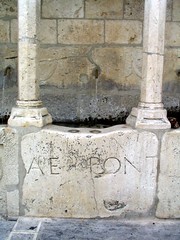
The Poste Italiane have issued a new stamp to represent Molise, to accompany Valle d'Aosta, Veneto, and Sicilia in their "Regioni d'Italia" series. Its design features the so-called "Fontana Fraterna," a well-known monument in the city of Isernia with an interesting history. It was supposedly built in the 14th century by the Rampiniani family in honor of Pope Celestine V, a native of Isernia, incorporating Roman stonework from the family tomb of the Pontii family (of Judean procuratorship fame). Of these suppositions, only the fact that it incorporates Roman spolia can be verified.

The idea that the fragmentary inscription ---]AE PONT[--- could be read famili]ae Pont[iae was disposed of by Mommsen, who read it Nerv]ae pont[ifici (CIL IX, 2636). M. Buonocore suggests that it need not pertain to Nerva, but could refer to a prominent local family.

Franco Valente, in his intriguing article "La Fraterna di Isernia, la fontana dei misteri," traces the long and winding history of the fountain. The most certain fact is that current fountain was rebuilt "exactly," albeit in a new location, after its destruction during the Second World War.

Earlier than that, the going gets dicey. The fountain, or a fountain, has been destroyed by earthquakes, rebuilt, moved, expanded, incorporated bits from other fountains, moved again -- maybe. It bears a curious Latin inscription on one end, which Valente dates to the 13th century and reads:
fons iste / cuius posit(ores) / Rampiniani / me parabis

I'm not convinced that the inscription must have originally referred to this particular fountain. Given the circumstances, I'm not sure where I would draw the line between this fountain and a different fountain. Is it really one fountain suffering numerous vicissitudes, undergoing numerous reconstructions, or a family of fountains, genetically linked as it were by incorporating material from predecessors?

(Stamp news source: primapaginamolise.it; Fountain history, F. Valente, 'La Fraterna di Isernia, la fontana dei misteri'; Fountain photos: my Flickr photos)

Tuesday, May 20, 2008

A new gate at Amelia, Umbria

According to the Soprintendenza per i Beni Archeologici dell'Umbria, a new gate has been discovered in the ancient city walls at Amelia, the ancient Ameria. The arch-topped gate was discovered during the dismantling of a modern embankment, and is now exposed to a height of 4.5 m. The wall circuit is built in polygonal masonry and dates generally to the 4th-3rd centuries BCE.

For more general information, see Bill Thayer's page on Amelia, and that of the Soprintendenza.

(Thanks to Dave Morris for the use of his photo of a (different) section of the walls)

More bits

The Römisch-Germanisches Zentralmuseum in Mainz hosts a database called TOMBA, which is "a multilingual internet image database for the tombs of the élites in Bronze and Early Iron Age Europe (2400/2300 - 480/450 BC). The database is localized into Danish, English, French, German, Greek, and Italian."
This is a fantastic resource, if you can get past the frames and javascript design.

Elizabeth Colantoni reviews Roman Roth, Styling Romanisation. Pottery and Society in Central Italy (2007), at BMCR.

The town of Frosolone in Molise is throwing a Transhumance Festival this coming weekend to celebrate the annual return of the Colantuono family and their 300 cows from Puglia. According to the article, the Colantuono are the only family still practicing long distance transhumance between Molise and Puglia (as opposed to the more common short-distance traffic between lowlands and uplands). I notice too that the Wikipedia article 'Transhumance' makes no mention of the Italian variety (somewhat remedied by the discussion in the Italian version, 'Transumanza'.


Research is to resume
at the important Nuragic site of Sant'Imbenia, Sardinia. Sant'Imbenia shows evidence of contact with Pithekoussai by the mid 8th century BCE. The new work aims at continuing excavation, setting the site within its broader landscape context, developing it as a didactic tool, and safeguarding it for future generations (no surprises there). If you need to brush up on your Sardinian archaeology, you can check out the recent monograph by Stephen Dyson and Robert Rowland, Jr., Archaeology and History in Sardinia from the Stone Age to the Middle Ages: Shepherds, Sailors, and Conquerors (2007).

Saturday, May 17, 2008

Miscellanea Italica

Three things to report today. To get to the hearts of the matter:

The (always momentous) news from Molise brought to my attention a band calling themselves "Tabula Osca," hailing from Agnone, the findspot of the famous Tavola di Agnone (seen here on the left is the copy held in the town hall at Agnone; the original is in the British Museum). The band's website is http://www.tabulaosca.it/. I haven't yet been able to give it a listen, but it's bound to be easier on the ears than "Sakahiter," self-proclaimed purveyors of "SAMNITE BLACK METAL," whose first album Lex Sacrata features an image of the Roman army passing under the Samnite yoke after the Battle of the Caudine Forks:


A new note by William Gilstrap, "Chronology and Variability of Etruscan Architectural Terracotta," is available over at Rasenna (Journal of the Center for Etruscan Studies). It seems to be a poster (with Carl Lipo and Hector Neff, all of California State University Long Beach) from the poster session at the SAA (Society for American Archaeology)'s 2008 Annual Meeting in Vancouver.


Epigraphers take note: the early third century CE statue of Neptune that came out of the Rhone along with the bust of the Elderly Republican Gentleman carries a Latin inscription on its base:

I haven't been able to rustle up a better photo yet, and I can't make a dang thing out from this one.

Wednesday, May 07, 2008

27 New Tombs at Tarquinia

Twenty seven Etruscan tombs were discovered on April 3 in Tarquinia at a construction site in loc. Madonna del Pianto. Of the 27, only one appears to have been violated, probably about 50 years ago, according to Maria Tecla Castanaldi, Soprintendente for Southern Etruria and director of the Museo Nazionale Etrusco in Tarquinia, who visited the open tomb yesterday morning. The new tombs are located about 500m from the painted tombs on Monterozzi hill, near the Scataglini necropolis.

(Via Eternally Cool, Tuscia Web, il Giornale)

Tuesday, May 06, 2008

Prohibited items

The United States Postal Service lists the following items as being prohibited from sending to Italy:

Albums of any kind (of photographs, postcards, postage stamps, etc.).
Arms and weapons.
Articles of platinum or gold; jewelry; and other valuable articles unless sent as insured Priority Mail International parcels.
Artificial flowers and fruits and accessories for them.
Bells and other musical instruments and parts thereof.
Cartridge caps; cartridges.
Clocks and supplies for clocks.
Compound medicaments and medicines.
Coral mounted in any way.
Ether and chloroform.
Exposed photographic and cinematographic films.
Footwear of any kind.
Haberdashery and sewn articles of any kind, including trimmings and lace; handkerchiefs; scarves; shawls, needlework including stockings and gloves; bonnets, caps, and hats of any kind.
Hair and articles made of hair.
Human remains.
Leather goods.
Lighters and their parts, including lighter flints.
Live bees, leeches, and silkworms.
Live plants and animals.
Nutmeg, vanilla; sea salt, rock salt; saffron.
Parasites and predators of harmful insects.
Perfumery goods of all kinds (except soap).
Playing cards of any kind.
Postage stamps in sealed or unsealed First-Class Mail International shipments.
Radioactive materials.
Ribbons for typewriters.
Roasted or ground coffee and its substitutes; roasted chicory.
Saccharine and all products containing saccharine.
Salted, smoked or otherwise prepared meats; fats; and lard.
Tobacco.
Toys not made wholly of wood.
Treated skins and furs.
Weapons of any kind and spare parts for them.


At first glance, it's an odd and amusing list (and has been seen as such already). It certainly wasn't composed all at one time; note the separately listed, redundant items "Arms and weapons" and "Weapons of any kind." In 2008, we're used to all sorts of restrictions on dangerous materials such as weapons, lighters, radioactive materials, and the like. Postal reluctance to handle live bees is understandable. But "Bells and other musical instruments and parts thereof"? "Footwear of any kind"? "Roasted or ground coffee and its substitutes; roasted chicory"? These may be holdovers from the import restrictions imposed by the Fascist government in the late 1920s and early 30s to protect prices of Italian-made goods. But really -- "Artificial flowers and fruits and accessories for them"?

Monday, May 05, 2008

The News from Italy


Archeoblog signals the opening of a new exhibition in Matelica, "Potere e Splendore: gli antichi Piceni a Matelica" ("Power and Magnificence: the ancient Picenes in Matelica"). The exhibition has a flashy website at http://www.poteresplendore.it, available in both Italian and English. The artifacts on display come from tombs excavated in the necropoleis of Brecce, Villa Clara, Cavalieri, Passo Gabella, and Crocifisso, dating between the 9th and 7th centuries BCE. It runs through October 31st.

Elsewhere in the museum is the "Globo di Matelica," which is "a kind of ancient solar clock found in the historic centre. It is an exceptional instrument belonging to the Hellenistic-Roman period, unique all over the world, which, through the boundary line between lights and shadows traced out on its marble surface, showed the hours of the day, the seasons and the constellations." It looks a bit like the Death Star to me...


In other news, with the dust freshly resettled after the recent elections, I'd like to point out those on their way out (outgoing Minister of Culture Francesco Rutelli, instrumental in the return of, among other things, the Sarpedon krater; via Looting Matters), and those on their way in (incoming Mayor of Rome Gianni Alemanno, who wants to get rid of Meier's Ara Pacis museum; via Eternally Cool).

Tuesday, April 29, 2008

On the "Greek Temple" in Alexandria

The report from April 21 on Rogue Classicism of the report from several days prior [the link is not working as I type] says this:
A team of archaeologists have unearthed a Greek temple in the Egyptian coastal city of Alexandria, showing that the Greeks worshipped Pharaonic deities more than 2,500 years ago.

An official of the expedition said that the temple was found during the renovation of an area of Alexandria with the relics of the temple unearthed evidence that Greeks were influenced by the ancient Egyptian civilization.

He added that the Greeks believed in the holy trinity of Isis, Osiris and the child Horus, developing these gods after Alexander the great conquered the city in 332 BC.


I cannot offer a substantial source, but a friend in Alexandria tells me that this temple was found during conservation work at the Serapeum, in the western half of the site. "More than 2,500 years ago" would mean pre-Greek, pre-foundation, and definitely pre-date the "Alexandrian trinity." The idea that an Egyptian settlement (Rhakotis) existed on the site before Alexander arrived has been gaining acceptance in Alexandrian studies lately, but this would be a nice proof -- of course, we'll have to wait for some published confirmation or clarification.

Thursday, April 24, 2008

Arcadian ramblings

A while back, David Meadows confessed to never having heard of the Temple of Apollo at Bassae. Those finding themselves in a similar state of ignorance should run out (or log on) and purchase Beard and Henderson, Classics: A Very Short Introduction (ISBN 0192853856; LibraryThing), which might also be titled, The Temple of Apollo at Bassae: A Shortish Introduction.

The temple, as noted by Beard and Henderson, and in Meadows' quotation, "is now entirely shored up and covered by a tent (the restoration and consolidation works continue), because [of] its critical state":

Temple of Apollo Epikourios, Bassae

Unfortunately, this unsightly tent, designed to preserve the temple from the ravages of pollution (and, wicked witch-like, rain), does a better job trapping pollution inside so it can really have a go at the limestone. It does, however, make for easier sighting from the ash altar atop Mt. Lykaion...

Early morning, Mt. Lykaion

...which gets a mention in Classics: "High on a mountainside in a rugged and lonely part of Arcadia stands a remote shrine to Zeus Lykaios, Wolf Zeus" (C. Segal, Tragedy and Civilisation 1981, 1, quoted in Beard and Henderson, 89-90)... "grim precinct... the mountain where a grisly and primitive cult violated one of the first laws of human civilization as the Greeks defined it, the taboo against cannibalism" (B&H, 96).

The early excavations at Mt. Lykaion found no evidence of human sacrifice, and the past season of work at the altar, despite the careful attention of a renowned physical anthropologist, also produced no human remains. Madeleine Jost ("À propos des sacrifices humains dans le sanctuaire de Zeus du mont Lycée." In Robin Hägg (ed.), Peloponnesian Sanctuaries and Cults: Proceedings of the Ninth International Symposium at the Swedish Institute at Athens, 11-13 June 1994, pp. 183-6) has suggested that if there were human sacrifices, the victims may not have been mixed with the animal remains on the altar. That said, I believe Plato's Republic (565 d-e) is the earliest written reference to human sacrifice at Mt. Lykaion, and that account does not inspire particular confidence:
"'What, then, is the starting-point of the transformation of a protector into a tyrant? Is it not obviously when the protector's acts begin to reproduce the legend that is told of the shrine of Lykaion Zeus in Arcadia?' 'What is that?' he said. 'The story goes that he who tastes of the one bit of human entrails minced up with those of other victims is inevitably transformed into a wolf. Have you not heard the tale?'"

The connection of Mt. Lykaion with lycanthropy is a common one (see, e.g., Segal above, or the latest issue of Archaeology), and dates back at least as far as Plato. It is, however, etymologically false. The Greek epithet lukai~os derives not from lu/kos "wolf" but from *lu/kh "light, dawn", and ultimately the PIE root *leuk- of roughly the same meaning. This was pointed out already by A.B. Cook in his monumental Zeus of 1914, pp. 63-64.

Of course, the Greeks were never ones to let false etymology get in the way of a good story. You can see a selection of testimonia to strange and fantastic occurrences here on the Mt. Lykaion Excavation and Survey Project website. (In the interest of full disclosure, I suppose I ought to mention that I work for said project.)