Sunday, November 09, 2008

Of Plastics and Potsherds

I note a recent article in Science, "Bioactive Contaminants Leach from Disposable Laboratory Plasticware" (discussion at Wired). I wonder, not being so chemically attuned, whether this is so different from the fact that ceramics shouldn't be kept in plastic bags if they're to be submitted to organic residue analysis.

For discussion, see two pages every practicing field archaeologist should read, "Protocols: Ceramic Artefacts and Skeletal Material," in Archaeology Meets Science: Biomolecular Investigations in Bronze Age Greece, eds. Y. Tzedakis, H. Martlew, M.K. Jones, Oxbow 2008 [ISBN
1-84217-238-7, WorldCat] 236-7, the upshot of which is: when handling ceramics, don't use plastic bags, don't use plastic gloves (if gloveless, use "hands that are free of potions and lotions"), and don't wash with acid.

"Archaeologists can render science useless unless as excavators, they handle their material in the right way...
No one, not any archaeologist or excavator, can be criticised for the way ceramic or skeletal material was excavated, cleaned, or stored, until contaminants started appearing in the organic residue results and were traced back to their sources. Excavators did what they thought was the best thing, and it was, until science came along and changed the rules.
From now on, however, there is no way an archaeologist can escape condemnation if he/she wilfully allows information that has been stored inside a pot or a bone, to be destroyed.
It is now an absolute obligation for excavators to think about the future application of science to archaeological subjects, and to prepare and archive artifacts accordingly, i.e. in such a way that the chemical signals that have survived hundreds or thousands of years, are not contaminated or destroyed through thoughtless handling and storage."

(And to make this post strictly relevant to the blog as a whole... pages 273-280 of the above-quoted book describe organic residue analyses of a Canaanite jar; a Myceneaean Vapheio cup, crocus-painted askos, and pithos; and local carinated cup and barbotine jug from the settlement of Punta d'Alaca on the island of Vivara near the Bay of Naples. Among the residues identified were vegetable oil flavored with a woody herb/bark, herb-flavored unresinated wine, olive oil flavored with an herbal extract, and an herbal mixture possibly flavoring milk or cream.)

Thursday, October 23, 2008

Italic Webcast!

This isn't a proper summer wrap-up post (since, among other things, it's no longer summer), but I wanted to draw your immediate attention to:


Communicating Identity in Italic Iron Age Communities
International Symposium

23-24 October 2008
Copenhagen

which will be (and I suppose already half has been) webcast with a live feed, and is supposed to be available as a podcast after the fact.

For more info
Abstracts

For the live feed (QuickTime required)

Monday, June 23, 2008

Summer diggings

The summer fieldwork season at Mt. Lykaion begins tomorrow, so that's where I'll be for the next six weeks. I'll be the (pre-)Romanist sub rosa.

The official project website:
http://lykaionexcavation.org/

The official project blog, which will be updated more regularly, by yours truly among others:
http://mountlykaion.wordpress.com/

Saturday, June 07, 2008

Italian Round-up

Some gobbets for the skewer:

Italian police recover 3500 artifacts looted from "an Etruscan site near Rome." (IHT)


The 8th Roman Archaeology Conference, 3-5 April 2009 at the University of Michigan, will include several sessions of immediate interest to the discerning Italicist:
-The Late Republican period in "native" Southern Italy
Organizer: Fabio Colivicchi (Queen's University)
-Kings, Clans and Conflict: Italic Warfare in the first millennium BC
Organizers: Hilary Becker (Washington & Lee University) and Jeremy Armstrong (University of Auckland)
-Current Approaches to the Archaeology of first millennium BC Italian Urbanism
Organizers: Jeffrey Becker (Boston University) and Elizabeth Robinson (University of North Carolina)
-Comparative issues in the archaeology of the Roman rural landscape, site classification between survey, excavation and historical categories
Organizers: Peter A.J. Attema (University of Groningen) and Günther Schoerner (Friedrich-Schiller Universität, Jena)

(Session abstracts available here)


There's some novita' at the Center for Etruscan Studies' website. They're beginning to post back-issues of the journal Etruscan Studies, starting with Volume 8, 2001 (confusingly labeled 2008). Some of the links are misdirected at the moment, to the host bepress.com rather than http://scholarworks.umass.edu...


Excavations on the site of a Late Antique villa in Spello, Umbria have uncovered a mosaic (Soprintendenza per i Beni Archeologici dell'Umbria, with photo)


Michele Stefanile reports at Archeologia Subacquea on the supposed discovery of Roman Misenum in a Google Earth satellite image, but remains skeptical. You can see the area in question also via Google Maps here. Stefanile's skepticism is well-founded; compare the rectilinear features that appear in the satellite image further east in the Bay of Naples. I bet you could find a similar pattern many other places around the world due to imaging artifacts. I suppose it's a bit like seeing Jesus in your toast.


There are some nice photos of the Terme Ruler at EternallyCool.net.

Friday, May 23, 2008

Isernia's Fontana Fraterna


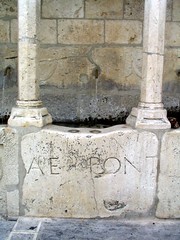
The Poste Italiane have issued a new stamp to represent Molise, to accompany Valle d'Aosta, Veneto, and Sicilia in their "Regioni d'Italia" series. Its design features the so-called "Fontana Fraterna," a well-known monument in the city of Isernia with an interesting history. It was supposedly built in the 14th century by the Rampiniani family in honor of Pope Celestine V, a native of Isernia, incorporating Roman stonework from the family tomb of the Pontii family (of Judean procuratorship fame). Of these suppositions, only the fact that it incorporates Roman spolia can be verified.

The idea that the fragmentary inscription ---]AE PONT[--- could be read famili]ae Pont[iae was disposed of by Mommsen, who read it Nerv]ae pont[ifici (CIL IX, 2636). M. Buonocore suggests that it need not pertain to Nerva, but could refer to a prominent local family.

Franco Valente, in his intriguing article "La Fraterna di Isernia, la fontana dei misteri," traces the long and winding history of the fountain. The most certain fact is that current fountain was rebuilt "exactly," albeit in a new location, after its destruction during the Second World War.

Earlier than that, the going gets dicey. The fountain, or a fountain, has been destroyed by earthquakes, rebuilt, moved, expanded, incorporated bits from other fountains, moved again -- maybe. It bears a curious Latin inscription on one end, which Valente dates to the 13th century and reads:
fons iste / cuius posit(ores) / Rampiniani / me parabis

I'm not convinced that the inscription must have originally referred to this particular fountain. Given the circumstances, I'm not sure where I would draw the line between this fountain and a different fountain. Is it really one fountain suffering numerous vicissitudes, undergoing numerous reconstructions, or a family of fountains, genetically linked as it were by incorporating material from predecessors?

(Stamp news source: primapaginamolise.it; Fountain history, F. Valente, 'La Fraterna di Isernia, la fontana dei misteri'; Fountain photos: my Flickr photos)

Tuesday, May 20, 2008

A new gate at Amelia, Umbria

According to the Soprintendenza per i Beni Archeologici dell'Umbria, a new gate has been discovered in the ancient city walls at Amelia, the ancient Ameria. The arch-topped gate was discovered during the dismantling of a modern embankment, and is now exposed to a height of 4.5 m. The wall circuit is built in polygonal masonry and dates generally to the 4th-3rd centuries BCE.

For more general information, see Bill Thayer's page on Amelia, and that of the Soprintendenza.

(Thanks to Dave Morris for the use of his photo of a (different) section of the walls)

More bits

The Römisch-Germanisches Zentralmuseum in Mainz hosts a database called TOMBA, which is "a multilingual internet image database for the tombs of the élites in Bronze and Early Iron Age Europe (2400/2300 - 480/450 BC). The database is localized into Danish, English, French, German, Greek, and Italian."
This is a fantastic resource, if you can get past the frames and javascript design.

Elizabeth Colantoni reviews Roman Roth, Styling Romanisation. Pottery and Society in Central Italy (2007), at BMCR.

The town of Frosolone in Molise is throwing a Transhumance Festival this coming weekend to celebrate the annual return of the Colantuono family and their 300 cows from Puglia. According to the article, the Colantuono are the only family still practicing long distance transhumance between Molise and Puglia (as opposed to the more common short-distance traffic between lowlands and uplands). I notice too that the Wikipedia article 'Transhumance' makes no mention of the Italian variety (somewhat remedied by the discussion in the Italian version, 'Transumanza'.


Research is to resume
at the important Nuragic site of Sant'Imbenia, Sardinia. Sant'Imbenia shows evidence of contact with Pithekoussai by the mid 8th century BCE. The new work aims at continuing excavation, setting the site within its broader landscape context, developing it as a didactic tool, and safeguarding it for future generations (no surprises there). If you need to brush up on your Sardinian archaeology, you can check out the recent monograph by Stephen Dyson and Robert Rowland, Jr., Archaeology and History in Sardinia from the Stone Age to the Middle Ages: Shepherds, Sailors, and Conquerors (2007).

Saturday, May 17, 2008

Miscellanea Italica

Three things to report today. To get to the hearts of the matter:

The (always momentous) news from Molise brought to my attention a band calling themselves "Tabula Osca," hailing from Agnone, the findspot of the famous Tavola di Agnone (seen here on the left is the copy held in the town hall at Agnone; the original is in the British Museum). The band's website is http://www.tabulaosca.it/. I haven't yet been able to give it a listen, but it's bound to be easier on the ears than "Sakahiter," self-proclaimed purveyors of "SAMNITE BLACK METAL," whose first album Lex Sacrata features an image of the Roman army passing under the Samnite yoke after the Battle of the Caudine Forks:


A new note by William Gilstrap, "Chronology and Variability of Etruscan Architectural Terracotta," is available over at Rasenna (Journal of the Center for Etruscan Studies). It seems to be a poster (with Carl Lipo and Hector Neff, all of California State University Long Beach) from the poster session at the SAA (Society for American Archaeology)'s 2008 Annual Meeting in Vancouver.


Epigraphers take note: the early third century CE statue of Neptune that came out of the Rhone along with the bust of the Elderly Republican Gentleman carries a Latin inscription on its base:

I haven't been able to rustle up a better photo yet, and I can't make a dang thing out from this one.

Wednesday, May 07, 2008

27 New Tombs at Tarquinia

Twenty seven Etruscan tombs were discovered on April 3 in Tarquinia at a construction site in loc. Madonna del Pianto. Of the 27, only one appears to have been violated, probably about 50 years ago, according to Maria Tecla Castanaldi, Soprintendente for Southern Etruria and director of the Museo Nazionale Etrusco in Tarquinia, who visited the open tomb yesterday morning. The new tombs are located about 500m from the painted tombs on Monterozzi hill, near the Scataglini necropolis.

(Via Eternally Cool, Tuscia Web, il Giornale)

Tuesday, May 06, 2008

Prohibited items

The United States Postal Service lists the following items as being prohibited from sending to Italy:

Albums of any kind (of photographs, postcards, postage stamps, etc.).
Arms and weapons.
Articles of platinum or gold; jewelry; and other valuable articles unless sent as insured Priority Mail International parcels.
Artificial flowers and fruits and accessories for them.
Bells and other musical instruments and parts thereof.
Cartridge caps; cartridges.
Clocks and supplies for clocks.
Compound medicaments and medicines.
Coral mounted in any way.
Ether and chloroform.
Exposed photographic and cinematographic films.
Footwear of any kind.
Haberdashery and sewn articles of any kind, including trimmings and lace; handkerchiefs; scarves; shawls, needlework including stockings and gloves; bonnets, caps, and hats of any kind.
Hair and articles made of hair.
Human remains.
Leather goods.
Lighters and their parts, including lighter flints.
Live bees, leeches, and silkworms.
Live plants and animals.
Nutmeg, vanilla; sea salt, rock salt; saffron.
Parasites and predators of harmful insects.
Perfumery goods of all kinds (except soap).
Playing cards of any kind.
Postage stamps in sealed or unsealed First-Class Mail International shipments.
Radioactive materials.
Ribbons for typewriters.
Roasted or ground coffee and its substitutes; roasted chicory.
Saccharine and all products containing saccharine.
Salted, smoked or otherwise prepared meats; fats; and lard.
Tobacco.
Toys not made wholly of wood.
Treated skins and furs.
Weapons of any kind and spare parts for them.


At first glance, it's an odd and amusing list (and has been seen as such already). It certainly wasn't composed all at one time; note the separately listed, redundant items "Arms and weapons" and "Weapons of any kind." In 2008, we're used to all sorts of restrictions on dangerous materials such as weapons, lighters, radioactive materials, and the like. Postal reluctance to handle live bees is understandable. But "Bells and other musical instruments and parts thereof"? "Footwear of any kind"? "Roasted or ground coffee and its substitutes; roasted chicory"? These may be holdovers from the import restrictions imposed by the Fascist government in the late 1920s and early 30s to protect prices of Italian-made goods. But really -- "Artificial flowers and fruits and accessories for them"?

Monday, May 05, 2008

The News from Italy


Archeoblog signals the opening of a new exhibition in Matelica, "Potere e Splendore: gli antichi Piceni a Matelica" ("Power and Magnificence: the ancient Picenes in Matelica"). The exhibition has a flashy website at http://www.poteresplendore.it, available in both Italian and English. The artifacts on display come from tombs excavated in the necropoleis of Brecce, Villa Clara, Cavalieri, Passo Gabella, and Crocifisso, dating between the 9th and 7th centuries BCE. It runs through October 31st.

Elsewhere in the museum is the "Globo di Matelica," which is "a kind of ancient solar clock found in the historic centre. It is an exceptional instrument belonging to the Hellenistic-Roman period, unique all over the world, which, through the boundary line between lights and shadows traced out on its marble surface, showed the hours of the day, the seasons and the constellations." It looks a bit like the Death Star to me...


In other news, with the dust freshly resettled after the recent elections, I'd like to point out those on their way out (outgoing Minister of Culture Francesco Rutelli, instrumental in the return of, among other things, the Sarpedon krater; via Looting Matters), and those on their way in (incoming Mayor of Rome Gianni Alemanno, who wants to get rid of Meier's Ara Pacis museum; via Eternally Cool).

Tuesday, April 29, 2008

On the "Greek Temple" in Alexandria

The report from April 21 on Rogue Classicism of the report from several days prior [the link is not working as I type] says this:
A team of archaeologists have unearthed a Greek temple in the Egyptian coastal city of Alexandria, showing that the Greeks worshipped Pharaonic deities more than 2,500 years ago.

An official of the expedition said that the temple was found during the renovation of an area of Alexandria with the relics of the temple unearthed evidence that Greeks were influenced by the ancient Egyptian civilization.

He added that the Greeks believed in the holy trinity of Isis, Osiris and the child Horus, developing these gods after Alexander the great conquered the city in 332 BC.


I cannot offer a substantial source, but a friend in Alexandria tells me that this temple was found during conservation work at the Serapeum, in the western half of the site. "More than 2,500 years ago" would mean pre-Greek, pre-foundation, and definitely pre-date the "Alexandrian trinity." The idea that an Egyptian settlement (Rhakotis) existed on the site before Alexander arrived has been gaining acceptance in Alexandrian studies lately, but this would be a nice proof -- of course, we'll have to wait for some published confirmation or clarification.

Thursday, April 24, 2008

Arcadian ramblings

A while back, David Meadows confessed to never having heard of the Temple of Apollo at Bassae. Those finding themselves in a similar state of ignorance should run out (or log on) and purchase Beard and Henderson, Classics: A Very Short Introduction (ISBN 0192853856; LibraryThing), which might also be titled, The Temple of Apollo at Bassae: A Shortish Introduction.

The temple, as noted by Beard and Henderson, and in Meadows' quotation, "is now entirely shored up and covered by a tent (the restoration and consolidation works continue), because [of] its critical state":

Temple of Apollo Epikourios, Bassae

Unfortunately, this unsightly tent, designed to preserve the temple from the ravages of pollution (and, wicked witch-like, rain), does a better job trapping pollution inside so it can really have a go at the limestone. It does, however, make for easier sighting from the ash altar atop Mt. Lykaion...

Early morning, Mt. Lykaion

...which gets a mention in Classics: "High on a mountainside in a rugged and lonely part of Arcadia stands a remote shrine to Zeus Lykaios, Wolf Zeus" (C. Segal, Tragedy and Civilisation 1981, 1, quoted in Beard and Henderson, 89-90)... "grim precinct... the mountain where a grisly and primitive cult violated one of the first laws of human civilization as the Greeks defined it, the taboo against cannibalism" (B&H, 96).

The early excavations at Mt. Lykaion found no evidence of human sacrifice, and the past season of work at the altar, despite the careful attention of a renowned physical anthropologist, also produced no human remains. Madeleine Jost ("À propos des sacrifices humains dans le sanctuaire de Zeus du mont Lycée." In Robin Hägg (ed.), Peloponnesian Sanctuaries and Cults: Proceedings of the Ninth International Symposium at the Swedish Institute at Athens, 11-13 June 1994, pp. 183-6) has suggested that if there were human sacrifices, the victims may not have been mixed with the animal remains on the altar. That said, I believe Plato's Republic (565 d-e) is the earliest written reference to human sacrifice at Mt. Lykaion, and that account does not inspire particular confidence:
"'What, then, is the starting-point of the transformation of a protector into a tyrant? Is it not obviously when the protector's acts begin to reproduce the legend that is told of the shrine of Lykaion Zeus in Arcadia?' 'What is that?' he said. 'The story goes that he who tastes of the one bit of human entrails minced up with those of other victims is inevitably transformed into a wolf. Have you not heard the tale?'"

The connection of Mt. Lykaion with lycanthropy is a common one (see, e.g., Segal above, or the latest issue of Archaeology), and dates back at least as far as Plato. It is, however, etymologically false. The Greek epithet lukai~os derives not from lu/kos "wolf" but from *lu/kh "light, dawn", and ultimately the PIE root *leuk- of roughly the same meaning. This was pointed out already by A.B. Cook in his monumental Zeus of 1914, pp. 63-64.

Of course, the Greeks were never ones to let false etymology get in the way of a good story. You can see a selection of testimonia to strange and fantastic occurrences here on the Mt. Lykaion Excavation and Survey Project website. (In the interest of full disclosure, I suppose I ought to mention that I work for said project.)

Thursday, March 06, 2008

To Alexandria

On Saturday I leave for Egypt for a week, and specifically Alexandria. I follow in the Italic footsteps of MARAIOC BAKEIOY MAMEPTINOC, that is, Maraios Vacceius the Mamertine, though hopefully I won't die and be buried there, as he did. His loculus with painted cover slab was found in the Hadra necropolis in the first half of the last century. He was probably a mercenary serving in the army of the Ptolemies, along with the (relatively-speaking) more famous Galatians once buried in the "Tomb of the Mercenaries" and elsewhere. For a mention of Maraios, see Gianluca Tagliamonte's fundamental study of the Italic mercenariate, I Figli di Marte, p. 211.

Monday, February 18, 2008

Varia Februaria

David Meadows alerts us that MEFRA (Mélanges de l'Ecole française de Rome. Antiquité) is available online via http://www.persee.fr -- just select it from the drop-down menu. Unfortunately, many or most images are locked out in the free version.

Over at Current Epigraphy, Gabriel Bodard gives us the run-down on a lecture by Michael Crawford on
"Language, geography, and economy in early Italy."

For those lucky enough to reside in the greater Philadelphia metro area, there are a couple of events this week pertaining to early Italy:

"Etruscan Treasures of the Vatican Museum"
Dr. Maurizio Sannibale & Dr. Carlo Aurisicchio,
Thursday, 21 February 2008 - 6:30 PM
Penn Museum Classroom 2, University of Pennsylvania
(for more info, see here)
(Updated 2/19: If you're in the DC area, see it here)

"Italic Identity in the Roman Republic and Italian Social War Propaganda"
Gary D. Farney, Rutgers University
Friday, 22 February 2008 - 4:30 PM
Rhys Carpenter Library B21, Bryn Mawr College

Wednesday, February 06, 2008

Spolia update


inscription
Originally uploaded by Phil-AEK
I'm happy to report that the "Spolia" group on Flickr has grown to 39 members and 206 pictures since its inception on December 27 of last year. I don't anticipate maintaining such a rate of growth, though. I've searched most of the obvious tags (e.g. spolia, re-used, recycled) in as many of the languages as I felt I could do so profitably (English, Italian, French, Spanish, German). Future additions will be more dependent on self-submission by members than on invitations by me. Of course, there are many pictures out there showing spolia without saying so in their description, which makes it harder to find them.

The locations represented are concentrated in Mediterranean Europe, with a good showing from the British Isles, along with, thus far, one from China and one from Chicago. I've decided to keep Spolia broadly defined, including, for instance, the Lothar Cross with its Roman cameo of Augustus embedded in a 10th-century cross.

The Duomo in Pisa is particularly well-represented in the pool with 8 pictures, no doubt due to the frequency with which it is touristed. The Yerebatan Sarayı or Basilica Cistern in Istanbul is very well represented on flickr as a whole, but thus far only one picture has been added to the Spolia pool. Likewise, many pictures of a wall on Paros have been invited, but few have thus far accepted.

For purely epigraphic considerations, the best groups on Flickr that I've seen are "Visible Words - Visibile Parlare" for Latin and the Latin alphabet (1500 photos) and Greek (203 photos). There's also Inscriptiones, but it seems to have died with 19 photos.

Saturday, January 12, 2008

Tria Corda goes (officially) Open Access

Sebastian Heath gave a quick run-down on Open Access licenses among the ancient blogging community over at the AWBG. His guess that "some bloggers haven't given this issue much thought" was spot on for me. Tria Corda has followed a wandering developmental road since its inception back on August 12, 2005. "Sporadic Italic blogging is all that can be expected," I said then, and it has indeed been sporadic -- nothing between January and December of 2006! I think I've also been charged with being "chatty" in the past, to which I can only plead guilty. With the spur from the AWBG, I've determined to focus more on Tria Corda, which includes giving issues more thought. As a result, I'm now publishing it with a Creative Commons 3.0 Attribution Unported license, which you'll see over in the right hand column o' stuff. This means (as per the license) you are free to 1. Share — to copy, distribute and transmit (the contents of the blog); 2. Remix — to adapt (the contents of the blog); but on the condition that you must attribute the work in the manner specified by the author or licensor (but not in any way that suggests that they endorse you or your use of the work).

I note also that Chuck Jones has since CC'd the PFAP blog and is presumably responsible for AWBG itself.

AIA/APA Chicago Report no. 3

On Saturday I attended the excellent session on Magna Graecia (AIA 4D, January 5, 1:30-4:30 PM).

Opening up,
Johanna Hobratschk put "Apulian Vase-painting in Context: A Reconsideration of Dramatic Scenes." Past scholarship (e.g. Trendall and Webster) has seen a direct representation of South Italian theater on Apulian volute-kraters. Hobratschk argues for the development of architecture in dramatic scenes on vases from naiskoi in funerary contexts. The Iliupersis Painter was the first to paint naiskoi in funerary scenes, and the first to make major use of the volute krater, with some fourteen attributed vases. The buildings in his later dramatic scenes show clear similarities with his earlier funerary naiskoi. By contrast, in Campanian fabric where funerary scenes are very uncommon, the conventions for representing dramatic architecture are different.

Camilla R. Norman presented "The Myth of the Ransom of Hector on the Daunian Stelai." These enigmatic objects (late 7th-mid 5th centuries BCE) were almost single-handedly saved -- and interpreted -- by Silvio Ferri during the 1950's and 60's, coinicident with the introduction of the deep plow in Apulian agriculture. Ferri's Classical training led him to describe many of the figural scenes as illustrations of Greek myths or Homeric episodes rather than on their own terms. His interpretation of a recurring scene as the "Ransom of Hector," based on the identification of the central object as the Lyre of Achilles, required him to assert that the actual body of Hector was implied but not depicted, and that Achilles was painted in, rather than engraved like the rest of the figures! Achilles' lyre is not even described in connection with Priam's recovery of his son's body. Norman posits instead that the scene shows some aspect of women's life, perhaps connected with the production of textiles. The "lyre of Achilles" may in fact be a hand loom, a wool basket, or a hanging cloth, among other possibilities.


Unfortunately, Gianfranco Carollo was not present to give an update on "Burials and Reconstruction of Social and Cultural Contexts. The Unpublished Necropolis of Ripacandida (Potenza, Italy)," a particular shame since, as noted, the material is still unpublished.

After a break, Dante Bartoli read "
Archaeology and Environment in the Sila Mountains (Calabria, Italy). Analysis of the Prehistoric Settlements" for Domenico Marino and Annalisa Zarattini. A lush prehistoric forest stretched across Calabria and there is evidence for occupation by both Homo erectus and Neandertal man. During the Neolithic, new areas were settled in the Sila mountains, based on short-distance transhumance and fishing, and the local obsidian quarries were first used at this time. Excavations between 2005 and 2007 have revealed Neolithic settlements submerged in the Lago di Cecita, dated 3800-3350 BCE, with subsistence based on agriculture, gathering, cattle and fish. Between the Neolithic and Bronze age there was a progressive exapansion of settlements in the hills as termini of transhumance. At Timpone del Gigante there are an Iron Age settlement, Hellenistic defensive walls, and a Roman quarry.

Finally, Sandra Lucore, director of the excavation of the North Baths at Morgantina, shared her thoughts on "
Tradition and Innovation in Western Greek Baths." Despite the lack of full publication of any baths in the Western Greek world, Lucore identifies a clear typology of baths based on heated communal immersion bathing. The earliest evidence of such bathing in Sicily is at late 4th century Gela, including the individual bathing tubs and slightly later tholos-room which both remain standard features of western baths. The typical thermal complex including a double room and tholos adjoined by a hypocaust, as found at Syracuse, Morgantina, and Megara Hyblaea. The dome over the tholos and barrel-vaulted rooms at Morgantina were constructed with interlocking hollow terracotta tubes, which were then covered with a rough mortar compound. These tubular vaults are the earliest known, and the technique betrays a practical knowledge of statics, which may be connected with the work of Archimedes at Syracuse.

Wednesday, January 09, 2008

AIA/APA Chicago Report no. 2

Continuing with AIA Session 2E: Etruria and Samnium...


Elizabeth C. Robinson
re-examined "Rural Settlement Patterns and Sanctuaries in the Middle Volturno Valley (Campania)" between the Archaic period and the 1st cent. BCE. The area has been discussed twice in recent memory, by P. Carafa in his 1997 dissertation "I Culti in Campania" (published in 2006) and by S.P. Oakley in his 1996 The Hill-Forts of the Samnites, but neither treatment is completely satisfactory. Robinson finds no evidence for city-state organization or border sanctuaries in the region, and Oakley's work (not surprisingly) focuses mostly on clearly identifiable fortified sites. Robinson reclassified the 16 identified sites into new categories: large oppida with a fortified acropolis and 1 or more wall circuits; small oppida with no separate acropolis, no more than one circuit, enclosing an area of less than 0.16m2; rural cult sites and necropoleis.

For instance, the site of La Rocca, with its three terraces and two circuits of polygonal masonry, becomes a large oppidum, which Carafa had identified as a boundary sanctuary purely on the basis of four terracotta heads, which may be antefixes. One of the difficulties that emerged from discussion was the lack of a real survey of the area, as well as the small quantities of material used to define a site -- do two bronze statuettes make Zappini a rural cult site? As some conclusions, the sanctuaries show little evidence of monumental architecture, the settlement pattern is very unlike that of poleis, and we should abandon the idea of boundary sanctuaries for Samnium.


Next, Rachel Van Dusen gave us "Saving Face: Samnite Elites in the Aftermath of the Samnite Wars." The families of Samnite generals identified in Livy's account of the Samnite Wars (Papius Brutulus, Statius Gellius, Gellius Egnatius, Min. Staius Minatius) continue to be attested as meddices tutici for several hundred years. For instance, the Staii produced at least 12 meddices for the period 296 - 90 BCE. The monumentalization of sanctuaries in Samnium, which coincides with a reduction in wealth of grave goods, provides further evidence for the continuing control of these families through inscriptional evidence. Four of the six Papii known as meddices tutici are attested in inscriptions from sanctuaries, e.g. G. Papius with the smaller temple at Schiavi D'Abruzzo, ca. 100-90 BCE. Likewise, two of three Statii, including G. Statius Clarus with Temple B at Pietrabbondante; one of three Egnatii, and a wopping 10 of 12 Staii, including six at Pietrabbondante, one at Campochiaro, plus an otherwise unattested Staius known from a bronze tablet at Vastogirardi. These families were clearly able to maintain their status despite a shift from positions of military power to civil posts.


Finally, Tesse Stek read a paper on
"Sanctuaries and Society in Central-Southern Italy in the Republican Period." Stek investigated the sanctuaries' function in society; the oft-cited commercial profits made by Italic merchants of the period are not a sufficient reason in and of themselves, only a condition. None of the three commonly proposed explanations (transhumance road shrines, territorial markers, constituents of the Italic pattern of settlement) for sanctuary development are satisfactory. If they were road-shrines connected with transhumance, then why are so many perched on mountain tops unsuited for flocks or large markets? The idea of the of the border sanctuary originated with Polignac's work in Greece, but the Greek system does not map neatly onto the Italic world. This is not a polis-system, and the ethnic groups represented may not have been so rigidly territorially defined. Finally, the oft-discussed pagus-vicus system is based on problematic and disparate literary references, rather than on archaeology, although it wins points for its attempt at a purely Italic model.

Stek finds a problem in that the spatial context of most Samnite sanctuaries is largely unknown. He took as a test case the sanctuary at S. Giovanni in Galdo, loc. Colle Rimontato, based on 2004-2005 Leiden surveys and unpublished finds from the 1970's. They surveyed the 7km
2 directly around the sanctuary with theoretical 20% coverage; concentrations of >5 artifacts/m2 were labeled as sites and resurveyed. For the Archaic Period Stek found a nucleated settlement around a spring, with cemetery some 500m north of the sanctuary. The Hellenistic Period saw a dispersion of smaller sites, nine contemporary with the sanctuary, while the prior nucleated settlement was extended into a hamlet of 8 ha. For the Roman Period, the total number of sites remained the same, but their locations changed, though the hamlet continued to be occupied as did a number of farmsteads. The sanctuary shows evidence of use into the late Imperial period.

Stek hypothesizes the sanctuary as perhaps a pole of attraction for the surrounding communities, or possibly vice versa, being constructed in a (relatively) densely-populated area. He finds no evidence for territorial marking or for a connection with transhumance, although neither possibility can be ruled out at this stage.


Thus concludes the session on Etruria and Samnium. Tune in next time for coverage of Magna Graecia; I have some reviews of a couple of new books on ancient Italy in the works as well.

Tuesday, January 08, 2008

AIA/APA Chicago Report no. 1

This will be the first in a planned series of posts summarizing some of the papers I heard at the Joint Annual Meeting in Chicago, though I certainly didn't make it to all that I would have liked to!

On Friday, I attended AIA Session 2E: Etruria and Samnium.

To kick it off, David Soren of the University of Arizona read "Horace's Healing Spring at Chianciano, Tuscany: The Final Report" on the U. of A.'s excavations at the Etrusco-Roman thermal complex at Chianciano in Tuscany. The site is identified as the ancient Fontes Clusinii, renowned especially in the early Principate for its healing waters, a reputation that endures to this day. The Emperor Augustus, by command of his physician, sought (and found) relief from his stomach ailments there. The site seems to have been maintained deliberately rustic and unembellished, despited repeated additions and repairs from the 2nd century BCE to the 5th century CE. This suggests to Professor Soren that the complex was run by a community of ascetics. Analysis of water from the still-bubbling spring revealed concentrations of calcium carbonate which, ingested in small quantities, would have flushed the digestive system.

Next, Walter McCall of UNC-Chapel Hill presented "The Falerii Novi Project 2004-2006: Our Preliminary Conclusions." Ground survey revealed several previously-unknown gates in the Roman wall circuit, immediately south of the theater as well as near the northeast corner of the city. McCall suggests that the Roman grid of 80-90 m x 60 m insulae was designed to take into account a previously existing Faliscan settlement or path system, as evidenced by the non-rectilinear path of the pomerium road. Additionally, the southern entrance of the Via Amerina was shifted eastward to enter directly into the theater complex after the construction of that edifice -- maybe, I wonder, to move dispersing crowds quickly out of the city?

I missed the beginning of Hilary Becker's paper on
"Family identity and heraldic signs in Etruria;" I came in as Ms. Becker was discussing the Tagliatella oinochoe, which depicts a line of warriors with shields all bearing identical wild-boar devices, headed by a man identified by inscription as "Mamerce." Becker contrasted the unity of devices on this Etruscan vase with contemporary images such as the Chigi Vase, which show lines of hoplites each having unique shield-devices.
On the walls of the 4th cent. BCE "Giglioli Tomb" at Tarquinia are three painted shields, bearing the devices of a wild boar, an amphora and an 'A'. These emblems are also found on contemporary coins from Tarquinia and nearby areas, probably issued by local noble families. The images may therefore be emblems of particular families, employed heraldically on both coins and on shields. Such devices could also be punning; there is a shield painted with a half-moon on the wall of the Tius ("Moon") family of Chiusi.
Family-specific devices may have been warranted by a clan's independent military actions. Of such bella privata, the best known is the attack on Veii in 477 BCE by the 306 members of the Roman gens Fabia (Livy 2.48-50). Though none of these private wars is recorded as contemporary for the tombs discussed, they may have gone unrecorded. The votive deposit at Vetulonia of 125 bronze helmets, of which nineteen were inscribed with the name of a prominent family, "Haspnas," may be indicative of clan-based warfare.

Lastly before the break, in
"Imported Bucchero from Poggio Civitate: Socio-Political Exchange," Jason P. Bauer found that of the thousands of bucchero fragments from the area of the Orientalizing builidng at Poggio Civitate (constructed ca. 650 BCE, with a burn layer ca. 620-600), only some 53 were imported. In contrast to the coarse local production, the imported bucchero is probably to be connected with a system of trade and contact between elites.

That's it for today; I'll cover the last three papers from this panel on Samnium in a future post, along with some from other sessions.