Just a quick note here to say that I've joined flickr. I was inspired to create a group called "Spolia," which does just what it says on the tin. Thus far it's mostly my own photos from Central and South Italy, but I'd welcome contributions from far and wide.
Spoliation is much easier these days. Texts, images and other such fragments can be embedded in new creations with a few clicks of the mouse; you don't even have to wait for the original to crumble into pieces.

Quintus Ennius tria corda habere sese dicebat, quod loqui Graece et Osce et Latine sciret.
"Quintus Ennius said that he had three hearts, because he spoke Greek and Oscan and Latin."
-Aulus Gellius, Noctes Atticae 17.17
Friday, December 28, 2007


Thursday, December 20, 2007
Italic Matters in Chicago
Has it been a year already? The recent construction of the Ancient World Bloggers Group in a day has spurred (or rather goaded, in this pre-spur age) me into thinking about a return to blogging. With the annual joint meeting of the Archaeological Institute of America and the American Philological Association coming up January 3-6, 2008, and in the interests of taking it slow and minimizing the risk of injury, I'm starting out with some simple synthesis, a list of papers that may be of interest to the student of pre-Roman and Roman Italy, arranged chronologically by session, the AIA and the APA commingled in a model of harmonious coexistence. Before jumping into the list, I'll note in passing that the AIA/APA Annual Meeting Scheduling Tool is now online.
FRIDAY, JANUARY 4:
* AIA Session: 1J: Poster Session (Friday, January 4, 10:00 AM - 2:00 PM)
3. William Colsher, "The Topography of Prostitution in Pompeii"
12. Martin J. Goalen, From Raw Data to Graphic Analysis: Computer Modelling as a Tool in Site Conservation and Presentation at Insula VI.1, Pompeii.
14. Jeffrey A. Becker and Nicola Terrenato, The Gabii Excavation Project: A Report on the First Season
*APA Session : Polis Religion in Greece and Rome (Friday, January 4, 11:15 AM – 1:15 PM)
Section 10 Crystal Ballroom C
-Amanda Coles, Worshipping Diana: Religion and Colonization in Northern Italy
-Susan Satterfield, Alien Insiders: Etruscan Haruspices in Rome
* APA Session 11: Aeneid (Friday, January 4, 11:15 AM – 1:15 PM)
Columbus Hall KL
-Jennifer Ferriss, Virgil Polyglottos: Sabellic Etymologizing in Aeneid 7
*APA Session 12: Latin Historiography (Friday, January 4, 11:15 AM – 1:15 PM)
Columbus Hall AB
-Jackie Elliott, Ennius’ Fabius Maximus Cunctator and the history of an ablative gerund in the Roman historiographical tradition
* APA Session 13: Linguistics (Friday, January 4, 11:15 AM – 1:15 PM)
Grand Suite 5
-Jay Fisher, Bridgemaker or Pathfinder?: the Origin of Latin Pontifex Revisited
* AIA Session: 2E: Etruria and Samnium (Friday, January 4, 1:30 PM - 4:30 PM)
1. David Soren, Horace's Healing Spring at Chianciano, Tuscany: The Final Report
2. Walter McCall, The Falerii Novi Project 2004-2006: Our Preliminary Conclusions
3. Hilary Becker, Family identity and heraldic signs in Etruria
4. Jason P. Bauer, Imported Bucchero from Poggio Civitate: Socio-Political Exchange
5. Elizabeth C. Robinson, Rural Settlement Patterns and Sanctuaries in the Middle Volturno Valley (Campania)
6. Rachel Van Dusen, Saving Face: Samnite Elites in the Aftermath of the Roman Samnite Wars
7. Tesse D. Stek, Sanctuaries and Society in Central-Southern Italy in the Republican Period
* AIA Session: 2G: Embodiment and Remembrance in a Mortuary Context (Friday, January 4, 1:30 PM - 4:30 PM)
5. David Soren, Malaria, Magic, and Infant Burials at Lugnano in Teverina, Umbria
6.Mauro Rubini, Disfiguring Diseases and Society in the Fourth - Fifth Century A.D.:The Case of Palombara Sabina (Rome, Central Italy)
SATURDAY, JANUARY 5:
Though most unrelated to the Italic world, you'll surely find me at:
* AIA Session: 3F: Greek Sanctuaries (Saturday, January 5, 9:00 AM - 12:00 PM)
3. Excavations and Research at the Sanctuary of Zeus on Mt. Lykaion in the Peloponnesos, 2004-2007,
an interim report on the site I worked at last summer in the field, and continue to help out with here in the lab.
* APA Session 35: Italian Epigraphy (Saturday, January 5, 11:15 AM - 1:15 PM)
Columbus Hall IJ
1. Christer Bruun, Property Ownership by Women in Rome and Roman Italy (15 mins.)
2. Cynthia J. Bannon, Fish Farming and Fraud: Rational Economic Strategies for Roman Landowners? (15 mins.)
3. Rebecca Benefiel, Advertising for Sex in Ancient Pompeii (15 mins.)
4. Megan Nutzman, Faith or Family? Jewish Epitaphs from Rome (15 mins.)
* AIA Session: 4C: Pompeii and Ostia (Saturday, January 5, 3:15 PM - 4:30 PM)
1. Gary Devore and Steven J.R. Ellis, Plebs versus the City: The Competition for Space between Public and Private Interests at Pompeii
2. J. Clayton Fant, Bars with Marble Surfaces; Evidence for the Mediterranean Marble Trade and for Pompeii’s Innkeepers
3. Genevieve Gessert, Excavation of the Domus del Tempio Rotondo, Ostia Antica 2003-2007
4. Douglas Boin, The Temple of Vulcan at Ostia and the Late Antique "Pagan Revival"
* AIA Session: 4D: Magna Graecia (Saturday, January 5, 1:30 PM - 4:30 PM)
1. Johanna Hobratschk, Apulian Vase-painting in Context: A Reconsideration of Dramatic Scenes
2. Camilla R. Norman, The Myth of the Ransom of Hector on the Daunian Stelai
3. Gianfranco Carollo, Burials and Reconstruction of Social and Cultural Contexts. The Unpublished Necropolis of Ripacandida (Potenza, Italy)
4. Domenico Marino and Annalisa Zarattini, Archaeology and Environment in the Sila Mountains (Calabria, Italy). Analysis of the Prehistoric Settlements.
5. Sandra K. Lucore, Tradition and Innovation in Western Greek Baths
* Session: 4H: Cultural Identity and the Peoples of the Ancient Mediterranean, Joint AIA/APA Colloquium (Saturday, January 5, 1:30 PM - 4:30 PM)
3. Maria Swetnam-Burland, Aegyptus Capta: The Appropriation and Assimilation of Egypt in Roman Italy
SUNDAY, JANUARY 6:
*APA Session 53: Greek and Latin Linguistics (Sunday, January 6, 8:30 AM - 11:00 AM)
Grand Suite 5
3. Angelo O. Mercado, Poetry and Phonology of the Paelignians (25 mins.)
5. Michael Weiss, New Paradigms for Old in the Interpretation of the Iguvine Tables (25 mins.)
* AIA Session: 5B: The Archaeology of Sanctuaries and Ritual in Etruria (Sunday, January 6, 9:00 AM - 12:00 PM)
1. Katherine Rask, The Elusive Cult Statue of Etruria
2. Simonetta Stopponi, The Excavation of Campo della Fiera in Orvieto
3. Giovanna Bagnasco Gianni, Tarquinia: Excavations by the University of Milano at the Ara della Regina Sanctuary
4. Helen Nagy, Etruscan Votive Deposits and Their Archaeological Context
5. Nancy T. de Grummond, The Sacred Area at Cetamura del Chianti
6. Lisa Pieraccini, The Wonders of Wine and Ritual in Etruria
7. P. Gregory Warden, New Evidence for Ritual Activity at Poggio Colla
* APA Session 55: The Nature of the Roman Republic (Sunday, January 6. 11:30 AM - 1:30 PM)
Grand Suite 5
1. Catherine Tracy, Who Were the Quirites? The Composition of Contio Audiences (15 mins.)
2. Ayelet Haimson Lushkov, Constitutional Debate in Republican Rome and the
Elections of 184 B.C. (15 mins.)
3. Robert Morstein-Marx, The Struggle Over Italian Voting-Rights in 88-87 B.C. and Its Implications for the Debate about Political Participation in the Late Roman Republic (15 mins.)
* AIA Session: 6B: Villas and Villa Life (Sunday, January 6, 1:30 PM - 4:30 PM)
1. Elizabeth Fentress, Excavations at Villa Magna
2. Diane Atnally Conlin, Anne Haeckl, and Gianni Ponti, Excavations at the Villa of Maxentius: Report on the 2006 and 2007 Seasons
3. John W. Stephenson, Textile Hangings and Elite Self-Presentation in Late Roman Villas
4. Nicholas Hudson, Dining in Late Antiquity: An Analysis of Roman Dining Assemblages
*APA Session 61: Roman History (Sunday, January 6, 1:45 PM - 4:15 PM)
Columbus Hall KL
-Jessica Homan Clark, The Paradox of Ransom in the Roman Middle Republic
*APA Session 63: Plautus (Sunday, January 6, 1:45 PM - 4:15 PM)
Columbus Hall CD
1. Dorota Dutsch, A "Pythagorizing Girl" in the Plautine Poenulus? (15 mins.)
FRIDAY, JANUARY 4:
* AIA Session: 1J: Poster Session (Friday, January 4, 10:00 AM - 2:00 PM)
3. William Colsher, "The Topography of Prostitution in Pompeii"
12. Martin J. Goalen, From Raw Data to Graphic Analysis: Computer Modelling as a Tool in Site Conservation and Presentation at Insula VI.1, Pompeii.
14. Jeffrey A. Becker and Nicola Terrenato, The Gabii Excavation Project: A Report on the First Season
*APA Session : Polis Religion in Greece and Rome (Friday, January 4, 11:15 AM – 1:15 PM)
Section 10 Crystal Ballroom C
-Amanda Coles, Worshipping Diana: Religion and Colonization in Northern Italy
-Susan Satterfield, Alien Insiders: Etruscan Haruspices in Rome
* APA Session 11: Aeneid (Friday, January 4, 11:15 AM – 1:15 PM)
Columbus Hall KL
-Jennifer Ferriss, Virgil Polyglottos: Sabellic Etymologizing in Aeneid 7
*APA Session 12: Latin Historiography (Friday, January 4, 11:15 AM – 1:15 PM)
Columbus Hall AB
-Jackie Elliott, Ennius’ Fabius Maximus Cunctator and the history of an ablative gerund in the Roman historiographical tradition
* APA Session 13: Linguistics (Friday, January 4, 11:15 AM – 1:15 PM)
Grand Suite 5
-Jay Fisher, Bridgemaker or Pathfinder?: the Origin of Latin Pontifex Revisited
* AIA Session: 2E: Etruria and Samnium (Friday, January 4, 1:30 PM - 4:30 PM)
1. David Soren, Horace's Healing Spring at Chianciano, Tuscany: The Final Report
2. Walter McCall, The Falerii Novi Project 2004-2006: Our Preliminary Conclusions
3. Hilary Becker, Family identity and heraldic signs in Etruria
4. Jason P. Bauer, Imported Bucchero from Poggio Civitate: Socio-Political Exchange
5. Elizabeth C. Robinson, Rural Settlement Patterns and Sanctuaries in the Middle Volturno Valley (Campania)
6. Rachel Van Dusen, Saving Face: Samnite Elites in the Aftermath of the Roman Samnite Wars
7. Tesse D. Stek, Sanctuaries and Society in Central-Southern Italy in the Republican Period
* AIA Session: 2G: Embodiment and Remembrance in a Mortuary Context (Friday, January 4, 1:30 PM - 4:30 PM)
5. David Soren, Malaria, Magic, and Infant Burials at Lugnano in Teverina, Umbria
6.Mauro Rubini, Disfiguring Diseases and Society in the Fourth - Fifth Century A.D.:The Case of Palombara Sabina (Rome, Central Italy)
SATURDAY, JANUARY 5:
Though most unrelated to the Italic world, you'll surely find me at:
* AIA Session: 3F: Greek Sanctuaries (Saturday, January 5, 9:00 AM - 12:00 PM)
3. Excavations and Research at the Sanctuary of Zeus on Mt. Lykaion in the Peloponnesos, 2004-2007,
an interim report on the site I worked at last summer in the field, and continue to help out with here in the lab.
* APA Session 35: Italian Epigraphy (Saturday, January 5, 11:15 AM - 1:15 PM)
Columbus Hall IJ
1. Christer Bruun, Property Ownership by Women in Rome and Roman Italy (15 mins.)
2. Cynthia J. Bannon, Fish Farming and Fraud: Rational Economic Strategies for Roman Landowners? (15 mins.)
3. Rebecca Benefiel, Advertising for Sex in Ancient Pompeii (15 mins.)
4. Megan Nutzman, Faith or Family? Jewish Epitaphs from Rome (15 mins.)
* AIA Session: 4C: Pompeii and Ostia (Saturday, January 5, 3:15 PM - 4:30 PM)
1. Gary Devore and Steven J.R. Ellis, Plebs versus the City: The Competition for Space between Public and Private Interests at Pompeii
2. J. Clayton Fant, Bars with Marble Surfaces; Evidence for the Mediterranean Marble Trade and for Pompeii’s Innkeepers
3. Genevieve Gessert, Excavation of the Domus del Tempio Rotondo, Ostia Antica 2003-2007
4. Douglas Boin, The Temple of Vulcan at Ostia and the Late Antique "Pagan Revival"
* AIA Session: 4D: Magna Graecia (Saturday, January 5, 1:30 PM - 4:30 PM)
1. Johanna Hobratschk, Apulian Vase-painting in Context: A Reconsideration of Dramatic Scenes
2. Camilla R. Norman, The Myth of the Ransom of Hector on the Daunian Stelai
3. Gianfranco Carollo, Burials and Reconstruction of Social and Cultural Contexts. The Unpublished Necropolis of Ripacandida (Potenza, Italy)
4. Domenico Marino and Annalisa Zarattini, Archaeology and Environment in the Sila Mountains (Calabria, Italy). Analysis of the Prehistoric Settlements.
5. Sandra K. Lucore, Tradition and Innovation in Western Greek Baths
* Session: 4H: Cultural Identity and the Peoples of the Ancient Mediterranean, Joint AIA/APA Colloquium (Saturday, January 5, 1:30 PM - 4:30 PM)
3. Maria Swetnam-Burland, Aegyptus Capta: The Appropriation and Assimilation of Egypt in Roman Italy
SUNDAY, JANUARY 6:
*APA Session 53: Greek and Latin Linguistics (Sunday, January 6, 8:30 AM - 11:00 AM)
Grand Suite 5
3. Angelo O. Mercado, Poetry and Phonology of the Paelignians (25 mins.)
5. Michael Weiss, New Paradigms for Old in the Interpretation of the Iguvine Tables (25 mins.)
* AIA Session: 5B: The Archaeology of Sanctuaries and Ritual in Etruria (Sunday, January 6, 9:00 AM - 12:00 PM)
1. Katherine Rask, The Elusive Cult Statue of Etruria
2. Simonetta Stopponi, The Excavation of Campo della Fiera in Orvieto
3. Giovanna Bagnasco Gianni, Tarquinia: Excavations by the University of Milano at the Ara della Regina Sanctuary
4. Helen Nagy, Etruscan Votive Deposits and Their Archaeological Context
5. Nancy T. de Grummond, The Sacred Area at Cetamura del Chianti
6. Lisa Pieraccini, The Wonders of Wine and Ritual in Etruria
7. P. Gregory Warden, New Evidence for Ritual Activity at Poggio Colla
* APA Session 55: The Nature of the Roman Republic (Sunday, January 6. 11:30 AM - 1:30 PM)
Grand Suite 5
1. Catherine Tracy, Who Were the Quirites? The Composition of Contio Audiences (15 mins.)
2. Ayelet Haimson Lushkov, Constitutional Debate in Republican Rome and the
Elections of 184 B.C. (15 mins.)
3. Robert Morstein-Marx, The Struggle Over Italian Voting-Rights in 88-87 B.C. and Its Implications for the Debate about Political Participation in the Late Roman Republic (15 mins.)
* AIA Session: 6B: Villas and Villa Life (Sunday, January 6, 1:30 PM - 4:30 PM)
1. Elizabeth Fentress, Excavations at Villa Magna
2. Diane Atnally Conlin, Anne Haeckl, and Gianni Ponti, Excavations at the Villa of Maxentius: Report on the 2006 and 2007 Seasons
3. John W. Stephenson, Textile Hangings and Elite Self-Presentation in Late Roman Villas
4. Nicholas Hudson, Dining in Late Antiquity: An Analysis of Roman Dining Assemblages
*APA Session 61: Roman History (Sunday, January 6, 1:45 PM - 4:15 PM)
Columbus Hall KL
-Jessica Homan Clark, The Paradox of Ransom in the Roman Middle Republic
*APA Session 63: Plautus (Sunday, January 6, 1:45 PM - 4:15 PM)
Columbus Hall CD
1. Dorota Dutsch, A "Pythagorizing Girl" in the Plautine Poenulus? (15 mins.)
Saturday, December 09, 2006
Shepherds, Shake Off Your Drowsy Sleep...
After an unplanned, rather lengthy, and otherwise unremarkable hiatus (*yawn*...), postings will continue until morale improves. In the interim I've begun working at the University Museum in Philadelphia once more.
I recently discovered LibraryThing, an easy and addictive online book-cataloguing site, whose developer's interests, incidentally, "run to ancient history, Greek and Latin." It's easy to lose oneself in, and I spent quite a bit of time cataloguing while home for Thanksgiving, though the task is still far from complete. I also set up a widget in the sidebar below the links that shows random books from my library for amusement.
I'd also like to offer belated congratulations to Dr. Mercado! As I consider setting foot on that path in the not-too-distant future, it's encouraging to see such successes emerging from the end of the trail.
For whatever reason I just now recalled a sign I saw from the window of a bus from Assisi to Perugia, early in September 2005, for a bar called "Pantarei," which I thought was amusing at the time (Heraclitus' famous dictum, panta rei, means "everything flows"), but I see now is not so uncommon.
I recently discovered LibraryThing, an easy and addictive online book-cataloguing site, whose developer's interests, incidentally, "run to ancient history, Greek and Latin." It's easy to lose oneself in, and I spent quite a bit of time cataloguing while home for Thanksgiving, though the task is still far from complete. I also set up a widget in the sidebar below the links that shows random books from my library for amusement.
I'd also like to offer belated congratulations to Dr. Mercado! As I consider setting foot on that path in the not-too-distant future, it's encouraging to see such successes emerging from the end of the trail.
For whatever reason I just now recalled a sign I saw from the window of a bus from Assisi to Perugia, early in September 2005, for a bar called "Pantarei," which I thought was amusing at the time (Heraclitus' famous dictum, panta rei, means "everything flows"), but I see now is not so uncommon.
Tuesday, January 24, 2006
Catapult from Casalbordino
I was inspired by Angelo's post on Oscan abecedaria to dust off the old keyboard; for the future remain many exciting episodes from Italy and some brief things about the APA/AIA convention. The inscription that concerns me here is the following (format snagged from Sauvage Noble):
"Rix Fr 13
The letters that accompany what were originally ten holes evenly-spaced around the cylinder therefore indicate intervals of 36 degrees up to 324 (360 and 0 being of course the same). This division would give the artillerist a chance to adjust the tension with some degree of regularity, based on prior experience (probably the previous shot!). The cylinder probably dates to the period of the Social Wars, ca. 90 BCE, when many of the Italic tribes took arms against Roman hegemony.
"Rix Fr 13
Bronze cylinder, Casalbordino:
a b g d v z ḥ [i] k
Aside from 〈a〉, all the letters are/can be consonantal, without regard for voicing."
It's a bronze cylinder, found at Casalbordino in Abruzzo, now in the Museo Nazionale in Chieti.

The letters that accompany what were originally ten holes evenly-spaced around the cylinder therefore indicate intervals of 36 degrees up to 324 (360 and 0 being of course the same). This division would give the artillerist a chance to adjust the tension with some degree of regularity, based on prior experience (probably the previous shot!). The cylinder probably dates to the period of the Social Wars, ca. 90 BCE, when many of the Italic tribes took arms against Roman hegemony.
Wednesday, January 04, 2006
Trebula Mutuesca
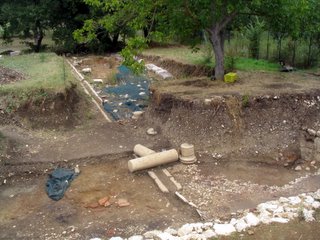
Faithful readers may remember that I was on a dig in Italy way back in August. Now that I'm home and starting to get my act together, I can offer some photographs from my travels. The site is Trebula Mutuesca, site of a Sabine sanctuary to the goddess Feronia, near the modern village of Monteleone Sabino, some ways north of Rome in the Sabine Hills. The excavation is in the area directly below the assumed site of the temple. A terrace wall (seen clearly in the first picture below) separates the temple area from a colonnaded approach (seen in the second picture).
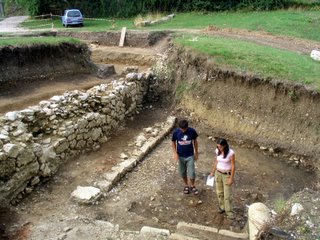
Interior designer by profession, archaeologist by passion, Leo uncovers a cache of five Roman Republican-era bronze coins: Lindsay, our site director Giulio, and Pierangelo take a break in the shade:

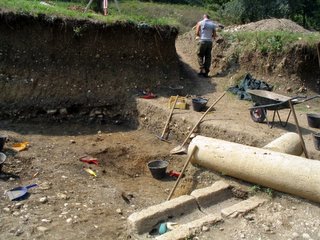
The apparatus of digging:
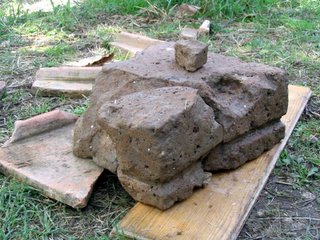
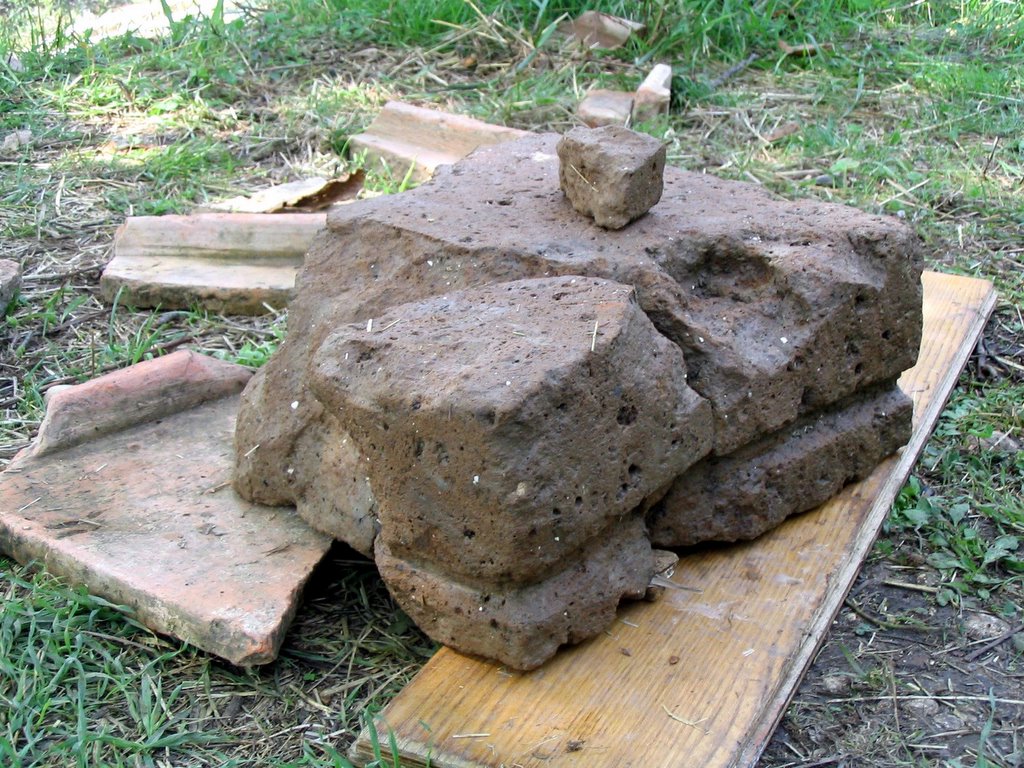
A single worked tufa block from a workshop at Falerii Veteres (modern Civita Castellana). Apparently used as fill during construction of the terrace and colonnade.
Giulio and Stefania inspect the site:
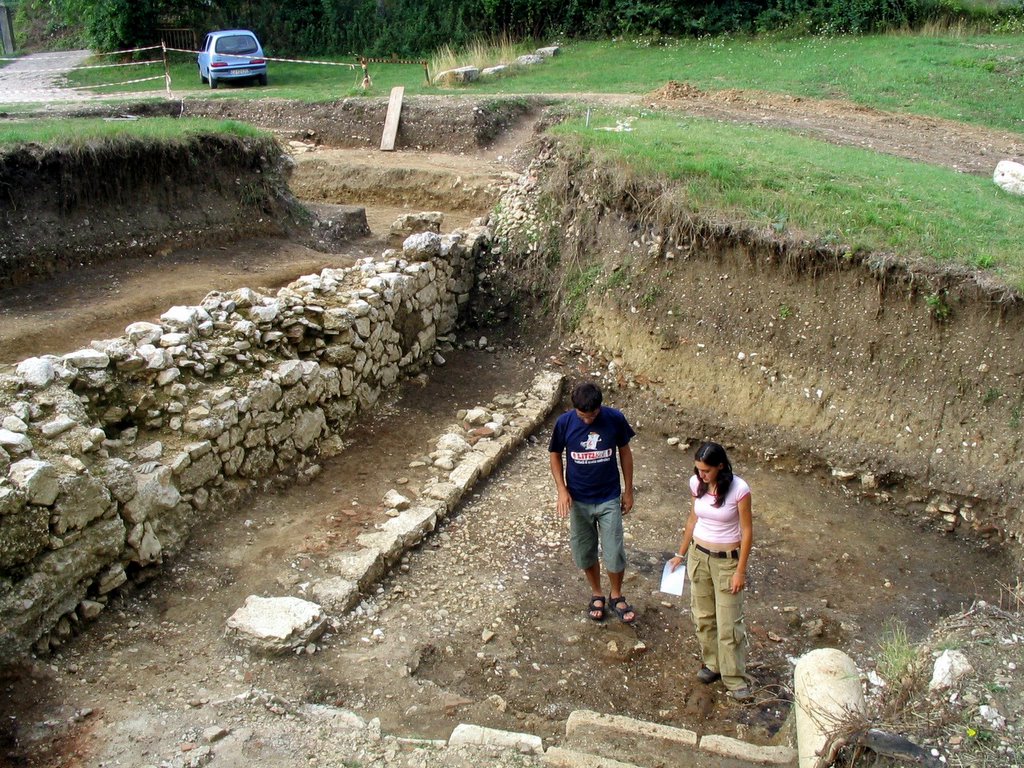
The terrace wall in the near foreground, the colonnade stretching away in the center, bordered on the left by a drain and the right by a wall.
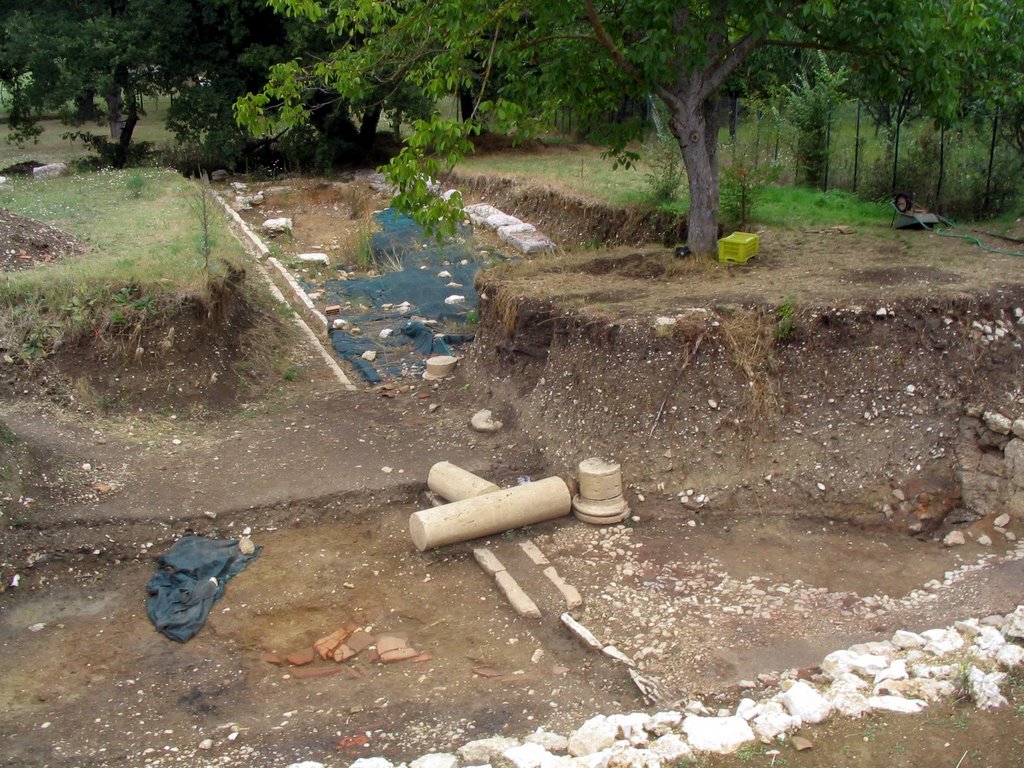
Interior designer by profession, archaeologist by passion, Leo uncovers a cache of five Roman Republican-era bronze coins:
 Lindsay, our site director Giulio, and Pierangelo take a break in the shade: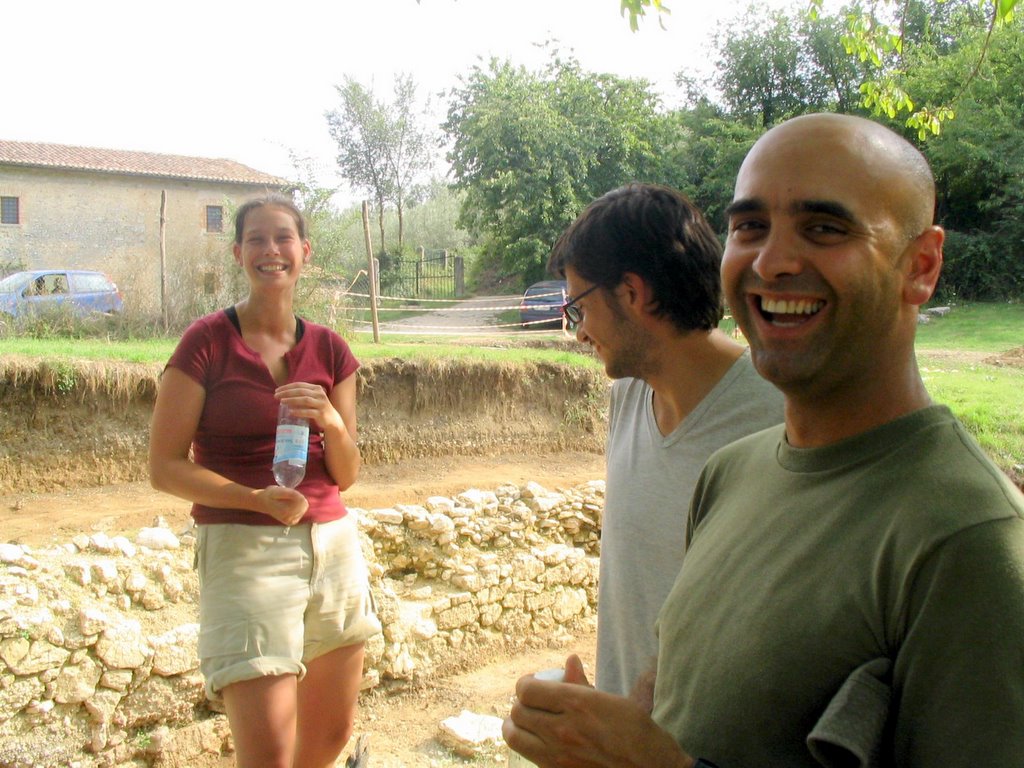
The apparatus of digging:
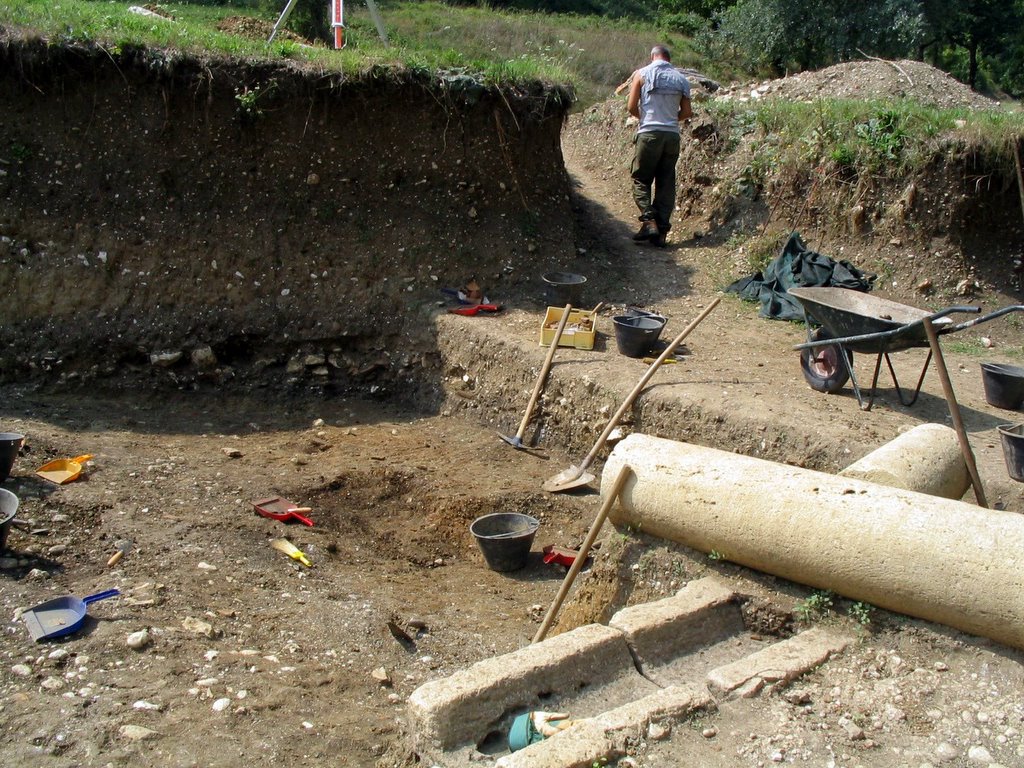
A single worked tufa block from a workshop at Falerii Veteres (modern Civita Castellana). Apparently used as fill during construction of the terrace and colonnade.
Thursday, November 17, 2005
Pilgrimage to Pietrabbondante
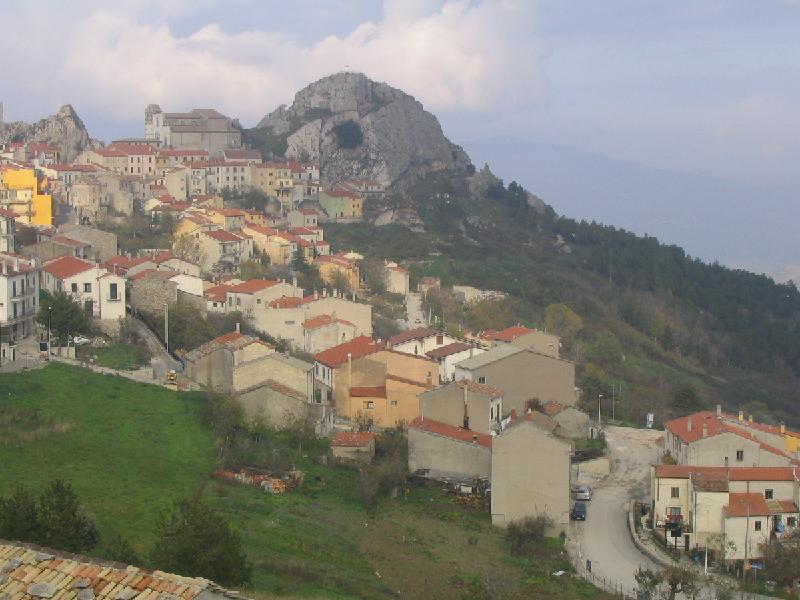
After spending the whole morning in Agnone, I caught a bus to Pietrabbondante around 2 pm. There are two big rocks that loom over the town (hence the name -- "abundant rocks"), and many smaller ones that do more lurking than looming. I descended from the bus in the main square, where a brazen Samnite warrior glared down upon me from his commemorative pedestal. The ancient site is a bit of a walk from the town, but it gives a good panoramic view:
By happy coincidence, the Samnites built their theater-temple complex on Mommsen Street:

It's generally agreed that Pietrabbondante, whatever its ancient name, was the foremost sanctuary and meeting place of the Samnites, regardless of tribe. It's likely that the legio linteata ("Linen Legion"), the crème de la crème of the Samnite fighting forces, was mustered here before its defeat at Aquilonia in 293 BCE.
This, the signs all say, is the greatest monument left by the Samnites:
 It's called "Temple B," and it dates to the end of the 2nd century BCE. The section of standing wall was reconstructed by archaeologists from fallen blocks. Below Temple B and on the same axis is a theater...
Idle thoughts
I'd like to visit Egypt -- the past few months I've been thinking a lot about Alexandria. But this is not the time.
Wednesday, November 16, 2005
Agnone Adventures
The day after Capua, Mario was going to Rome, so I had him drop me off in Isernia with the intention of catching a bus to Pietrabbondante. As it happened, there was no direct connection, so I went to Agnone first, which is a bit northwest of Pietrabbondante. I had about an hour to kill, and I knew there was a replica of the Oscan 'Table of Agnone' floating around (the original is in the British Museum), so I decided to investigate. At the first bar, I learned that a copy was housed in the church of , and thence I went. The church, however, was closed and locked; since it was only 9:30, I figured I'd try back after 10. In the meantime, I hoofed it to the centro storico looking for picturesque alleyways and maybe some spolia. I was passing the Municipio (town hall) and happened to glance through the open doorway. I spied a courtyard, and since antiquities are often to be found in such places, I stepped in. Two gentlemen strolling under the modest collonade asked my business, and I said I was looking for the reproduction of the Oscan tablet. It seemed I was in luck: there was one in the library upstairs. Upon arrival, however, it was not to be found. I was led down the hall to the office of some petty magistrate whose closet, as it happened, contained a replica in plastic. Just after getting the thing in my greasy little fingers, another man entered and informed us that the more true-to-life copy in bronze was being used for a class, and would I like to sit in? Shortly thereafter I was introduced to a class of about twenty ten-year olds as an "archaeologist from the United States very interested in the Oscan tablet" and shown a seat. The man teaching the class (who incidentally looked a bit like Rex Wallace) then turned to me, raised an eyebrow and said, "I know you." It turned out he was a journalist I'd been introduced to while helping Mario sell cheese at the Truffle Fair in S. Pietro Avellana a week prior... In any case, I got a 45-minute refresher course on Samnite history (in Italian, naturally). After the kids were dismissed, I got to take a look at the replica tablet and talked with Nicolà for quite some time.

His three great loves, it turns out, are the Samnites, tratturi, and horses. After picking up his kids from school, he drove me to the outskirts of town to show me the remains of the massive Samnite fortification walls:

We don't know the ancient name of Agnone; Nicolà suggested Aquilonia, site of the decisive Roman victory against the Samnite legio linteata in 293 BCE, but that seems to me to be more wishful thinking on his part. Whatever the case, he kept stressing the fact that the site has never been excavated and hinted that it might be a good place for my future work... I think it pained him to live so close to such a site and know so little about it. But it was time for me to catch another bus to Pietrabbondante, as the first one had departed hours before.


His three great loves, it turns out, are the Samnites, tratturi, and horses. After picking up his kids from school, he drove me to the outskirts of town to show me the remains of the massive Samnite fortification walls:

We don't know the ancient name of Agnone; Nicolà suggested Aquilonia, site of the decisive Roman victory against the Samnite legio linteata in 293 BCE, but that seems to me to be more wishful thinking on his part. Whatever the case, he kept stressing the fact that the site has never been excavated and hinted that it might be a good place for my future work... I think it pained him to live so close to such a site and know so little about it. But it was time for me to catch another bus to Pietrabbondante, as the first one had departed hours before.
Monday, November 14, 2005
Capua Recap
On the 8th of November I had the opportunity to visit Capua for several hours. The modern city is located on the site of ancient Casilinum, the river port of (pre-)Roman Capua, which is today Santa Maria Capua Vetere. As I was only tagging along while Mario went to Caserta a bit further on, I got there later than I'd hoped. Consequently I had only an hour to zoom through the rich and fabulous Museo Provinciale Campano before it closed for the afternoon and the day. When that's the case, I usually photograph everything and sort through it later; unfortunately, almost the entirety of the indoor galleries were No Foto Zones. Since I was the only person daft enough to be visiting at 12:30 in the middle of the week in the middle of November, I had my own personal "tour guide" -- read camera monitor. Be that as it may, it was still a great museum and I did take a few pictures:

A Roman mosaic full of young 'uns. Actually, a so-called "sacred choir" (makes me think of the Carmen Saecvlare) from the temple of Diana Tifatina. This was the picture that prompted the admonition "Vietato fare foto." Now, all those kids gotta come from somewhere...

...and that's where Mater Matuta comes in (though these date between the 6th and 2nd centuries BCE -- well before the mosaic). There are several galleries filled with statues of this sort -- I don't remember, but I believe there are over a hundred in the collection. They come from an Italic sanctuary nearby, and were probably ex voto dedications: an expecting mother would vow to set up a statue to the goddess if childbirth went easily. Numbers of children held range from one to twelve (seen here). Jumping forward again to Roman imperial times...

This is a detail of the left half of a relief, showing a man-powered crane lifting a column into place, the goddess Minerva in attendance. The inscription reads:
Lucceius Speculiaris redemptor prosceni fecit ex biso
"Lucceius Speculiaris the theater contractor made (this) after a vision."
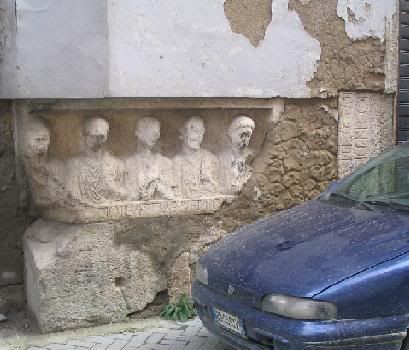
I didn't have time to see the iuvilas-inscriptions (in Oscan), which are by request only. In any case, I plan to come back and spend at least a day, maybe a week. I spent the rest of the day wandering up and down practically every street in the center of Capua. It's rich in spolia, that is, ancient inscriptions and architectural bits reused in later buildings. For example:

The church of S. Angelo in Audoaldis, which dates from the 11th c (CE). At the base of the tower you can see three or four reused Roman funerary stones.

The church of the Annunziata. Those familiar-looking blocks that form the base (and not only in front -- they stretch around the entirety of the rather long structure) come from the Roman amphitheater in S. Maria Capua Vetere. In fact, the entire modern city of Capua was built from the remains of that amphitheater. Indeed, no one in Europe has cut building stone since the fall of the Roman Empire. It's more efficient to go down to your friendly neighborhood Roman ruins and take what you need, plus it saves the environment by reducing the need for ugly quarries. Everybody's happy...

There are at least five pieces of spolia in this picture. Can you find them all? As the sun sets, farewell to Capua for now. Watch this space for exciting updates over the next several days.

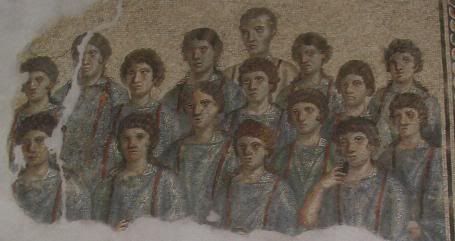
A Roman mosaic full of young 'uns. Actually, a so-called "sacred choir" (makes me think of the Carmen Saecvlare) from the temple of Diana Tifatina. This was the picture that prompted the admonition "Vietato fare foto." Now, all those kids gotta come from somewhere...
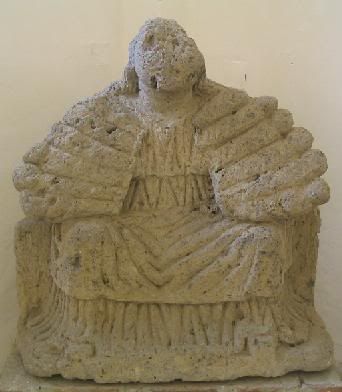
...and that's where Mater Matuta comes in (though these date between the 6th and 2nd centuries BCE -- well before the mosaic). There are several galleries filled with statues of this sort -- I don't remember, but I believe there are over a hundred in the collection. They come from an Italic sanctuary nearby, and were probably ex voto dedications: an expecting mother would vow to set up a statue to the goddess if childbirth went easily. Numbers of children held range from one to twelve (seen here). Jumping forward again to Roman imperial times...
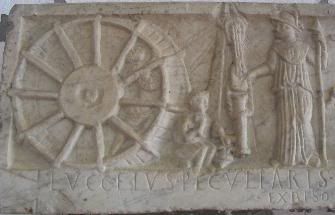
This is a detail of the left half of a relief, showing a man-powered crane lifting a column into place, the goddess Minerva in attendance. The inscription reads:
Lucceius Speculiaris redemptor prosceni fecit ex biso
"Lucceius Speculiaris the theater contractor made (this) after a vision."
I didn't have time to see the iuvilas-inscriptions (in Oscan), which are by request only. In any case, I plan to come back and spend at least a day, maybe a week. I spent the rest of the day wandering up and down practically every street in the center of Capua. It's rich in spolia, that is, ancient inscriptions and architectural bits reused in later buildings. For example:
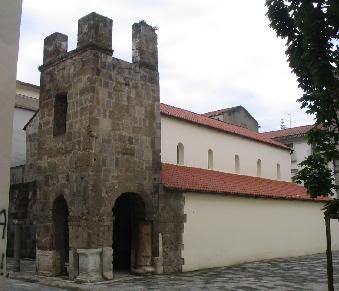
The church of S. Angelo in Audoaldis, which dates from the 11th c (CE). At the base of the tower you can see three or four reused Roman funerary stones.
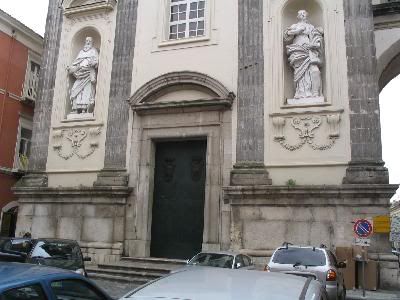
The church of the Annunziata. Those familiar-looking blocks that form the base (and not only in front -- they stretch around the entirety of the rather long structure) come from the Roman amphitheater in S. Maria Capua Vetere. In fact, the entire modern city of Capua was built from the remains of that amphitheater. Indeed, no one in Europe has cut building stone since the fall of the Roman Empire. It's more efficient to go down to your friendly neighborhood Roman ruins and take what you need, plus it saves the environment by reducing the need for ugly quarries. Everybody's happy...
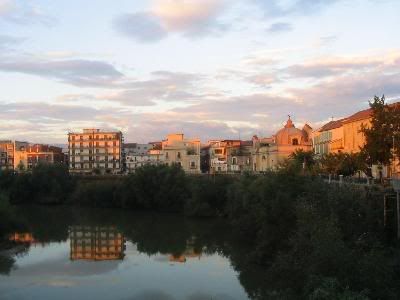
There are at least five pieces of spolia in this picture. Can you find them all? As the sun sets, farewell to Capua for now. Watch this space for exciting updates over the next several days.
Sunday, November 06, 2005
What's in your saddlebag?
When you ride off to put the sheep out to pasture, what do you carry at your side? You're looking at two to six hours of ovine overseeing in the remotest meadows of darkest Molise.
Water: 1.5 Liters of it. On a hot sunny day you need it all.
Lunch: Always delicious. Sometimes even better, like today, when I had two egg-and-cheese sandwiches, two apples and a janiform kiwi. The cheese is home-made (with milk from the farm down the road) scamorza --think dry mozzarella; actually, it's a bit too dry for my tastes, but excellent fried inside of an egg! Homemade sausages, bread from the wood-fired oven and my god, the ricotta is to die for (and I met a man who did, too). I don't even think it could be stuffed into manicotti shells: they would burst from the overwhelming goodness.
Reading materials: T.S. Eliot, Poesie. It's a Not-Quite-Complete Works (how could they omit the Four Quartets ?!) with facing-page Italian translation that I bought at the street fair in Larino many weeks ago. Sometimes Crime and Punishment, for the second time. I first read it at the last farm, in the archaic and unsigned Penguin Classics translation.
Instruments of composition: Notebook, stylish black LAMY (note that if you click on 'My LAMY', you get an error page: the correct address is this) fountain pen, utilitarian ballpoint in case of rain.
Instruments of melody: Pennywhistle in the key of D by Feadóg. I've been picking out some new songs, but I can't quite remember how 'Blackberry Blossom' goes.
Instruments of communication: cell phone -- so much for the romantic isolation of the shepherd in the mountains. Used to call for backup in case there are more than twenty-three sheep rustlers. I can handle any number less than that, with the three-to-five large and ferocious fluffy white Maremma sheepdogs and the yellow plastic shepherd's cane of righteousness that draws down lightning from Heaven.
Instruments of torture: Fuses to scare off menacing canines.
What's in your saddlebag, or would be, if you had one?
Water: 1.5 Liters of it. On a hot sunny day you need it all.
Lunch: Always delicious. Sometimes even better, like today, when I had two egg-and-cheese sandwiches, two apples and a janiform kiwi. The cheese is home-made (with milk from the farm down the road) scamorza --think dry mozzarella; actually, it's a bit too dry for my tastes, but excellent fried inside of an egg! Homemade sausages, bread from the wood-fired oven and my god, the ricotta is to die for (and I met a man who did, too). I don't even think it could be stuffed into manicotti shells: they would burst from the overwhelming goodness.
Reading materials: T.S. Eliot, Poesie. It's a Not-Quite-Complete Works (how could they omit the Four Quartets ?!) with facing-page Italian translation that I bought at the street fair in Larino many weeks ago. Sometimes Crime and Punishment, for the second time. I first read it at the last farm, in the archaic and unsigned Penguin Classics translation.
Instruments of composition: Notebook, stylish black LAMY (note that if you click on 'My LAMY', you get an error page: the correct address is this) fountain pen, utilitarian ballpoint in case of rain.
Instruments of melody: Pennywhistle in the key of D by Feadóg. I've been picking out some new songs, but I can't quite remember how 'Blackberry Blossom' goes.
Instruments of communication: cell phone -- so much for the romantic isolation of the shepherd in the mountains. Used to call for backup in case there are more than twenty-three sheep rustlers. I can handle any number less than that, with the three-to-five large and ferocious fluffy white Maremma sheepdogs and the yellow plastic shepherd's cane of righteousness that draws down lightning from Heaven.
Instruments of torture: Fuses to scare off menacing canines.
What's in your saddlebag, or would be, if you had one?
Friday, September 16, 2005
et ego in Samnio sum
I'm here, I'm alive, I'm loving it! (and I'm on dial-up). The country is beautiful, the people are nice, there's a bunch of ancient stuff around, the address I posted below works (takes about 5 days - thanks for the letters!). So far I've dug postholes, dug a ditch, mended a wheelbarrow, raked, hoed, picked tomatoes and zucchini... a fabulous land where the four major food groups are wine, pasta, tomatoes and olive oil! I feed the animals every evening - pigs, sheep, chickens, geese, dogs, and one horse -- and the barnyard cats get something, too. That's all for now, time for dinner!
Thursday, September 08, 2005

Today, Todi
Rain threatened early, but it held off. All the museums in Italy close for lunch, so when I arrived I had to do some wandering -- not that I minded much. I followed the "Via Mura Etrusche" in hopes of something, but something failed to materialize. I'm sure half the stones in the houses were first cut about 2500 years ago. Which reminds me of a slogan I thought of a couple of days ago... The Roman Empire®: Providing well-cut stone, lime, and architectural details to Italy and the rest of Europe for over 2000 years. I also saw walked the "Via del Teatro Antico," the only trace of said theater being the curving route of the street. Likewise at the end of the "Via del Anfiteatro Romano," although there was a section of wall more or less preserved.
The Museo in the Palazzo del Capitano was modest but respectable. No military equipment, alas, aside from some of the ubiquitous spear- and javelin- points. Their claim-to-fame seems to be a coin collection, which is mounted in rotating frames that must have seemed like a good idea at the time, but are a few degrees short of perfection. The coins end up facing down, which, with the way the lights are set up, leaves them shrouded in shadow.
I realize now that Angelo already blogged the Iguvian "battle hymn" I included a couple of posts ago... and he was more scholarly responsible to boot, including references that I utterly failed to note, plus his has nicer formatting.
The Museo in the Palazzo del Capitano was modest but respectable. No military equipment, alas, aside from some of the ubiquitous spear- and javelin- points. Their claim-to-fame seems to be a coin collection, which is mounted in rotating frames that must have seemed like a good idea at the time, but are a few degrees short of perfection. The coins end up facing down, which, with the way the lights are set up, leaves them shrouded in shadow.
I realize now that Angelo already blogged the Iguvian "battle hymn" I included a couple of posts ago... and he was more scholarly responsible to boot, including references that I utterly failed to note, plus his has nicer formatting.
Wednesday, September 07, 2005
A soggy Assisi
Well, I mentioned I might go to Todi today, but instead I found myself in Assisi, as one does... the bus is quite convenient. My first stop was the tomb of St. Francis, a crowded place; I was reminded that he is the patron saint of Italy, after all -- the man must be busy! I considered skipping the upper church, which is more richly decorated than the lower, in keeping with the ideas of the saint, but my Let's Go guide promised a room off to the side wherein I could view his tunic and sandals, so I bit the bullet and went up. No vestments in sight, unfortunately. Next stop was the Foro Romano in (where else?) the center of town. There's a bit of a lapidary collection, as all Italian towns seem to have. There are stones lining the halls of the excavated Forum. It's really nifty - the Roman level is a bit below the modern level, so it's all underground, walking along the original pavement and drainage ditches; half of the stairs up to the temple of Minerva are preserved. I hadn't realized that Assisi (Latin Assisium) had itself a monumental temple approach like those at Praeneste's Temple of Fortuna Primigenia and elsewhere... Assisi seems to have been the birthplace of the poet Propertius, and there's a "Casa di Properzio" lurking about somewhere, but I didn't encounter it. Lots of epigraphic evidence of the gens in the collection, though.
After the Forum, I went in search of the amphitheater, which turns out to have been consumed by the city; the Via dell' Anfiteatro Romano preserves the ovoid outline of the structure in much the same way that the streets outline Pompey's Theater in the Campus Martius in Rome. Then the rain came in, and I headed back to Perugia, where it continues to rain.
After the Forum, I went in search of the amphitheater, which turns out to have been consumed by the city; the Via dell' Anfiteatro Romano preserves the ovoid outline of the structure in much the same way that the streets outline Pompey's Theater in the Campus Martius in Rome. Then the rain came in, and I headed back to Perugia, where it continues to rain.
Tuesday, September 06, 2005
ukriper fisiu tutaper ikuvina
Spent the day in Gubbio (Latin Iguvium, Umbrian Ikuvium) today: took the bus from Perugia. I got there just at noon, which is when the museums close for lunch/siesta, so my first destination was the funivia (chair-lift, minus the chair) that ascends Monte Ingino to the Basilica of St. Ubaldo (whose pickled body lies atop the altar). Before I visited the basilica, though, I climbed the path behind it to the summit of the mount, the ukar fisiu (Fisian mount) of the Iguvine Tables (q.v. sub). It was a perfect day for it: the sun was out but not blazing, there was a gentle breeze; there were bees and butterflies and the buzzing of cicadas. There's a medieval-looking tower at the top, well-maintained, behind the large metal scaffold used every December to hold a giant star when the entire hill becomes the world's largest "Christmas tree." The view is spectacular, which combined with the thrill of being on a mountain sacred to the ancient Umbrians made for an awesome experience. There's a kind of blue thistle that grows on the top, apparently a plant much loved by snails: I saw them on nearly every stalk. Back down in the basilica, I also saw the three ceri ("candles"), enormous wooden pillars run through town and up to the basilica every May 15, in celebration of the saint. Some see in this run a survival of Umbrian rituals outlined in the Iguvine Tables.
The funivia closes between 1:15 and 2:30, but I didn't mind being stranded. I wandered around the three summits of Ingino and relaxed. After the mountain, the museums were underwhelming. The seven Iguvine Tables (Tavole Eugubine in Italian), which in themselves make up about 95% of the surviving records of the ancient Umbrian language, were mounted rather quaintly in glass-and-wood swivel cases in a room off to one side. The first tablet was even mounted upside-down... it should have been possible to swivel it to read correctly, but the mechanism was stuck. The light from the window reflecting on the glass made them a bit difficult to read, not to mention next to impossible to photograph. I know they've been professionally photographed (indeed, I bought a book with such photographs afterwards), but there's nothing quite like taking your own pictures of something. I suppose it's a sort of poor substitute for the experience of killing a man in battle and despoiling his corpse.
The tablets describe in great detail the purification of the entire state of Ikuvium and the lustration of the army, among other things. They are the basis of our understanding of the Umbrian culture, which materially is not sufficiently different from other Sabellic and Etruscan cultures to distinguish archaeologically.
The remainder of the two museums was mediocre. They're divided into the Museo Civico (which houses the Tables, some quotidian Latin inscriptions, glossy medieval ceramic and some paintings) and the Museo Archeologico (a case of Umbrian spearpoints, some bits of pottery, some more humdrum Latin, statuary bits and such). I also hit the Roman theater, nothing out of the ordinary, but well-enough preserved that they still put on performances in it. An Antiquarium nearby, which promised mosaics from the surrounding area, looked open but turned out to be locked. In any case, the trip up the mountain was worth the whole trip.
Tomorrow, I believe I'll head south to the city of Todi, which is mentioned in the Tables...
...totam tarsinatem trifo tarsinatem tuscom naharcom iabuscom nome /
totar tarsinater trifor tarsinater tuscer naharcer iabuscer nomner nerf sihitu ansihitu iouie hostatu /
anhostatu tursitu tremitu hondu holtu ninctu nepitu sonitu sauitu preplotatu preuilatu
the Tadinate (= of Todi) town, the Tadinate territory, the Tuscan, the Narcan, the Iapodic name, the veterans in office and not in office, the young men under arms and not under arms, of the Tadinate town, of the Tadinate territory, of the Tuscan, the Narcan, the Iapodic name: terrify them and cause them to tremble, defeat and ruin them, kill and annihilate them, wound and ulcerate them, shackle and fetter them!
The funivia closes between 1:15 and 2:30, but I didn't mind being stranded. I wandered around the three summits of Ingino and relaxed. After the mountain, the museums were underwhelming. The seven Iguvine Tables (Tavole Eugubine in Italian), which in themselves make up about 95% of the surviving records of the ancient Umbrian language, were mounted rather quaintly in glass-and-wood swivel cases in a room off to one side. The first tablet was even mounted upside-down... it should have been possible to swivel it to read correctly, but the mechanism was stuck. The light from the window reflecting on the glass made them a bit difficult to read, not to mention next to impossible to photograph. I know they've been professionally photographed (indeed, I bought a book with such photographs afterwards), but there's nothing quite like taking your own pictures of something. I suppose it's a sort of poor substitute for the experience of killing a man in battle and despoiling his corpse.
The tablets describe in great detail the purification of the entire state of Ikuvium and the lustration of the army, among other things. They are the basis of our understanding of the Umbrian culture, which materially is not sufficiently different from other Sabellic and Etruscan cultures to distinguish archaeologically.
The remainder of the two museums was mediocre. They're divided into the Museo Civico (which houses the Tables, some quotidian Latin inscriptions, glossy medieval ceramic and some paintings) and the Museo Archeologico (a case of Umbrian spearpoints, some bits of pottery, some more humdrum Latin, statuary bits and such). I also hit the Roman theater, nothing out of the ordinary, but well-enough preserved that they still put on performances in it. An Antiquarium nearby, which promised mosaics from the surrounding area, looked open but turned out to be locked. In any case, the trip up the mountain was worth the whole trip.
Tomorrow, I believe I'll head south to the city of Todi, which is mentioned in the Tables...
...totam tarsinatem trifo tarsinatem tuscom naharcom iabuscom nome /
totar tarsinater trifor tarsinater tuscer naharcer iabuscer nomner nerf sihitu ansihitu iouie hostatu /
anhostatu tursitu tremitu hondu holtu ninctu nepitu sonitu sauitu preplotatu preuilatu
the Tadinate (= of Todi) town, the Tadinate territory, the Tuscan, the Narcan, the Iapodic name, the veterans in office and not in office, the young men under arms and not under arms, of the Tadinate town, of the Tadinate territory, of the Tuscan, the Narcan, the Iapodic name: terrify them and cause them to tremble, defeat and ruin them, kill and annihilate them, wound and ulcerate them, shackle and fetter them!
Monday, September 05, 2005
Velzna and Perusia Bella
Not the Bellum Perusinum, mind you... I'm holed up in Perugia at the moment, though with more freedom of movement than Lucius Antonius when he did the same in 40 BCE.
Yesterday I rode out of Rome on the Orvieto (Etruscan Velzna) Express: Two museums and a tour in two hours. First, the Museo Archeologico Nazionale. They've only recently moved in to this location to the right of the Duomo, so they've got spiffy new cases and everything, although they could do with a bit more in the way of description. Then again, how much can you really say about case after case of bucchero? Some very nice terracotta sculpture from temples, but the best in show was split between two painted Etruscan tombs installed in the back and a full panoply, which actually came from one of the two tombs and therefore the prize need not be split at all. Made up of a bronze shield cover, greaves, muscle cuirass, and Montefortino-type helmet (others of this type). All the museums seem to insist on referring to these as "elmi di tipo Etrusco," when it seems rather to have been a Gaulish invention. Furthermore, many of them (including this one) show up with triple-disc cheek-pieces, which must be inspired by the triple-disc armor popular among the Samnites a bit farther south. Finally they, like many -- nay, most -- other museums had the helmet displayed backwards, with the brim of the neckguard sticking out in front. This type is also referred to as a "Jockey"-style, because of the brim -- but it was worn with the brim in back, unlike a jockey. I told one of the guides about this problem, so maybe they'll fix it....
The Museo Faina across from the Duomo in Orvieto was a wash for me... I have a confession to make: I'm sick and tired of Attic figured vases. Exekias this! Berlin Painter that! Bah humbug. I think it's because in my mind they represent the adoration of antiquity to art object, the tearing of form from context, the elevation of beauty to truth, the destruction of knowledge in pursuit of esthetics. Keats is wrong. But if you like such things it's a fabulous museum.
Next I caught a tour of some of the Etruscan tunnels underneath the city: wells and workshops, millstones for olive oil and such. Pretty neat, but nothing mind-blowing. The really impressive thing is that they stretch under the entire city and you only see a fraction on the tour. Then I jumped on a train for Perugia, skirted the edge of Lake Trasimene (now something of a resort, I gather) and got into the hostel just before curfew after a bus ride that was a real trip.
Today I wandered around Perugia, saw walls, gates, wall & gate museums... the Pozzo Etrusco, or "Etruscan Pit," formerly the city's main source of water. The Mus. Arch. Naz. in Perugia has scads of Etruscan burial urns, very nice, very nice. The Cippus Peruginus, one of the most important Etruscan inscriptions, dealing with a property agreement between two families, is tucked in at the end of a hallway with little fanfare, although it does rate a polychrome explanatory panel...
There's a nifty Greek parade helmet of Phrygian type from an Etruscan tomb, associated with three urns... I wasn't expecting more than that. I entered another room, and felt a bit like Dave in Kubrick's Odyssey: "My God, it's full of helmets... " Eleven, count 'em, eleven helmets and associated grave goods from various necropoleis around Perugia. Five Montefortinos (di tipo Etrusco, of course) plus four Chalcidian/Attic and four "of Italic type" that have many similarities with the Chalcidian. Of particular interest was a pair of greaves, not actually present, having been removed for restoration, bearing an inscription in Umbrian:
TVTAS
that is, "of the people/state," leading to speculation that the Umbrians had state-issued military equipment. This was certainly the case in Athens, at least after the Ephebic Reform of 335 BCE, but Athens and Umbria are two different places entirely. Finally, the greaves came from an Etruscan grave: perhaps spoils of war buried with their captor.
Updates will follow. Maybe pictures, too, though that doesn't seem likely in the near future, unfortunately. Also, I have my phone figured out -- except that I don't seem to have service, which probably means something's broken.
Yesterday I rode out of Rome on the Orvieto (Etruscan Velzna) Express: Two museums and a tour in two hours. First, the Museo Archeologico Nazionale. They've only recently moved in to this location to the right of the Duomo, so they've got spiffy new cases and everything, although they could do with a bit more in the way of description. Then again, how much can you really say about case after case of bucchero? Some very nice terracotta sculpture from temples, but the best in show was split between two painted Etruscan tombs installed in the back and a full panoply, which actually came from one of the two tombs and therefore the prize need not be split at all. Made up of a bronze shield cover, greaves, muscle cuirass, and Montefortino-type helmet (others of this type). All the museums seem to insist on referring to these as "elmi di tipo Etrusco," when it seems rather to have been a Gaulish invention. Furthermore, many of them (including this one) show up with triple-disc cheek-pieces, which must be inspired by the triple-disc armor popular among the Samnites a bit farther south. Finally they, like many -- nay, most -- other museums had the helmet displayed backwards, with the brim of the neckguard sticking out in front. This type is also referred to as a "Jockey"-style, because of the brim -- but it was worn with the brim in back, unlike a jockey. I told one of the guides about this problem, so maybe they'll fix it....
The Museo Faina across from the Duomo in Orvieto was a wash for me... I have a confession to make: I'm sick and tired of Attic figured vases. Exekias this! Berlin Painter that! Bah humbug. I think it's because in my mind they represent the adoration of antiquity to art object, the tearing of form from context, the elevation of beauty to truth, the destruction of knowledge in pursuit of esthetics. Keats is wrong. But if you like such things it's a fabulous museum.
Next I caught a tour of some of the Etruscan tunnels underneath the city: wells and workshops, millstones for olive oil and such. Pretty neat, but nothing mind-blowing. The really impressive thing is that they stretch under the entire city and you only see a fraction on the tour. Then I jumped on a train for Perugia, skirted the edge of Lake Trasimene (now something of a resort, I gather) and got into the hostel just before curfew after a bus ride that was a real trip.
Today I wandered around Perugia, saw walls, gates, wall & gate museums... the Pozzo Etrusco, or "Etruscan Pit," formerly the city's main source of water. The Mus. Arch. Naz. in Perugia has scads of Etruscan burial urns, very nice, very nice. The Cippus Peruginus, one of the most important Etruscan inscriptions, dealing with a property agreement between two families, is tucked in at the end of a hallway with little fanfare, although it does rate a polychrome explanatory panel...
There's a nifty Greek parade helmet of Phrygian type from an Etruscan tomb, associated with three urns... I wasn't expecting more than that. I entered another room, and felt a bit like Dave in Kubrick's Odyssey: "My God, it's full of helmets... " Eleven, count 'em, eleven helmets and associated grave goods from various necropoleis around Perugia. Five Montefortinos (di tipo Etrusco, of course) plus four Chalcidian/Attic and four "of Italic type" that have many similarities with the Chalcidian. Of particular interest was a pair of greaves, not actually present, having been removed for restoration, bearing an inscription in Umbrian:
TVTAS
that is, "of the people/state," leading to speculation that the Umbrians had state-issued military equipment. This was certainly the case in Athens, at least after the Ephebic Reform of 335 BCE, but Athens and Umbria are two different places entirely. Finally, the greaves came from an Etruscan grave: perhaps spoils of war buried with their captor.
Updates will follow. Maybe pictures, too, though that doesn't seem likely in the near future, unfortunately. Also, I have my phone figured out -- except that I don't seem to have service, which probably means something's broken.
Sunday, September 04, 2005
With my knapsack on my back
Got the wanderlust again... had an offer to work at the hostel where I've been staying, but I came to Italy to get out of Rome for a while. Tentative itinerary: Orvieto - Perugia - Gubbio - Ancona - Ascoli Piceno - Campobasso or Bari. The last two are options available for organic farming. I'm not sure which I'd prefer, but there's no reason I can't do one after another. Campobasso is in Molise, the real heart of ancient Samnium -- I've got the sanctuary at Piettrabondante in my sights.
In other news, my digicam was guasta, only showed black and purple lines on the LCD and took correspondingly trippy photos. If I were a modern artist, I might have appreciated it more, but it doesn't take very good pictures of inscriptions and helmets and the like. In any case, I googled the problem, discovered that it's a common one with this model (Canon PowerShot A70), which Canon denies any responsibility for, and can be temporarily fixed by applying a good whack with the palm of the hand. Apparently it's caused by a loose connection inside.
I've been passing my time with a lovely pair of Aussie fiancées who've spent the last two months travelling; last night they taught me how to play gin rummy while we swapped stories.
In other news, my digicam was guasta, only showed black and purple lines on the LCD and took correspondingly trippy photos. If I were a modern artist, I might have appreciated it more, but it doesn't take very good pictures of inscriptions and helmets and the like. In any case, I googled the problem, discovered that it's a common one with this model (Canon PowerShot A70), which Canon denies any responsibility for, and can be temporarily fixed by applying a good whack with the palm of the hand. Apparently it's caused by a loose connection inside.
I've been passing my time with a lovely pair of Aussie fiancées who've spent the last two months travelling; last night they taught me how to play gin rummy while we swapped stories.
Saturday, September 03, 2005
The dig is finished
We finished up cleaning pottery and photographing and documenting the site late Thursday afternoon, the day after a gigantic downpour turned the excavation into a mudbath. We were dogged by rain the whole two weeks I was there, but it wasn't so bad the first four, I've been told. As the rain poured down for the better part of an hour and Jove thundered with both great menace and great proximity, one of the supervisors, proclaimed in a rare English utterance, "The dig is finished." This the same fellow who on many occasions was heard to state, "We will never surrender!"...
That coin turned out to come from the 3rd c. BCE, and so worn that a ship's prow seemed like military standards -- in total contrast to the two pristine asses found the following day, which seemed to have been deposited by the hand of the moneyer himself! Hopefully I can soon post pictures. At the moment, the hostel is giving a free pizza-and-beer party to celebrate the opening of their new patio, and at 9 Elton John is giving a free concert at the Colosseum, so the rest must wait.
That coin turned out to come from the 3rd c. BCE, and so worn that a ship's prow seemed like military standards -- in total contrast to the two pristine asses found the following day, which seemed to have been deposited by the hand of the moneyer himself! Hopefully I can soon post pictures. At the moment, the hostel is giving a free pizza-and-beer party to celebrate the opening of their new patio, and at 9 Elton John is giving a free concert at the Colosseum, so the rest must wait.
Sunday, August 28, 2005
In Rome again for the day, and I'm headed to the Musei Capitolini.
At Trebula, we thought we were digging in 3c BCE Republican levels, but someone had to go and find a coin with the Parthian standards on the reverse, which weren't returned until the reign of Augustus... I'm having a wonderful time. Monteleone Sabino is a gem of a medieval hilltop village. This weekend was the Festival of San Giovanni, and twice a day they throw ciambelle -- more or less rock-hard bagels -- from a certain house in the town, while all who are able fight to catch them. My Italian is improving, though slowly.
At Trebula, we thought we were digging in 3c BCE Republican levels, but someone had to go and find a coin with the Parthian standards on the reverse, which weren't returned until the reign of Augustus... I'm having a wonderful time. Monteleone Sabino is a gem of a medieval hilltop village. This weekend was the Festival of San Giovanni, and twice a day they throw ciambelle -- more or less rock-hard bagels -- from a certain house in the town, while all who are able fight to catch them. My Italian is improving, though slowly.
Sunday, August 21, 2005
(Pretend this was posted a week ago, like the date implies)
I made it safe and sound to Rome...
I hit the Museo Nazionale Romano at the Palazzo Massimo last night after I got settled in at my hostel. This morning I revisited my old friend, the museum at the Terme di Diocleziano with its collection of early epigraphic materials and the proto-history of the Latin peoples. At noon I met my new friends Jasper and Christy, until then only online acquaintances, through the Roman Army Talk forum. We grabbed lunch and then did the Pantheon and the Palazzo Altemps with its rooms of fine (and frequently heavily-restored) statuary. After that they went back to their hotel, and I journeyed on to another friend, the Museo Nazionale Etrusco della Villa Giulia. Of course, there's a "No Foto" policy in effect there -- I had to be careful and take my time so as not to get caught until I'd gotten what I needed. There were certain things that were just untakeable -- it's really a museum best done with a large group, so the bulk of the party can create a distraction while you snap your prizes.
Tomorrow I head to Monteleone Sabino north of Rome for the TrebulaMutuesca dig... who knows when I'll next have internet access. Vale for now.
Subscribe to:
Posts (Atom)

