Showing posts with label antiquities trade. Show all posts

Friday, July 06, 2012

Coin collector busted

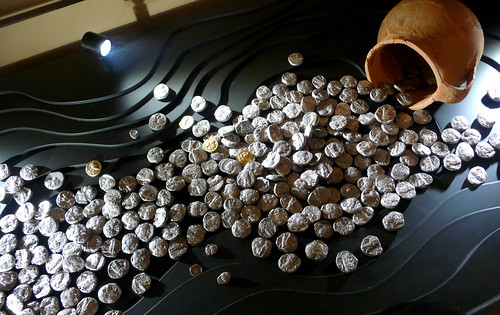
silver tetradrachms
A surgeon from Rhode Island--who had ties to RISD and Harvard--pleaded guilty to attempting to sell what he believed to be three silver tetradrachms looted from Sicily. He was secretly recorded saying, "I know this is a fresh coin. This was dug up a few years ago." The coins have since been examined and determined to be "exquisite, extraordinary forgeries, but forgeries nonetheless."
[Seattle Times; more background at Chasing Aphrodite]

Photo by flickr user Cåsbr; used under CC BY 2.0 license.

Friday, June 22, 2012

The Return of Dionysus


The Etruscan Black Figure kalpis/hydria by the Micali Painter in Toledo will be returned to Italy—the latest in a long line of returns to have come through the Medici warehouse. Reports differ as to the cooperation between US federal officials, the Toledo Museum of Art, and Italy.

[Looting Matters; Sandusky Register; Adnkronos]

Wednesday, September 29, 2010

6th c. BCE bronze statue seized near Nola


Carabinieri have seized an 80 cm-tall bronze statue from a healthcare provider in Cimitile, near Nola. The statue is described as being of a Greek warrior, similar to the "Etruscan Mars"-type, and dating to the 6th c. BCE. It's a shame there isn't a larger photo -- it looks a bit 'funny' to my eyes, although scholars from the Naples and Pompeii Soprintendenza have apparently confirmed its authenticity.

Sources: Il Nolano, Irpinia News

Sunday, October 04, 2009

Varia for October 4, 2009

In the Journals:
The latest issue (113.4) of the American Journal of Archaeology is available online, including:
-Elizabeth A. Meyer on "Writing Paraphernalia, Tablets, and Muses in Campanian Wall Painting" (abstract);
-Jeffrey Becker, Marcello Mogetto, and Nicola Terrenato uncover "A New Plan for an Ancient Italian City: Gabii Revealed" (abstract);
-John Oakley reviews the past decade in "Greek Vase Painting" (abstract);
-Bruce Hitchner's review article "Roman Republican Imperialism in Italy and the West" (link);
-and reviews of Archaeology and History in Sardinia from the Stone Age to the Middle Ages and Il Santuario dei Palici: Un centro di culto nella Valle del Margi.

Eric Poehler reviews Vedia Izzet, The Archaeology of Etruscan Society, in Rasenna 2.1 (2009).

This is a few years old, but I've just now run across it: M. Rubini, "A case of cranial trepanation in a Roman necropolis (Cassino, Italy, 3rd century BC)," International Journal of Osteoarchaeology 18.1 (2007): 95-99 (Abstract).

Banditry:
Returns to Italy of an Italian-American's collection of Medieval and later material from the Mezzogiorno (link).

The Carabinieri busted a wineshop in Ardea and turned up 500 pieces, including a 3rd c. BCE urn, a marble statue of a "Persian" Artemis, and Archaic Latial votive material (link).

Conferences:
Via David Meadows at RogueClassicism, I note that the conference entitled "Moisa Epichorios: Regional Music and Musical Regions" (Ravenna 1-3 October 2009) had a session on "Ancient Italy: Magna Grecia and Etruria":
Antonella Provenza (Palermo) – The paean and Apollo’s cult in Magna Graecia: music therapy among the Early Pythagoreans
Marina F.A. Martelli (Milan) – L’italica armonia di Senocrate di Locri
Carolyn Bowyer (London) – Etruscan trumpets

Posters:

Emiliano Li Castro (Viterbo) – Il cuore nascosto di Diòniso
Angela Bellia (Palermo) – Mito, musica e rito nelle raffigurazioni dei pinakes del Persephoneion di Locri Epizefirii (VI – V sec. a.C.)
Anna Di Giglio (Foggia) – Strumenti a percussione nel mondo greco e magno greco: testimonianze letterarie e iconografiche
Giancarlo Germanà (Syracuse) – Gli dèi, gli uomini e la musica: analisi di un tema iconografico nelle importazioni attiche a Gela tra il VI ed il V secolo a.C.

Also from RogueClassicism, I note that the conference "OIKOS FAMILIA The Family in Antiquity: Framing the discipline in the 21st Century" (Gothenburg, 5-7 November 2009) will have a session on "Etruscan and Pre-Roman Family":
Key note addres: Marjatta Neilsen: Etruscan familes – the dead and the living
Jenny Högström Berntson: Women, Children and Votives in Magna Graecia
Elisa Perego: Iron Age and early Roman Veneto
Rafael Scopacasa: Familial Segregation and Communal Drinking in Ancient Appenine Italy

Monday, March 16, 2009

Sexing Up the Antiquities Market?

Over the past week or two, a certain antiquities gallery has begun sending out email updates titled "Can YOU find the antiquity?" with a link to an object for sale. The first object to be so treated was this pre-Dynastic Egyptian vessel; the photo showing it next to a pair of shapely female legs has since been removed, presumably to make way for number 2. The conceit, based on the responses provided-- e.g. "I couldn't see the antiquity and I stared at the picture for a good 10 minutes"; "This must be a joke; there is no antiquity in this picture"-- is that we are to be distracted by the other objet d'art present in the photo.

My objection is not to do with any notions of prudishness; the pictures involved are not terribly risqué. Rather, I object to promoting the sale of unprovenanced antiquities (I admit I don't know when the late William Bowmore, O.B.E., collected the piece) through association with attractive women. That's a clumsy way to put it, I know, but it'll have to do for now.

Perhaps it's something to do with the economy, I don't know. Are antiquities no longer sexy enough to sell on their own appeal? Are they slipping relative to fur coats (Carlos Picón wants one) and in need of a makeover?