Showing posts with label Magna Graecia. Show all posts

Saturday, June 30, 2012

Beyond Vagnari: new themes in the study of south Italy in the Roman period

International colloquium, University of Edinburgh, 26-28 October 2012
The School of History, Classics and Archaeology is pleased to host an international colloquium on the study of south Italy in the Roman period that will bring together leading archaeologists and historians of ancient Lucania, Apulia and Bruttium. The conference will take place in Edinburgh on 26-28 October 2012.

Following the publication of the excavations at Vagnari by Prof. Alastair Small, an honorary research fellow in the School of History, Classics and Archaeology, the workshop is intended to explore further the historical development of south Italy in Roman imperial times.


Confirmed speakers and chairs include Maureen Carroll (Sheffield), Marcella Chelotti (Bari), Amanda Claridge (RHUL), Michael Crawford (UCL), Helga di Giuseppe (Rome), Lisa Fentress (Rome), Helena Fracchia (Alberta), Maurizio Gualtieri (Perugia), Edward Herring (Galway), Philip Kenrick (Oxford), Maria Luisa Marchi (Foggia), Myles McCallum (Halifax), Tracy Prowse (McMaster), Nicholas Purcell (Oxford), Pasquale Rosafio (Lecce), Christopher Smith (Rome), Hans VanderLeest (Mount Allison), Domenico Vera (Parma), Giuliano Volpe (Foggia), and Douwe Yntema (Amsterdam).

Beyond Vagnari introduction; program and Call for Posters (due 1 September) here.

South Italy, Sicily and the Mediterranean: Cultural Interactions Conference

17th - 21st July 2012
La Trobe University
Melbourne, Australia
This conference will focus on the movement of people and interactions of culture in the Mediterranean region of Southern Italy and Sicily from antiquity until the present. The program will include exhibitions at the Hellenic Museum and the Museo Italiano of ancient Greek vases from Southern Italy and Sicily as well as other pieces from the collection of the Trendall Research Centre...

This inter-disciplinary conference seeks to foster critical analysis of geographical and chronological interconnections in Southern Italy and Sicily. Consideration of cultural interaction, population movements, and changing religious and philosophical ideas over a period of approximately 3000 years will prompt scholarly discussion around continuity and change over time in this region of the Mediterranean.

Program and abstracts available via the conference website. [I note that La Trobe has a TARDIS: Teaching Archaeological Research Discipline In Simulation.]

[Via rogueclassicism and the Classicists list]

Tuesday, November 17, 2009

'Beyond Magna Graecia' conference follow-up


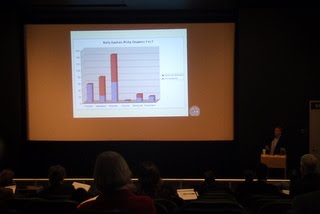
This past weekend I was in Cincinnati for the Semple Symposium "Beyond Magna Graecia: New Developments in South Italian Archaeology. The Contexts of Apulian and Lucanian Pottery." Turnout was quite frankly higher than I'd been expecting, possibly somewhere in the neighborhood of 100 -- the photo below, taken Friday around midday, doesn't really do it justice. As usual, it was good to catch up with a couple of friends and meet others for the first time.

So, have new developments taken us 'beyond Magna Graecia'? There was plenty of evidence on hand for a widespread corrective necessary in this A.T. period (After Trendall), to put South Italian Red Figure back into its contexts (Trendall frequently omitted such information in his publications, even when it was certainly known). Some of Trendall's attributions were questioned, painters divided and joined, but one of the take-aways was to what an extent the field still relies on his monumental works. In any case, those contexts turn out more often than not to be non-Greek. Moving from Messapia, up to Daunia, and then back through Peucetia, the papers provided a sensitive analysis of the way Red Figure ceramics were used and produced by both non-Greek and Greek inhabitants of Apulia, responding to local needs and customs.

Ted Robinson speaks on archaeometric analysis.

The art historical element, strong in traditional Anglophone scholarship on South Italy, was present at the conference, but it was clear that no one would today dispense with the archaeological context of the artifact class in question. Ted Robinson's work on archaeometric analysis is certainly a step in the right direction, and the wider exposure of information from ongoing excavations in Italy is welcome. That the work of Italian researchers is not more widely known is a problem, and one that is only part due to the difficulty of obtaining foreign publications. I hope that the published proceedings will do their part to lead a new generation of American students to learn Italian -- honestly, if one has already learned Latin and French, it shouldn't be that difficult!

Several speakers emphasized the continued importance of Taranto, so as not to throw the baby out with the Greek bathwater. But, despite some tantalizing new data, there is still no certainly clinching evidence of Red Figure production at Taranto, at least not of the sort found at Metaponto, likely though it may be.

The conference was organized with the express intent of publishing proceedings as an up-to-date state-of-the-field in English; the last few Semple Symposia have had an average of three years from lectern to library, so look for a volume in 2012, maybe -- perfect vacation reading for the apocalypse?

Thanks to all at Cincinnati.