Showing posts with label Lucania. Show all posts

Sunday, November 10, 2024

Museum Capsule Reviews (and thoughts) 3: Venosa

Photo of the first gallery in the archaeological museum of Venosa, located in the interior of a castle with several display cases.
The beginning of the first gallery

Yesterday I visited the Museo Archeologico Nazionale "Mario Torelli" in Venosa for the first time. I'd heard good things about it, and it lived up to the hype. 

I usually don't go in much for interactives, touch screens, and the like, but as I'd been advised that they were well done here, I gave them a go. I don't know how they fare with the general public (I saw no one else in the museum during the three or so hours I spent there on a Saturday morning), but I did find them useful in communicating information in more depth than was presented in the wall panels, and the occasional animations were interesting (I was surprised to see that the fellow holding the survey rod for the Roman gromaticus was wearing a Samnite tunic and belt, though on further reflection maybe I shouldn't be surprised; the Grand Bargain was played out also at this scale... While we're on the subject of screens and Samnites, I did notice an image of the famous tomb painting of returning warriors from Nola misattributed to Paestum). There were subtle noises from the screens, but fortunately nothing overly grating.

Samnite on the left

The museum in Venosa is conceived as a unit with the archaeological museum of Melfi, with the latter concentrating on the pre-Roman archaeology of the area, while the former begins just prior to the arrival of the Romans and continues through to the early modern period.

One aspect of the wall panels that I found peculiar was the frequent inclusion of a photograph of an artifact that was displayed in a case immediately beside it. I suppose this could aid accessibility?

There are some stand-out artifacts for the student of Roman Italy, such as the inscribed stones from Bantia interpreted by the museum's honorand Mario Torelli as a templum augurale, and the small fragment of the Tabula Bantina that isn't in Naples (in Venosa the Oscan side of the tablet is given pride of place, though the Latin side can be observed, albeit very partially hidden by the supports; this contrasts with the principal fragment's installation in Naples, which displays the—from my point of view—less interesting Latin side, with the Oscan side totally unobservable against the wall).

A fragmentary bronze tablet with a Latin inscription resting against two clear plastic supports.
Tabula Bantina, Venosa fragment, Latin side

The whole historic center of Venosa is dotted with Roman-period spolia, and the castle that houses the museum is no exception. At one point in the Imperial gallery, a couple of bits of spolia, totally unmentioned, can be seen in the wall behind a musealized and labeled inscription. This seems like a missed opportunity to draw connections between the exhibit and its host structure, as well as to talk about the process of spoliation and reuse so locally evident:

Photo of the museum with a Latin inscription and built into the interior castle wall behind it two fragments of other Roman monuments.
Silent spolia

It's refreshing to see the exhibit continue through to the early modern period. At least here, there's some connection with the castle, two cannon barrels punctuating the end of the exhibit. A lot more I could say, but I have to get up early tomorrow morning; back to fieldwork at Rossano di Vaglio.

Saturday, June 30, 2012

Beyond Vagnari: new themes in the study of south Italy in the Roman period

International colloquium, University of Edinburgh, 26-28 October 2012
The School of History, Classics and Archaeology is pleased to host an international colloquium on the study of south Italy in the Roman period that will bring together leading archaeologists and historians of ancient Lucania, Apulia and Bruttium. The conference will take place in Edinburgh on 26-28 October 2012.

Following the publication of the excavations at Vagnari by Prof. Alastair Small, an honorary research fellow in the School of History, Classics and Archaeology, the workshop is intended to explore further the historical development of south Italy in Roman imperial times.


Confirmed speakers and chairs include Maureen Carroll (Sheffield), Marcella Chelotti (Bari), Amanda Claridge (RHUL), Michael Crawford (UCL), Helga di Giuseppe (Rome), Lisa Fentress (Rome), Helena Fracchia (Alberta), Maurizio Gualtieri (Perugia), Edward Herring (Galway), Philip Kenrick (Oxford), Maria Luisa Marchi (Foggia), Myles McCallum (Halifax), Tracy Prowse (McMaster), Nicholas Purcell (Oxford), Pasquale Rosafio (Lecce), Christopher Smith (Rome), Hans VanderLeest (Mount Allison), Domenico Vera (Parma), Giuliano Volpe (Foggia), and Douwe Yntema (Amsterdam).

Beyond Vagnari introduction; program and Call for Posters (due 1 September) here.

South Italy, Sicily and the Mediterranean: Cultural Interactions Conference

17th - 21st July 2012
La Trobe University
Melbourne, Australia
This conference will focus on the movement of people and interactions of culture in the Mediterranean region of Southern Italy and Sicily from antiquity until the present. The program will include exhibitions at the Hellenic Museum and the Museo Italiano of ancient Greek vases from Southern Italy and Sicily as well as other pieces from the collection of the Trendall Research Centre...

This inter-disciplinary conference seeks to foster critical analysis of geographical and chronological interconnections in Southern Italy and Sicily. Consideration of cultural interaction, population movements, and changing religious and philosophical ideas over a period of approximately 3000 years will prompt scholarly discussion around continuity and change over time in this region of the Mediterranean.

Program and abstracts available via the conference website. [I note that La Trobe has a TARDIS: Teaching Archaeological Research Discipline In Simulation.]

[Via rogueclassicism and the Classicists list]

Thursday, April 21, 2011

Workshop: Social change in Early Iron Age Southern Italy


This conference looks like a lot of fun...

May 5-6, 2011 - workshop internazionale
Koninklijk Nederlands Instituut Rome

Dinamiche sociali nell’Italia meridionale della Prima Età del Ferro /
Social change in Early Iron Age Southern Italy

Thursday, April 22, 2010

Torre di Satriano back in the news


The mid-6th century BCE building at Torre di Satriano in Lucania is back in the news; we last heard about it in January, when the news-worthy angle was calling it a 'palace'. This time around it's the news that the 'temple or palace' has got a pre-fab roof system. The Telegraph and other English-language sources have the idea that the whole building, stones and all, was so built, but I believe that the inscriptions are limited to the terracotta elements of the roof system (for which see the informative Unibas site, images numbers 15-20 and 32-60). The inscriptions on are in Laconian-Tarentine characters of the 6th c., matching the date proposed on the basis of the decoration.


The whole system is similar to one known from Serra di Vaglio, loc. Braida, which may come from the same moulds. The mid-6th century structure at Torre di Satriano was transformed in the late 6th/early 5th century and re-roofed with anthemia and lion-head waterspouts of Tarentine moulds. In plan, the structure seems to a have a megaron-like element, to which is appended a colonnaded porch on the side that shifts the entrance to the short axis (see, e.g. fig. 34).

[ANSA; Telegraph; Times Online; Vancouver Sun]

Previous coverage at Tria Corda:
6th c. BCE Palace at Torre di Satriano

Sunday, January 17, 2010

6th c. BCE Palace at Torre di Satriano


Reports in the press on this past season's fieldwork at Torre di Satriano in Basilicata announce the discovery of a "palace" there [ANSA; Il Quotidiano della Basilicata; La Gazzetta del Mezziogiorno]--though it's been known at least since 2008. The megaron structure (picture above) dates to the mid 6th c. BCE; four contemporary tombs were discovered nearby. The environs of Satriano have been investigated off and on over the past 60-odd years, from some 30 tombs in 1943, to Ross Holloway's team in 1966 and 1967, and the 1986-88 excavations by the Soprintendenza. The current work is a joint effort between the University of Basilicata under Massimo Osanna and Queen's University under Fabio Colivicchi. There's a thorough page on Satriano at the Unibas site, with good photos (if sometimes a bit small). The structure sported a continuous terracotta frieze of horsemen, a tiled roof, and a terracotta sphinx on the roof beam. A second phase of the structure dates to the late 6th or early 5th c.

Some of the nicer material from the excavation was on display at the Museo Archeologico Nazionale della Basilicata "Dinu Adamesteanu" in Potenza for the special exhibit Principi ed Eroi della Basilicata Antica: immagini e segni del potere tra VII e V secolo a.C., which I happened to catch back in July of 2009; here's a section of the frieze with the sphinx...


And below, an Ionic cup and two fragments of Athenian Black Figure:

Tuesday, November 17, 2009

'Beyond Magna Graecia' conference follow-up


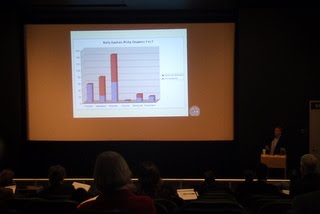
This past weekend I was in Cincinnati for the Semple Symposium "Beyond Magna Graecia: New Developments in South Italian Archaeology. The Contexts of Apulian and Lucanian Pottery." Turnout was quite frankly higher than I'd been expecting, possibly somewhere in the neighborhood of 100 -- the photo below, taken Friday around midday, doesn't really do it justice. As usual, it was good to catch up with a couple of friends and meet others for the first time.

So, have new developments taken us 'beyond Magna Graecia'? There was plenty of evidence on hand for a widespread corrective necessary in this A.T. period (After Trendall), to put South Italian Red Figure back into its contexts (Trendall frequently omitted such information in his publications, even when it was certainly known). Some of Trendall's attributions were questioned, painters divided and joined, but one of the take-aways was to what an extent the field still relies on his monumental works. In any case, those contexts turn out more often than not to be non-Greek. Moving from Messapia, up to Daunia, and then back through Peucetia, the papers provided a sensitive analysis of the way Red Figure ceramics were used and produced by both non-Greek and Greek inhabitants of Apulia, responding to local needs and customs.

Ted Robinson speaks on archaeometric analysis.

The art historical element, strong in traditional Anglophone scholarship on South Italy, was present at the conference, but it was clear that no one would today dispense with the archaeological context of the artifact class in question. Ted Robinson's work on archaeometric analysis is certainly a step in the right direction, and the wider exposure of information from ongoing excavations in Italy is welcome. That the work of Italian researchers is not more widely known is a problem, and one that is only part due to the difficulty of obtaining foreign publications. I hope that the published proceedings will do their part to lead a new generation of American students to learn Italian -- honestly, if one has already learned Latin and French, it shouldn't be that difficult!

Several speakers emphasized the continued importance of Taranto, so as not to throw the baby out with the Greek bathwater. But, despite some tantalizing new data, there is still no certainly clinching evidence of Red Figure production at Taranto, at least not of the sort found at Metaponto, likely though it may be.

The conference was organized with the express intent of publishing proceedings as an up-to-date state-of-the-field in English; the last few Semple Symposia have had an average of three years from lectern to library, so look for a volume in 2012, maybe -- perfect vacation reading for the apocalypse?

Thanks to all at Cincinnati.

Sunday, September 13, 2009

Conference: Beyond Magna Graecia


Beyond Magna Graecia:
New Developments in South Italian Archaeology

The Contexts of Apulian and Lucanian Pottery

November 12-14, 2009,
University of Cincinnati
A Semple Symposium

(Or, "Apulian Red Figure: more than just a pretty vase"...?)

Free and open to the public. More info at the UC site