Tuesday, November 24, 2009

Exhibits ending and beginning


If you were in Rome on November 20 you might have seen the Ara Pacis brilliantly lit up in its original colors by a fancy projection system. [ANSA]

If you're in Rome between now and December 13, you still have time to catch the exhibit Etruschi e Fenici sul mare: da Pyrgi a Cartagine ("Etruscans and Phoenicians at sea: from Pyrgi to Carthage") at the Vittoriano. [via Archaeogate; Provincia di Roma]

If you time it right, you can then head up to Bologna for the opening on December 12 of the exhibit Cavalieri etruschi dalle Valli al Po: Tra Reno e Panaro, la valle del Samoggia nell’VIII e VII sec.a.C. ("Etruscan horsemen from the Vales to the Po: Between Reno and Panaro, the Valle del Samoggia in the 8th and 7th c. BCE"), which runs until April 5, 2010. [photo above; via Archaeogate; press release; exhibit page]

And another if: the Museo delle navi antiche di Pisa might partially open to the public in April 2010. [via Storia Romana].

Wednesday, November 18, 2009

Don't Eat That, Elmer, That's Horse [Finch]!

There's been some controversy about a free distribution of On the Origin of Species with a "special" introduction; in any case, I gladly note the existence of a counterpoint group, "Don't Diss Darwin," with the tongue–in–cheek motto "noli fringillidas edere!" I had to look up the middle word, which as it turns out is the scientific Latin term for the family of finches, of course. The Classical form on which it's based is fringilla, -ae which the OLD tells me means "a song-bird, perhaps the chaffinch," attested in Varro and Festus (usually a bad sign), and Martial in a form fringillus, cf. Greek φρυγίλος. This latter occurs once in Classical Greek—where else?—the Birds of Aristophanes, 763, where it gets trotted out for a pun with Φρὺξ.

For what it's worth, there was a Cistercian monastery of S. Angelo in Fringillis (or Frigido) founded in Calabria in 1220, as well as a Fringilla: some tales in verse of 1895 by
Richard Doddridge Blackmore (famous today for his novel Lorna Doone), with the doddgy lines quorsum haec? non potui qualem / Philomela querelam; sed / fringilla velut pipitabunda vagor adorning the frontispiece. The illustrations are passerable, but the verse, oh, the verse! The one snippet ought to be enough; the rest is available freely at Google Books:
God is with us ; He shall speed us ;
Or (if this vile crew impede us)
Let some light into their brain,
By the sword of Tubal Cain.
-Lita of the Nile, Part I, XII

All that said, Wikipedia informs me that Darwin's finches are now placed in the tanager family of Thraupidae rather than the true finch family, Fringillidae. θραυπίς occurs only in Aristotle History of Animals 592b30 and refers to a small bird. Such is the nature of scientific Latin. So noli fringillas edere, noli thraupidas edere, noli θραυπίδας edere, as you like.

Heroes and villains, dogs and goats


The Museo Civico Archeologico di Fara in Sabina [excellent website] has mounted an exhibit entitled "Un Re, un Guerriero, un Eroe | La tomba 36 della necropoli sabina di Eretum." The three-chambered Tomb 36 of the Colle del Forno necropolis, discovered in 2005, contained the burial of a Sabine potentate of the late 6th c. BCE, his ashes deposited in a wooden box draped with a gold-embroidered cloth, along with his arms, bronze cauldrons, a terracotta throne, a chariot and sacrificed horses. It's certainly worth noting here that the contents of another rich tomb of the same necropolis, Tomb XI [another excellent website], dating to the early 7th c. BCE, are currently on display in the Ny Carlsberg Glyptotek in Copenhagen, having been looted in the 1970s and passed through the hands of the infamous Robert Hecht [NYTimes (16/3/2009); Looting Matters (17/3/09); Iconoclasm (18/5/09); Iconoclasm (18/10/09)].

Apropos of the previous post, a 4th-3rd c. BCE Greek necropolis was discovered in the territory of Castellaneta (Ta), unfortunately already looted [Corriere del Mezzogiorno; AGI]

Speaking of looting, SafeCorner reports on the "L'Arma per L'Arte 1969-2009" exhibit at Castel Sant'Angelo, celebrating 40 years of the Comando Carabinieri per la Tutela Patrimonio Culturale.

Cultural patrimony laws got you down? Now you can get your very own legal memento of a trip to Italy-- adopt a stray dog from Pompeii, via the "(C)Ave Canem" project [News in English; official Italian site].

....and, the mostly* gratuitous link of the day:
Extinct Goat Tried out Reptilian, Cold-Blooded Living

*(it has to do with adapting to a small Mediterranean island -- Majorca, in this case)

Tuesday, November 17, 2009

'Beyond Magna Graecia' conference follow-up


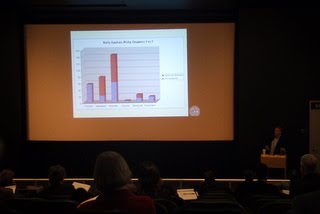
This past weekend I was in Cincinnati for the Semple Symposium "Beyond Magna Graecia: New Developments in South Italian Archaeology. The Contexts of Apulian and Lucanian Pottery." Turnout was quite frankly higher than I'd been expecting, possibly somewhere in the neighborhood of 100 -- the photo below, taken Friday around midday, doesn't really do it justice. As usual, it was good to catch up with a couple of friends and meet others for the first time.

So, have new developments taken us 'beyond Magna Graecia'? There was plenty of evidence on hand for a widespread corrective necessary in this A.T. period (After Trendall), to put South Italian Red Figure back into its contexts (Trendall frequently omitted such information in his publications, even when it was certainly known). Some of Trendall's attributions were questioned, painters divided and joined, but one of the take-aways was to what an extent the field still relies on his monumental works. In any case, those contexts turn out more often than not to be non-Greek. Moving from Messapia, up to Daunia, and then back through Peucetia, the papers provided a sensitive analysis of the way Red Figure ceramics were used and produced by both non-Greek and Greek inhabitants of Apulia, responding to local needs and customs.

Ted Robinson speaks on archaeometric analysis.

The art historical element, strong in traditional Anglophone scholarship on South Italy, was present at the conference, but it was clear that no one would today dispense with the archaeological context of the artifact class in question. Ted Robinson's work on archaeometric analysis is certainly a step in the right direction, and the wider exposure of information from ongoing excavations in Italy is welcome. That the work of Italian researchers is not more widely known is a problem, and one that is only part due to the difficulty of obtaining foreign publications. I hope that the published proceedings will do their part to lead a new generation of American students to learn Italian -- honestly, if one has already learned Latin and French, it shouldn't be that difficult!

Several speakers emphasized the continued importance of Taranto, so as not to throw the baby out with the Greek bathwater. But, despite some tantalizing new data, there is still no certainly clinching evidence of Red Figure production at Taranto, at least not of the sort found at Metaponto, likely though it may be.

The conference was organized with the express intent of publishing proceedings as an up-to-date state-of-the-field in English; the last few Semple Symposia have had an average of three years from lectern to library, so look for a volume in 2012, maybe -- perfect vacation reading for the apocalypse?

Thanks to all at Cincinnati.

Wednesday, November 11, 2009

Magazine online: ArcheoMolise


The Centro Europeo di Ricerche Preistoriche in Isernia (Molise) is hosting the new magazine ArcheoMolise, whose issues now number three. Available here in .rar and .zip formats, which unpack into pdfs. The journal focuses on the archaeology of Molise, with forays into Colombia, and its chronological scope ranges from the Paleolithic through the present day, as can be seen from the contents:

(Aprile/Giugno 2009, No. 0 - Anno I):
- Antonella Minelli et al., 'Isernia La Pineta. Il sito preistorico alla luce delle recenti acquisizioni'
- Ettore Rufo, '40.000 anni fa a Rocchetta a Volturno. Gli artigiani neandertaliani di Grotta Reali'
- Chiara Santone, 'Il ripostiglio di Vinchiaturo. Alcune osservazioni.'
- Sandra Guglielmi & Petronilla Crocco, 'La necropoli di Ripatagliata. Studio antropologico dei resti scheletrici umani rinvenuti a Guglionesi'
- Karicla Scarcella, 'Il carnevale di Cercepiccola. Mesi, stagioni e drammi carnascialeschi'
- Michele Fratino, 'La catapulta sannitica di Casalbordino'


(Giulio/Settembre 2009, No. 1 - Anno I):
- Marta Arzarello et al., 'I bifacciali di Monteroduni. Un sito acheuleano di occupazione?'
- Michele Raddi, 'L'alta valle del Volturno. Insediamenti tardo antichi e medioevali'
- Walter Santoro, 'S. Croce di Sepino. Un Eigenkloster della valle del Moschiaturo'
- Luca D'Alessandro, 'Le maitunat' di Gambatesa. Una tradizione secolare'
- Brunella Muttillo, 'Alla riscoperta di El Dorado. La missione archeologica molisana in Colombia'
- Andrea Lonardelli, 'Il costume funerario femminile nel Molise preromano. I casi di Termoli, Guglionesi, Larino, San Giuliano di Puglia, Pozzilli e Gildone'


(Ottobre/Dicembre 2009, No. 2 - Anno I):
- Lorenzo Quilici, 'Il castello di Gerione presso Casacalenda, da Annibale agli Angioini'
- Adriano LaRegina, 'Ritratto di Caligola, poi di Augusto, dal Molise'
- Giovanna Falasca, 'San Giuliano del Sannio, alla ricerca delle origini storiche'
- Gabriella Di Rocco, 'Insediamenti fortificati del Molise occidentale, tra alto e basso Medioevo'
- Alessandro Testa, 'La Maschera del Cervo a Castelnuovo al Volturno, breve introduzione alla storia ed alle interpretazioni di una pantomima tradizionale'
- Roberta Venditto, 'Un alabastro inglese nel Regno di Napoli. Il caso del polittico del museo archeologico di Venafro'


(I'll be in Cincinnati for the "Beyond Magna Graecia" conference from tomorrow, Thursday, through Saturday, November 12 - 14. The organizers have helpfully put up a selection of background readings for the conference topic here.)

Sunday, October 04, 2009

Varia for October 4, 2009

In the Journals:
The latest issue (113.4) of the American Journal of Archaeology is available online, including:
-Elizabeth A. Meyer on "Writing Paraphernalia, Tablets, and Muses in Campanian Wall Painting" (abstract);
-Jeffrey Becker, Marcello Mogetto, and Nicola Terrenato uncover "A New Plan for an Ancient Italian City: Gabii Revealed" (abstract);
-John Oakley reviews the past decade in "Greek Vase Painting" (abstract);
-Bruce Hitchner's review article "Roman Republican Imperialism in Italy and the West" (link);
-and reviews of Archaeology and History in Sardinia from the Stone Age to the Middle Ages and Il Santuario dei Palici: Un centro di culto nella Valle del Margi.

Eric Poehler reviews Vedia Izzet, The Archaeology of Etruscan Society, in Rasenna 2.1 (2009).

This is a few years old, but I've just now run across it: M. Rubini, "A case of cranial trepanation in a Roman necropolis (Cassino, Italy, 3rd century BC)," International Journal of Osteoarchaeology 18.1 (2007): 95-99 (Abstract).

Banditry:
Returns to Italy of an Italian-American's collection of Medieval and later material from the Mezzogiorno (link).

The Carabinieri busted a wineshop in Ardea and turned up 500 pieces, including a 3rd c. BCE urn, a marble statue of a "Persian" Artemis, and Archaic Latial votive material (link).

Conferences:
Via David Meadows at RogueClassicism, I note that the conference entitled "Moisa Epichorios: Regional Music and Musical Regions" (Ravenna 1-3 October 2009) had a session on "Ancient Italy: Magna Grecia and Etruria":
Antonella Provenza (Palermo) – The paean and Apollo’s cult in Magna Graecia: music therapy among the Early Pythagoreans
Marina F.A. Martelli (Milan) – L’italica armonia di Senocrate di Locri
Carolyn Bowyer (London) – Etruscan trumpets

Posters:

Emiliano Li Castro (Viterbo) – Il cuore nascosto di Diòniso
Angela Bellia (Palermo) – Mito, musica e rito nelle raffigurazioni dei pinakes del Persephoneion di Locri Epizefirii (VI – V sec. a.C.)
Anna Di Giglio (Foggia) – Strumenti a percussione nel mondo greco e magno greco: testimonianze letterarie e iconografiche
Giancarlo Germanà (Syracuse) – Gli dèi, gli uomini e la musica: analisi di un tema iconografico nelle importazioni attiche a Gela tra il VI ed il V secolo a.C.

Also from RogueClassicism, I note that the conference "OIKOS FAMILIA The Family in Antiquity: Framing the discipline in the 21st Century" (Gothenburg, 5-7 November 2009) will have a session on "Etruscan and Pre-Roman Family":
Key note addres: Marjatta Neilsen: Etruscan familes – the dead and the living
Jenny Högström Berntson: Women, Children and Votives in Magna Graecia
Elisa Perego: Iron Age and early Roman Veneto
Rafael Scopacasa: Familial Segregation and Communal Drinking in Ancient Appenine Italy

Umbrian Roundup

Todi in context

The XXVII Convegno di Studi Etruschi ed Italici will run from October 27 to 31 in Perugia, Gubbio, and Urbino, on the topic 'Gli Umbri in età preromana'. More information, and the program (pdf).

Back in the beginning of September, in Perugia, a Roman kiln for roof-tiles was discovered. (link)

News from the Soprintendenza for Umbria:
- 2nd century CE Roman tombs discovered at Gubbio (link).
- The Museo Archeologico in Orvieto is revamping its exhibits to display little-known and unpublished material from the Crocifisso del Tufo necropolis, and by the end of autumn will have an area devoted to research on the Campo della Fiera (link).
- In Perugia, the exhibit "Mira et Magica," which focuses on ancient inscribed gems, runs from September 25 to December 31, 2009 (link).
- In Spoleto, the Archaeological Museum has opened a second new gallery, "Dal Municipio all'età Imperiale" (link).
- The Museo Civico in Todi has opened a new display of local stone artifacts dating from antiquity to the present day, including a sundial and an Augustan altar (link).

Sunday, September 13, 2009

September 13, 2009


(I'm more or less settled in here at Michigan; now that I've got enough work to need distracting from, blogging will continue...)

From a journal you might not follow (I don't): Mangone et al., "Technological features of 'gnathia' pottery." X-Ray Spectrometry 38.5 (2009), 386-393 [abstract].

The Università degli Studi di Lecce has digitized Studi di Antichità and four monographs published by the Dipartimento di Beni Culturali dell'Università di Lecce - Settore Storico-Archeologico, available here (once you've clicked on the number you want, you have to click on "Contents..." in the left-hand column). Also possibly of interest: Gli Album del Centro di Studi Papirologici, Papyrologica Lupiensia and Kronos; you can see the full list of scanned journals and monographs here (don't miss the E-Prints down at the bottom of the page).

We are looking forward to Michael Weiss' forthcoming (2009) books Language and Ritual in Sabellic Italy (Leiden: Brill) and Outline of the Historical and Comparative Grammar of Latin (Ann Arbor: Beech Stave). His 2009 article "Umbrian erus" is available as a pdf on his website (above).

As for books that have already come out: Josh Katz (favorably) reviews Rex Wallace, The Sabellic languages of ancient Italy (2007) in Language 85.2 (June 2009), 490-492. Katz writes, "W rightly reminds us that the corpora of ‘dead languages’ are not always closed. It is exciting when a new inscription turns up..."

...and there are, apparently, a few new inscriptions, published by Adolfo Zavaroni and Giancarlo Sani, "Iscrizioni nord-umbre del bellum sociale nella Valle di Ospitale: prime indicazioni." Klio 91.1 (June 2009), 69-103. I think I will have more to say about this article and these inscriptions, but for now I'll simply copy the summary since it doesn't appear to be publicly available:
In two sites of the Valle di Ospitale (Modena province, near the border between Aemilia and Etruria) many inscriptions written on rocks during the bellum sociale (90–89 B. C.) by rebels against Rome have recently come to light. The rebels define themselves as Umbrians, but their dialect has several particularities which drive us to distinguish it from the Umbrian of the Iguvinian Tables. The alphabet contains some special letters, but it is above all the frequent use of ligatures that characterizes these inscriptions and makes their reading often difficult. Most of them contain exhortations to revolt against Rome and form an Umbrian League. A few writings have an erotic content; others are illuminating on the main gods worshipped by the rebels. Here we present a selection of the inscriptions whose reading is more easy.
[!!!]


(The leppard in the picture above is found on Gnathia-style cup from Rudiae, now in the Museo Archeologico Provinciale 'S. Castromediano' in Lecce. )

Conference: Beyond Magna Graecia


Beyond Magna Graecia:
New Developments in South Italian Archaeology

The Contexts of Apulian and Lucanian Pottery

November 12-14, 2009,
University of Cincinnati
A Semple Symposium

(Or, "Apulian Red Figure: more than just a pretty vase"...?)

Free and open to the public. More info at the UC site

Saturday, August 01, 2009

From the MiBAC Newsletter of 31 July 2009

Interesting things as always in the weekly update from the (still monstrously-named) Ministero per i Beni e le Attivita' Culturale (you can sign-up here; back-issues here, though not up-to-date):


The waves of the Mediterranean exposed the grave of a 'warrior' of the 3rd millennium BCE, ten meters from the shore, within the military zone at Torre Astura in Lazio. The contents of the grave, which find their comparanda in the Gaudo facies of the Italian Copper Age, include six ceramic vessels, a flint arrowhead, two flint dagger blades, and one human skeleton. The photo caption claims that he was killed by an arrow in the side, but I find no mention of this elsewhere. The press release, with excellent photos, is here; see the "Scheda tecnica, dettaglio" (.doc) for more technical details.

The first phase of restoration of the Herculaneum boat is complete, allowing for public viewing (Saturday and Sunday, 10:00-12:30 and 14:00-17:00, at no additional cost). The press release, again with photos, is here.

There's a new exhibition called Santuario di Ercole Vincitore. Il cantiere, lo scavo, le meraviglie ("Sanctuary of Hercules Victor. The site, the excavation, the wonders") at the sanctuary of that name in Tivoli. It will run from October of 2009 until February 2010, open every Saturday except December 26 from 10:30 - 13:00, free of charge. Info here.

La Religiosità nella locride tra passato e presente ("Religiosity in the Locride between past and present") is the title of a new exhibition in the Palazzo Nieddu in Locri. The exhibit, which covers the 4th century BCE to the 20th century CE, runs from July 31 to August 30, 2009.

Ferragosto


Spending a few days taking it slow in sweltering Rome... the Museo Nazionale Romano in the Palazzo Massimo just gets better every time I go back. The substantial remains of the "Scopri il Massimo" exhibit (18 December 2008 - 7 June 2009) are worth a look -- the paintings from the Columbarium in the Villa Pamphilj are wonderful (including the fisherman above).

First time I've seen the Warrior of Lanuvium's belt on display in the Baths of Diocletian (though it could have been out for years for all I know):

The Etruscan museum at the Villa Giulia is due to (re)open about a dozen galleries this fall [I happened to read this in a newspaper and failed to note the details].

In other news: Confiscation of smuggled antiquities in Calabria. [ANSA]

Friday, July 24, 2009

Update from Lecce (with pictures of Arpino)

"Cyclopean" Gate, Civitavecchia, Arpino

The hotel here in Lecce has free internet in the room, so here's a bit of an update. Having wrapped up work at Mt. Lykaion (site & blog) and spent a delightful but all-too-brief time in Athens, I made my way to Rome on the 17th of July. Since then a whirlwind of visits to Gabii, Arpino (see above and below), Paestum, Potenza, Matera, and now Lecce. Many more pictures will follow, as will discussion. For now, just these.

The medieval tower in Civitavecchia, Arpino.

The big news of the day has to do with Silvio Berlusconi and his recent scandals. Beyond the sex tapes, one recording has a man alleged to be Mr. Berlusconi talking about 30 Phoenician tombs found on the grounds of his private villa in Sardinia. The tombs have not been reported to the Ministry of Culture, as required by Italian law; this could bring a penalty of a year in jail...
(BBC; Guardian; L'Espresso: audio, transcription, and discussion). ...and I see David Meadows has fuller discussion at Rogueclassicism (of course).

Wednesday, May 20, 2009

Greetings from Athens

Apologies, dear readers (all four of you), for the lack of recent updates; preparations for summer field work and moving out of Philly have consumed my time. Posting will continue to be sporadic, but I'll try to provide at least minor updates on the work at Mt. Lykaion, starting June 1. I'm also planning an Italian excursion a bit later in the summer -- watch this space.

Wednesday, April 22, 2009

April 22, 2009

The British School at Rome has elected a new director to succeed Andrew Wallace-Hadrill, in the person of Christopher J. Smith. Professor Smith, currently Vice-Principal of the University of St Andrews, is the author of Early Rome and Latium: Economy and Society c. 1000 to 500 BC (1996) and The Roman Clan: The Gens from Ancient Ideology to Modern Anthropology (2006) as well as numerous articles on the development of early Rome. One of his current projects is A Very Short Introduction to the Etruscans [More info at BSR (.doc), St. Andrews].

Italy has drawn up a list of cultural monuments damaged by the Abruzzo earthquake whose restoration is up for 'adoption' by foreign governments. Among those monuments is the 16th century Forte Spagnolo, home to the National Museum of Abruzzo, where rescue workers recently discovered the skeleton of a prehistoric elephant still intact after the quake. [ANSA; bis]

PastHorizons gives notice of the Vultur Project, which "will focus upon the Lucanian Frontier as a sphere of pre-Roman cultural interaction and Late Roman stability."

T. Eckhart reviews B. Cunliffe, Europe Between the Oceans. Themes and Variations: 9000 BC to AD 1000 at BMCR.

Coverage of the city of Rome's purported 2762nd birthday at EternallyCool.

David Gill reports on the return of 14 objects to Italy by the Cleveland Museum of Art today as well as ancient bronzes passing through North America.

The BBC reports on a University of Sheffield DNA study to determine if Bronze Age copper mining in Wales involved a migration from the Mediterranean. [More info at Dienekes' Anthropology Blog]

Bill Caraher reflects on two years of archaeological blogging.

Sunday, April 19, 2009

19 April 2009

A series of caves beneath L'Aquila were revealed by the deadly Abruzzo earthquake, some of which may have been used by prehistoric humans [Via Explorator; Adnkronos; Libero-news.it (bis)]

EternallyCool reports on chariot races in honor of Rome's upcoming birthday.

The collection of Pompeian frescoes will reopen in the Naples Museum on April 29, after a decade of being closed. (No word on when they'll be open next once the 29th has passed...)

A Franco Valente philippic on the destruction of (possibly Roman) stone terraces near Venafro in Molise.

An Italian study of 3000 middle- and high-school students in England, France, Germany, Italy, and Spain finds that Italian students show the least interest in museums and monuments while Spanish students show the most.

Saturday, April 18, 2009

Another brick in the lodge - 18 April 2009

The Museo Archeologico Provinciale 'F. Ribezzo' (MAPRI) in Brindisi will reopen April 19 after two years of reorganization. Among the museum's collections are the bronzes recovered from a shipwreck off the Punta del Serrone, including a portrait of L. Aemilius Paulus [Archeologia Subacquea; Salentonline.it].

The archaeological site of Faragola in the Foggia province of Puglia will be inaugurated and opened to the public on April 24. The site, discovered in 2003, is best known for its sumptuous Late Antique villa, but shows evidence of occupation from the 6th c. BCE to the 8th c. CE [Via Viveur; more info in English and Italian, with much of the relevant bibliography available as pdfs].

The rock engravings from Valcamonica, in the Brescia province of Lombardy, are the subject of a new exhibition, 'La Valle Delle Incisioni,' which celebrates the centenary of their discovery in 1909 and the 30-year anniversary of their inclusion on the UNESCO World Heritage List. The exhibit, at the Palazzo Martinengo in Brescia, runs until May 10.

Brief piece on archaeological solidarity in the Abruzzo [ANSA].
Foreign funding for the restoration of cultural monuments in the Abruzzo [ANSA -- scroll down to the bottom].

Wednesday, April 15, 2009

The Weekly Bricolage: April 15, 2009

David Meadows skims the cream From the Italian Press at rogueclassicism.

The remains of the 7th c. BCE necropolis at Chiavari in Liguria, currently housed in Cicagna, could be moved to an exhibition space close to the location of the original excavation by this summer [Teleradiopace.tv; Google Maps]. It's not only the artifacts that are on display, but also, it seems the necropolis itself.

The Museo Bardini in Florence has reopened after a decade of restorations. Its collections run from antiquity up to the 18th century, with an emphasis on the Medieval and Renaissance.

The Palazzo Altemps in Rome is opening four new rooms for its Egyptian collection.

Clifford Ando reviews Edward Bispham, From Asculum to Actium. The Municipalization of Italy from the Social War to Augustus (2007) at BMCR; I note that "Bispham traces in relief the existence and history of the wide swaths of Italy that long remained unmunicipalized," though necessarily cursorily.

If your Italian interests run to the post-Antique, I note the recent publication (March 2009) of Paul Oldfield's City and Community in Norman Italy by Cambridge University Press. If you need to brush up on the intervening centuries, you might try C. Salvatore's Storia dell'Italia bizantina (VI-XI secolo). Da Giustiniano ai Normanni (2008).

When on Google Earth 18 is up at Scott McDonough's An Intermittent Waste of Time.

I can't let the recent earthquake in the Abruzzo pass without some words: a notice at Archeorivista. At The Guardian. The Italian Red Cross with the option of making a donation toward earthquake relief. MiBAC with information for donating to cultural heritage relief.

Thursday, April 02, 2009

RAC and roll all night

Off to RAC and TRAC in lovely Ann Arbor for the weekend...

Tuesday, March 31, 2009

Picking pebbles out of a drain


(n.b. one word NSFW)

I've posted a video of Will Sheff of the band Okkervil River performing "A Stone" live in Milwaukee. This is a bit beyond our usual purview here at Tria Corda, but there's archaeological imagery throughout the lyrics—unintentional I'm sure—plus I happen to like the song.
"You love white veins, you love hard grey, the heaviest weight, the clumsiest shape, the earthiest smell, the hollowest tone..."
I originally heard "hard grey" as "hard grain," which would have made the description of the stone a bit more scientific; for some reason I imagined the stele of Hammurabi, though its hard-grained, heavy, clumsily-shaped diorite doesn't have white veins in evidence. Nor have I detected any particularly earthy smell about it; if anyone's ever given it a ding, could you let me know how it sounds?
"You love a stone, because it's smooth and it's cold. And you'd love most to be told that it's all your own."
As long as there is a demand for antiquities, looting will continue.
"You're out singing songs, and I'm down shouting names at the flickerless screen..."
Sounds like somebody got stuck doing the GIS work while everybody else nipped off for a drink...
"And I think I believe that, if stones could dream, they'd dream of being laid side-by-side, piece-by-piece, and turned into a castle for some towering queen they're unable to know."
I particularly dig this part: the agency, intentionality of objects; taking their meaning from being grouped into "castle," anyone?

I've posted the lyrics below, because the band's site is in Flash and doesn't allow for direct linking to particular bits...

Hot breath, rough skin, warm laughs and smiling, the loveliest words whispered and meant - you like all these things. But, though you like all these things, you love a stone. You love a stone, because it's smooth and it's cold. And you'd love most to be told that it's all your own. You love white veins, you love hard grey, the heaviest weight, the clumsiest shape, the earthiest smell, the hollowest tone - you love a stone. And I'm found too fast, called too fond of flames, and then I'm phoning my friends, and then I'm shouldering the blame, while you're picking pebbles out of the drain, miles ago. You're out singing songs, and I'm down shouting names at the flickerless screen, going fucking insane. Am I losing my cool, overstating my case? Well, baby, what can I say? You know I never claimed that I was a stone. And you love a stone. You love white veins, you love hard grey, the heaviest weight, the clumsiest shape, the earthiest smell, the hollowest tone - you love a stone. You love a stone, because it's dark, and it's old, and if it could start being alive you'd stop living alone. And I think I believe that, if stones could dream, they'd dream of being laid side-by-side, piece-by-piece, and turned into a castle for some towering queen they're unable to know. And when that queen's daughter came of age, I think she'd be lovely and stubborn and brave, and suitors would journey from kingdoms away to make themselves known. And I think that I know the bitter dismay of a lover who brought fresh bouquets every day when she turned him away to remember some knave who once gave just one rose, one day, years ago.


We now return to our irregularly-scheduled programming...

Monday, March 30, 2009

Snippets for March 30

MiBAC announces the launch of "Cultura Italia," a web portal for Italy's cultural heritage, which looks like it would bear some exploring (available in Italian or English).

Construction on the Museo Nazionale Archeologico di Adria has been completed after seven years; the new Roman section opened on March 28 (IGN/Adnkronos; museum pages).

Stephen Chrisomalis blogs about deciding whether or not to go to grad school in anthropology over at Glossographia... which leads me to a personal aside: I'll be starting work on a PhD in the Interdepartmental Program in Classical Art and Archaeology (IPCAA) at the University of Michigan this fall.