Friday, June 29, 2012

Quaternary International 267

A pile of articles on the Early and Middle Pleistocene in Italy in the latest volume of Quaternary International (Volume 267, 26 July 2012):

Santangelo et al., "Palaeolandscapes of Southern Apennines during the late Early and the Middle Pleistocene," 20–29. http://dx.doi.org/10.1016/j.quaint.2011.02.036

Bellucci et al., "The site of Coste San Giacomo (Early Pleistocene, central Italy): Palaeoenvironmental analysis and biochronological overview," 30–39. http://dx.doi.org/10.1016/j.quaint.2011.04.006

Pavia et al., "Stratigraphical and palaeontological data from the Early Pleistocene Pirro 10 site of Pirro Nord (Puglia, south eastern Italy)," 40–55. http://dx.doi.org/10.1016/j.quaint.2010.12.019

Arzarello et al., "Evidence of an Early Pleistocene hominin presence at Pirro Nord (Apricena, Foggia, southern Italy): P13 site," 56–61. http://dx.doi.org/10.1016/j.quaint.2011.01.042

Mancini et al., "Coupling basin infill history and mammal biochronology in a Pleistocene intramontane basin: The case of western L’Aquila Basin (central Apennines, Italy)," 62–77. http://dx.doi.org/10.1016/j.quaint.2011.03.020

Martínez-Navarro et al., "First occurrence of Soergelia (Ovibovini, Bovidae, Mammalia) in the Early Pleistocene of Italy," 98–102. http://dx.doi.org/10.1016/j.quaint.2012.02.031

Sardella and Petrucci, "The earliest Middle Pleistocene Crocuta crocuta (Erxleben, 1777) at Casal Selce (Rome, Italy)," 103–110. http://dx.doi.org/10.1016/j.quaint.2012.01.028

Sunday, June 24, 2012

Etruscan Beer


Apropos, given the recently-mentioned 3 AM plans for Marzabotto, comes the news that Sam Calagione of Dogfish Head, Leonardo Di Vincenzo  of Birra del Borgo, and Dr. Pat McGovern of the Penn Museum are collaborating on a new project to make an Etruscan beer. The beer is being fermented in pithoi, while the recipe is based in part on the finds from the Casa Nocera necropolis of biconical urns containing the remains of hazelnuts, pomegranates, apples and grapes.

There is a nine-minute video explaining the project, which is well underway.

[Via MyBeerBuzz.com (x2); Birra del Borgo]

Workshop: Whither Colonization? Rome, 25 June 2012

The workshop aims to trace the discussion on ancient colonization(s), with a comparative perspective, by presenting different situations currently defined as "colonial" ones, from the Uruk expansion of the 4th millennium BCE to Roman colonialism in the late 1st millennium BCE.

10.30 - Introduction - Alessandro Vanzetti
11.00 - Marcella Frangipane (Sapienza): The Uruk "expansion" to North Mesopotamia: some reflections upon its nature, reasons and forms
11.30 - Mario Liverani (emeritus Sapienza): The Old Assyrian Colonies in Anatolia (19th–18th centuries BC)
12.00–13.00 Discussion
13.00 - Lunch
14.30 - Terence d'Altroy (Columbia): Civilizing chaos: Imperial Inka resettlement
15.00 - Discussion
15.30 - Alessandro Guidi (Roma Tre): Etruscan colonies?
16.00 - Nicola Terrenato (Michigan): Redefining Roman Republican colonialism and imperialism in the post-colonial era
16.30 - Coffee Break
16.45 - Discussion
17.45 - Forum (After CeC): Mediterranean Colonization, I millennium BC
18.45–19.00 Concluding Remarks

Monday, June 25th, 2012 10:30–19:00
Sapienza Università di Roma
Piazzale A. Moro, 5
Museo dell’Arte Classica
Palazzo di Lettere - Città Universitaria - piano interrato

For further information, contact Alessandro Vanzetti (alessandro.vanzetti@uniroma1.it).

Friday, June 22, 2012

The Return of Dionysus


The Etruscan Black Figure kalpis/hydria by the Micali Painter in Toledo will be returned to Italy—the latest in a long line of returns to have come through the Medici warehouse. Reports differ as to the cooperation between US federal officials, the Toledo Museum of Art, and Italy.

[Looting Matters; Sandusky Register; Adnkronos]

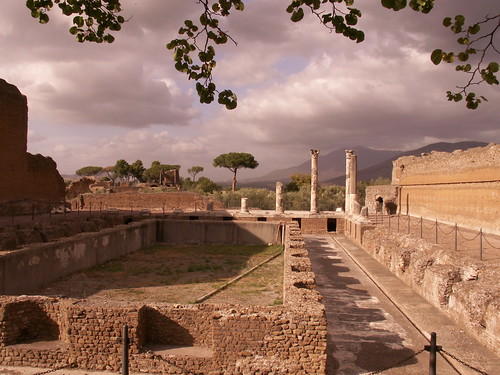
Ingrid D. Rowland on Trashing Hadrian's Villa

Hadrians Villa
Ingrid D. Rowland writes on the plan of the (almost aptly-named) governor of Lazio, Renata Polverini, to dump Rome's trash a few hundred meters from the Villa of Hadrian, in the NYRB.

(Photo by the Birthday Warrior, used under a CC BY-NC-SA 2.0 license.)

Thursday, June 21, 2012

Etruscan all-nighter at Marzabotto

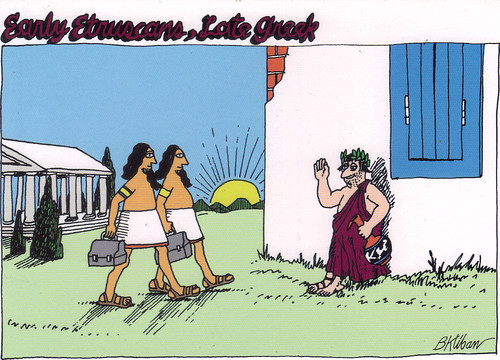
Early Etruscans Late Greek
 Notte magica nella città di Kainua. Aspettando il solstizio in compagnia degli Etruschi
A bit more than midnight at the museum...a guided tour of the site at 6 PM, then dinner with dishes "taken from the Etruscan tradition" (no word on whether couches are involved, but presumably this event will be co-ed), the museum at midnight, a lecture on beer at 3 AM followed by tasting of a chestnut brew... and don't forget the bagpipe procession to the necropolis at dawn!
(Night of June 23rd to the morning of the 24th.) [MiBAC]

Lupa Capitolina: Novità?


The results of the latest study on the Capitoline She-Wolf are in: a Medieval (12th-13th c. CE) copy of an Etruscan original. Edilberto Formigli and others will present their research in a conference on the Capitoline tomorrow, 22 June 2012.
[Officina Archeologica (with program); Adnkronos]

Tuesday, June 19, 2012

Tidbits from the Italian Press


A few weeks ago a gold cup dated to the Early Bronze Age was discovered at Montecchio Emilia. Its closest parallels come from Northwest Europe (Adnkronos; La Repubblica-Parma).

A large (17 cm) Nuragic bronze of a sitting priest(?) was found near Oristano, bringing the total of known seated Nuragic bronzes to three (ANSA; L'Unione Sarda).


A 4th c. CE mosaic depicting a mounted hunter spearing a boar was discovered by students at Empoli, loc. dell’Oratorio delle Muriccia, just southwest of Florence (la Nazione).

An exhibit is opening at the Museo Archeologico di Amelia entitled "Convivenze. Un percorso tra archeologia e arte contemporanea" (23 June - 8 July).

The University of Basel is digging in the Macchiabate necropolis at Francavilla Marittima (Paese24.it).

And the French are digging at Terravecchia/Giarratana near Ragusa (Ragusanews.com).

A French/Bolognese team are digging the Roman city at Ostra Vetera (AN), Marche (Valmisa).

Have to mention this educational intiative entitled "Calabria Jones"...

Jane Draycott interviewed re: "Bodies of Evidence"

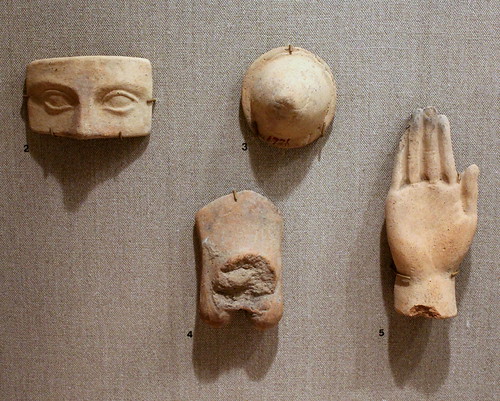
Terracotta votives
In keeping up with BSR news:
As something of a follow-up to the Bodies of Evidence conference, Jessica Hughes of Classics Confidential interviews Jane Draycott on anatomical votives, Roman medicine, and gardens.

BSR seeking volunteers to dig at Segni

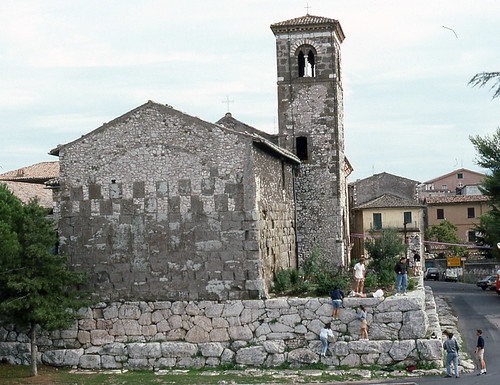
Polygonal Masonry at Signia/Segni: Capitolium
A new collaboration of the Archaeological Museum of Segni and the British School at Rome with the Soprintendenza for Lazio, with hopes of finding Archaic phases of the Temple of Juno Moneta, the early cathedral/Roman forum, and other traces of ancient settlement.
The Segni Archaeological Project
The BSR will be commencing a new joint excavation this summer at Segni in Southern Lazio. We are currently seeking a limited number of volunteers to participate in the excavation, running from the 27th August until the 21st September 2012. For further details seek the flyer or email Stephen Kay (s.kay@bsrome.it)
Details here.

(Photo by Roger Ulrich, used under CC BY-NC-SA 2.0 license.)

Contextualising "early Colonisation." Rome, 21-23 June 2012

Contestualizzare la “prima colonizzazione”:
Archeologia, fonti, cronologia e modelli interpretativi fra l’Italia e il Mediterraneo.
In memoria di David Ridgway (1938-2012)

A whopper of a conference this week in Rome, hosted by the Academia Belgica along with the Koninklijk Nederlands Instituut and the British School at Rome. The substantial program is here, including substantial abstracts/outlines.

(Photo source: Lefkandi Excavations).

Tria Corda rediviva

Updating from Rome (working at Sant'Omobono), in the middle of a heatwave...

Wednesday, November 16, 2011

Tria Corda: Autumn Edition

The every-other-month installment:

A sanctuary on the summit of Monte Cimino east of Viterbo: 1000 masl from 1000 BCE.

A mid-6th c. Etruscan tomb was located at Montalto di Castro, in the archaeological park of Vulci, after the arrest of tombaroli (21 photos and a video of the excavation accompany the article).

At Barrea, a few km from Alfedena along the Sangro river in Abruzzo, the tomb of a 4th c. BCE 'Samnite' 'warrior'.

Three 4th-3rd c. BCE tombs discovered by a farmer while plowing near Cerignola in the province of Foggia, Puglia. He promptly reported the discovery to the Carabinieri.

The tomb of an aristocratic Lombard lady near Lucca, dating to the first half of the 7th c. CE.

A new Late Etruscan dedicatory inscription from Populonia. The marble fragment, perhaps from an altar, was found in the vicinity of one of the three temples on the city's acropolis.

From back in September, Phil Perkins, David Ridgway, and Corinna Riva talk to Melvyn Bragg about the Etruscans on BBC Radio 4's "In Our Time".

A report on the 'inauguration' of the site of the Samnite sanctuary of Hercules at Campochiaro, near Campobasso.

The ongoing struggle against looting and antiquities traffickers continues:
- 77 individuals accused of involvement in a crime ring operating out of S. Sosti near Cosenza in Calabria; more than 1000 objects and 4000 coins seized.
- At the other end of the country, near Bolzano, three dinosaur eggs were among the 6400 paleontological objects seized from smugglers.
- A piece of an architrave stolen from the Terracina Museum in 1959 was discovered in a bar in the north of Rome, as were various other things.

Sunday, September 25, 2011

Museums, queens and thieves

Link
At Tarquinia, a "queenly" chariot/cart of the 7th c. BCE has been discovered in a tomb in the Tumulo della Regina. [Corriere della Sera; UnoNotizie]

The new Museo della Civiltà Sannitica at Pietrabbondante has been partially opened--or maybe not... [Nuovo Molise; ArcheoMolise]

Updates on the ongoing La Regina excavations at Pietrabbondante, including news on the so-called domus publica, over at PietrabbondanteBlog:
Nuove scoperte dagli ultimi scavi
A Pietrabbondante l’area sacra più importante della nazione sannitica

There's a bunch of artifacts from Molise (as well as Athens and Macedonia) on display in Thessaloniki for the exhibition "The Gift of Dionysos," including an ivory plaque with the head of the god, from Saepinum (image above). It runs through September of 2012. [ArcheoMolise]

A tombarolo from Ancona was arrested at Guardialfiera in Molise recently. Along with his metal detector and digging implements were found fragments of a bronze plate. [Primo Numero; ArcheoMolise]

The Paleochristian basilica at Larino got cleaned up thanks to private initiative. [Prima Pagina Molise]

Wednesday, August 24, 2011

Etruscan 4 and 6


The authors of a forthcoming article in Archaeometry use a new approach to assign values to the ambiguous Etruscan words sa and huth (4 and 6, respectively). The abstract follows:
The graphical and linguistic interpretation of the first six Etruscan numerals has long been confronted with the ambiguous assignment of the words huth and sa to either 4 or 6. Here, we show how the systematic combinatorial analysis of the numerals appearing on ancient southern Etrurian dice dated from the eighth to the third centuries bc, together with the careful comparison of the results with the only two existing dice carrying the alphabetical translations of the numerals conserved at the Bibliothèque Nationale de France, Paris, finally allows unambiguous mathematical resolution of the linguistic riddle, allowing the firm attribution of the numeral 6 to the graphical value huth and 4 to sa. Combinatorial analysis of the numerals distribution on the six faces of the die shows that only two of the 15 possible numerical combinations were actually in use in southern Etruria, and that during the fifth century bc there was a marked shift from the typical (1–2, 3–4, 5–6) combination used in the early seventh- to fifth-century bc dice to the (1–6, 2–5, 3–4) combination used at later times and still largely adopted today. The largest body of archaeometric data on dice specimens from Etruria is presented, based on macroscopic examination, X-ray diffraction, DRIFT spectroscopy and density measurements.
Artioli, G., Nociti, V. and Angelini, I. (2011), Gambling with Etruscan Dice: A Tale of Numbers and Letters. Archaeometry. doi: 10.1111/j.1475-4754.2011.00596.x

Thursday, April 21, 2011

Workshop: Social change in Early Iron Age Southern Italy


This conference looks like a lot of fun...

May 5-6, 2011 - workshop internazionale
Koninklijk Nederlands Instituut Rome

Dinamiche sociali nell’Italia meridionale della Prima Età del Ferro /
Social change in Early Iron Age Southern Italy

Wednesday, February 16, 2011

Journal available: Periodico di Mineralogia

I note the online presence of the Periodico di Mineralogia, "an international journal of mineralogy, crystallography, geochemistry, ore deposits, petrology, volcanology, and applied topics on environment, archaeometry and cultural heritage," based at La Sapienza. There's no explicit statement of open access, but all the issues from 1999 to 2010 are freely downloadable.

The journal's page is located at http://tetide.geo.uniroma1.it/riviste/permin/permin.html - click on "Issues Year xxxx" in the right hand column to access the issues.

A sampling of articles (all in English, by editorial policy) from 2010 include:
  • Belfiore et al., "Western production of “Ionian cups of type B2”: a preliminary archaeometric study to identify workshops in eastern Sicily,"
  • De Bonis et al., "Archaeometric study of roman pottery from Caudium area (Southern Italy),"
  • De Francesco et al., "Preliminary chemical characterization of Roman glass from Pompeii,"
  • B. Giammartini, "Mapping of the stones in the main façade of St. Giuliana castle (Umbertide, Italy),"
  • Kastenmeier et al., "The source of stone building materials from the Pompeii archaeological area and its surroundings"
  • Miriello et al., "Colour and composition of nodules from the Calabrian clay deposits: a possible raw material for pigments production in Magna Graecia,"
  • Scarpelli et al., "Archaeometric study of sub-geometric pottery found in Potenza, Italy: relationship and trade between near indigenous centers," and
  • Tucci et al., "Italica (Seville, Spain): use of local marble in Augustan age."

Sunday, January 30, 2011

The Italic March. Two conferences.

Five days, two conferences, one ocean in between.

There will be a conference at Brown titled "The Archaeology of Italy: The State of the Field 2011," March 18-19, 2011, organized by Jeffrey Becker and Sue Alcock. John Robb will deliver the keynote address.
The Joukowsky Institute will host a weekend symposium in March 2011 whose aim it is to discuss the current state of the archaeology of peninsular Italy in the twenty-first century, with an emphasis on the North American academy. With an interest not only in tracking the trends and methodologies in use in the archaeological investigation of this very important piece of the Mediterranean, the symposium also seeks to examine the place of peninsular Italian archaeology with respect to other geographical subfields of Mediterranean archaeology. Perhaps most importantly, the symposium will discuss not only the current state of the field, but also explore possible future directions, methodologies, and techniques to be employed.

The symposium will feature three sessions, one dealing with the current state of research, another future directions in research, and a third that will serve as forum for graduate students to discuss their own research and network with graduate colleagues and faculty. The organizers are seeking graduate student participants whose main research focus is the archaeology of peninsular Italy, broadly defined.
More information on the Brown conference available here.


The next day sees conference "Gods in Ruins. The archaeology of religious activity in Protohistoric, Archaic, and Republican central Italy" open at Oxford, March 20-22, 2011, organized by Ed Bispham and Charlotte Potts.
This conference will present the results of current or ongoing work on archaeological evidence for religious activities in central Italy prior to c.200 B.C.. By bringing together early-career academics, postdoctoral researchers, and advanced postgraduate students working on different aspects of material culture ranging from art history to archaeozoology, the conference aims to advance scholarly debate on cult activities in periods, places, and phenomena under-represented in the literary sources.

Speakers from Italy, Greece, Belgium, The Netherlands, America, and the United Kingdom offer delegates the opportunity to discuss work in progress in a variety of countries. Papers will address, among other topics, human sacrifice and ritual killing in Etruscan culture; the economic activities of Italic sanctuaries; Etruscan werewolves; maenadism in Etruria and Campania; and bronze Apennine votives. All papers will be delivered in English.
More information on the Oxford conference (including program) here.

Wednesday, January 12, 2011

ArcheoMolise nos. 5 & 6

In lo, these many months, not one but two new issues of ArcheoMolise (ISSN: 2036-3028) have hit the stands. They are, as always, freely available as zipped pdfs from the CERP-Isernia website. I'm not sure why they don't offer tables of contents online; I suppose the zipped-only format may point to bandwidth restrictions, even in this day and age? It makes them opaque to search engines, though, so I offer contents here. They maintain a Twitter feed with recent archaeological news both local and global. The ArcheoMolise Facebook page has all of the same, with an added agitationist/activist editorial voice condemning neglect and abuse of cultural heritage of Molise

In any case, the contents of ArcheoMolise no. 5 (July - September 2010):
  • An editorial by Marco Buonocore, "L'epigrafia nel Molise: quale futuro?" (p. 5).
  • Federica Fontana and Antonella Minelli, "Accampamenti preistorici in quota. Il sito di San Lorenzo (Civitanova del Sannio, Isernia) nell' Appennino molisano," pp. 6-15.
  • Enza Zullo (ed.), "L'area archeologica di Piazza Mercato ad Isernia," pp. 16-23.
  • Walter Santoro, "L'oblio della memoria storica. La Taverna del Cortiglio sul tratturo Lucero-Castel di Sangro," pp. 24-33.
  • Alessandro Testa, "Il culto dei Sanniti alla luce della comparazione indo-europea," pp. 34-51.
  • Antonia Valillo (ed.), "La Carrese di San Padro a Larino. Momenti di devozione popolare," pp. 52-59.
  • G. Lembo, A. di Nucci, M.A. Rufo, & B. Muttillo, "Come divulgare l'archeologia. L'esempio dei laboratori di preistoria dell'Associazione ArcheoIdea," pp. 60-69.


And the contents of ArcheoMolise no. 6 (October - December 2010):
  • Giovanna Falasca, "Santa Maria di Monteverde. Breve excursus su un'area di interesse storico e archeologico." pp. 6-17.
  • Bruno Sardella, "Sprondasino e San Bartolomeo di Sprondasino. Due insediamenti antichi dell'alta valle del Trigno nella 'Terra dei Borrello'." pp. 18-27.
  • Ulderico Iorillo, "Il complesso di Santa Maria delle Monache a Isernia. L'incidenza del sito sul tessuto urbano dal tardo-antico all'altomedioevo." pp. 28-37.
  • Gabriella Di Rocco, "La media valle del Biferno tra ricerca e oblio." pp. 38-47.
  • Francesco de Vincenzi, "La cartiera San Bernardo a Castel San Vincenzo. Un episodio di archeologia industriale posto alle sorgenti del Volturno." pp. 48-61.
  • Andrea Di Rollo, "Sessano del Molise. Evoluzione morfologica e climatica della conca intra-montana." pp. 62-69.
I note from the "Agenda" at the back of no. 6 that you have until January 31 to visit the exhibition "Il Dono di Dioniso. Mitologia del vino nel Sannio pentro e frentano" at the Museo Sannitico in Campobasso.

Novus annus, novus ordo

Still kicking. I finally updated the back-end of Tria Corda to the 'new' (as of a few years ago) Blogger templates. Some of the colors are darker (foreshadowing, perhaps?), and the rounded edges are gone. None of that nonsense from here on out. The classic marbled background and the delightfully Latinesque — some would say flippant — title image remain, however.

Sporadic Italic blogging is all that can be expected — that and a few words on the AIA/APA, and of course the latest offerings from Archeomolise, thereby confirming our crypto-Molisano agenda.